
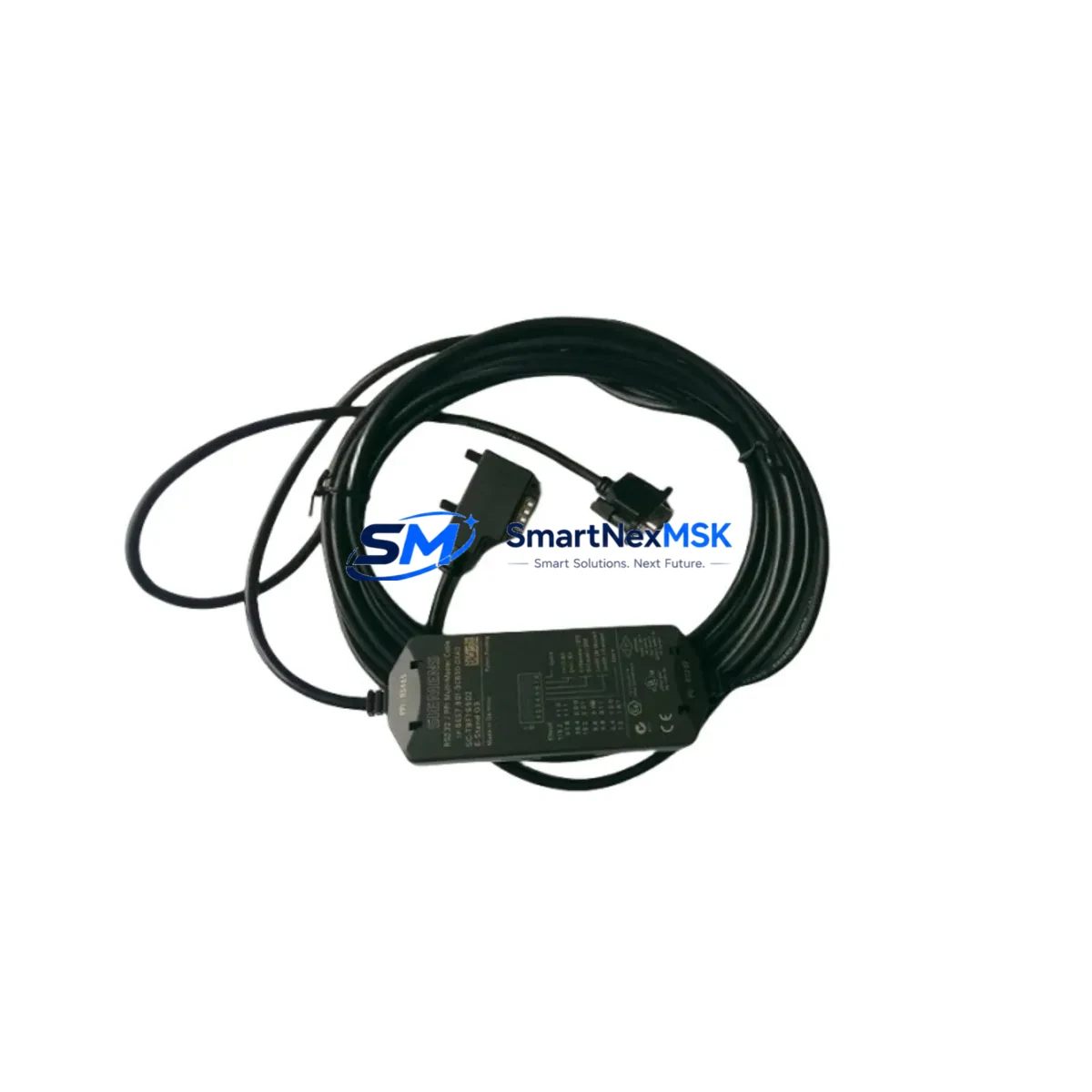
AMSAMOTION 3DB30 Retrofit-Ready PC Interface for AM Series Control Systems
The AMSAMOTION 3DB30 is a PC-to-PLC communication interface module engineered for seamless integration into AM Series programmable logic controller platforms. Designed with retrofit compatibility as a core requirement, the 3DB30 addresses one of the most persistent challenges in industrial automation: replacing aging or discontinued communication interface components without triggering a full control system overhaul. Whether your facility is migrating from legacy AM Series hardware, upgrading a control cabinet, or restoring a production line after an unplanned component failure, the 3DB30 provides a reliable, wiring-compatible, and protocol-consistent solution that minimizes engineering rework and downtime exposure.
The 3DB30 supports both RS-485 and RS-232 serial communication standards, making it directly compatible with the communication architecture used across the AM Series PLC family. Engineers replacing an older AMSAMOTION AM3 or AM5 series CPU module will find that the 3DB30 integrates without requiring changes to the existing communication cable routing or terminal block assignments. The module’s physical form factor and connector pinout are consistent with the AM Series backplane interface standard, allowing installation into existing DIN rail-mounted control cabinets without panel modification.
Before completing a retrofit using the 3DB30, engineers should verify several critical compatibility parameters. Power supply capacity at the control cabinet level must be confirmed — the 3DB30 draws from the 24VDC rail shared with other AM Series I/O modules, and adding or replacing a communication interface module may affect the total current budget of the AMSAMOTION AM-series power supply module already installed. Terminal wiring assignments should be cross-referenced against the original wiring diagram, particularly for RS-485 differential pair connections (A+/B−) and shield grounding, which are sensitive to reversal or floating ground conditions.
Backplane slot addressing must also be confirmed during the retrofit planning phase. In AM Series racks, module slot addresses are typically assigned by physical position, and inserting the 3DB30 into a different slot than the original interface module may require a corresponding update in the PLC program’s I/O configuration table. This is especially relevant when the 3DB30 is being used to replace a module that was originally mapped to a fixed communication port address within the AMSAMOTION programming environment. Program compatibility should be validated in offline simulation mode before live commissioning to avoid unexpected behavior on the production floor.
HMI screen bindings are another area requiring attention during migration. If the existing HMI — whether a standalone AMSAMOTION touch panel or a third-party operator interface — communicates with the PLC via the port managed by the 3DB30, the communication parameters (baud rate, station address, parity, stop bits) must be re-entered or verified in the HMI configuration software after the module swap. Mismatched communication parameters are a common cause of post-retrofit communication faults that can be mistaken for hardware failure.
Upgrade Compatibility Table
| Parameter | Details |
|---|---|
| Compatible PLC Series | AMSAMOTION AM Series (AM3, AM5, AM600) |
| Communication Interfaces | RS-485, RS-232 |
| Installation Method | DIN rail, backplane slot mount |
| Power Supply Requirement | 24VDC (from AM Series power supply module) |
| Replacement Compatibility | Drop-in for AM Series PC interface positions |
| Protocol Support | Modbus RTU, AMSAMOTION proprietary protocol |
| Commissioning Requirement | Slot address verification, baud rate/parity match |
| Warranty | 12 Months |
| Origin | China (CN) |
| Stock Status | In Stock — Ready to Ship |
Retrofit Planning for Existing Automation Systems
A successful 3DB30 retrofit begins well before the module arrives on-site. The engineering team should compile the existing control system documentation, including the original rack layout drawing, the PLC program backup, the HMI project file, and the communication wiring schematic. In AM Series installations, the control cabinet typically houses an AM Series CPU module, one or more digital input/output expansion modules, an AM Series analog I/O module for process variable monitoring, and the communication interface module being replaced. The 3DB30 slots into the communication interface position and restores PC-to-PLC connectivity without requiring changes to the surrounding I/O architecture.
For systems that also include an AMSAMOTION AM Series Ethernet module or a CANopen communication module, the 3DB30 operates independently on its dedicated serial port and does not interfere with parallel communication channels. This is particularly useful in multi-network control architectures where the PLC simultaneously manages serial HMI communication, fieldbus I/O, and Ethernet SCADA connectivity. The 3DB30’s serial port can be configured as either a programming port (for use with the AMSAMOTION programming cable and software) or as a runtime communication port for HMI or SCADA polling.
When the retrofit involves a control cabinet that also contains an AMSAMOTION AM Series expansion rack connected via a rack communication cable, engineers should verify that the 3DB30’s installation does not affect the rack communication timing. Expansion rack modules — including remote digital I/O modules and analog signal conditioning modules — rely on deterministic scan cycle timing, and any change to the communication module configuration should be followed by a full I/O scan test before returning the system to production.
For facilities managing multiple production lines with similar AM Series configurations, it is advisable to maintain a spare 3DB30 unit in the site’s critical spare parts inventory alongside other high-priority components such as the AM Series CPU module, the 24VDC power supply module, and key digital I/O modules. This approach supports a rapid swap-and-restore strategy that limits unplanned downtime to the time required for physical installation and communication parameter verification — typically under two hours for a prepared maintenance team.
Downtime Control During System Migration
Minimizing production downtime during a 3DB30 replacement requires a structured pre-outage preparation protocol. Before the scheduled maintenance window, the engineering team should export a verified backup of the current PLC program from the AMSAMOTION programming software, confirm that the backup file opens correctly in offline mode, and document all active communication parameters including port assignments, baud rates, station addresses, and timeout settings. The HMI project file should also be backed up and the current screen navigation verified against the live system to establish a baseline for post-retrofit validation.
During the physical swap, the control cabinet should be de-energized at the main disconnect, and the 3DB30 should be installed in the same backplane slot as the original module. After re-energization, the PLC program should be reloaded from the verified backup if any program loss is detected, and the communication link between the PC programming station and the PLC should be established using the AMSAMOTION programming cable before any HMI or SCADA reconnection is attempted. This sequenced approach isolates each communication layer and allows faults to be identified and resolved without ambiguity.
Field commissioning of the 3DB30 should include a live I/O scan test, a communication response time measurement, and a full HMI screen navigation test to confirm that all data bindings are active and displaying correctly. For systems with safety-critical interlocks or process alarms, each interlock should be individually verified before the system is returned to automatic operation. The 3DB30’s 12-month warranty covers manufacturing defects identified during this commissioning phase, and units that fail initial power-on testing should be returned for immediate replacement.
Retrofit Support FAQ
Q: Is the AMSAMOTION 3DB30 a direct drop-in replacement for the original AM Series PC interface module?
A: Yes. The 3DB30 is designed as a wiring-compatible replacement for the AM Series communication interface position. The connector pinout, backplane interface, and power supply requirements are consistent with the original AM Series specification. No panel modification or wiring rework is required for a standard replacement installation.
Q: What communication parameters need to be verified after installing the 3DB30?
A: After installation, verify the baud rate, station address, parity bit, and stop bit settings in both the PLC program configuration and the connected HMI or SCADA system. Mismatched parameters are the most common cause of communication faults following a module replacement. The 3DB30 supports standard Modbus RTU settings as well as AMSAMOTION’s proprietary serial protocol.
Q: Can the 3DB30 be used in an AM Series system that also has an Ethernet or CANopen module installed?
A: Yes. The 3DB30 operates on its dedicated serial port and does not conflict with other communication modules installed in the same AM Series rack. Multi-network configurations with simultaneous serial, Ethernet, and fieldbus communication are fully supported.
Q: What does the 12-month warranty cover, and what is the process for a warranty claim?
A: The 12-month warranty covers manufacturing defects and component failures under normal operating conditions. Units that fail during initial commissioning or within the warranty period should be reported to our sales team with a description of the fault condition and the installation environment. Replacement units are dispatched promptly to minimize production impact. Contact: [email protected] | +86 18259474341
© 2026 SMARTNEXMSK. All rights reserved.
Original Source: https://smartnexmsk.com
Contact: [email protected] | +86 18259474341