
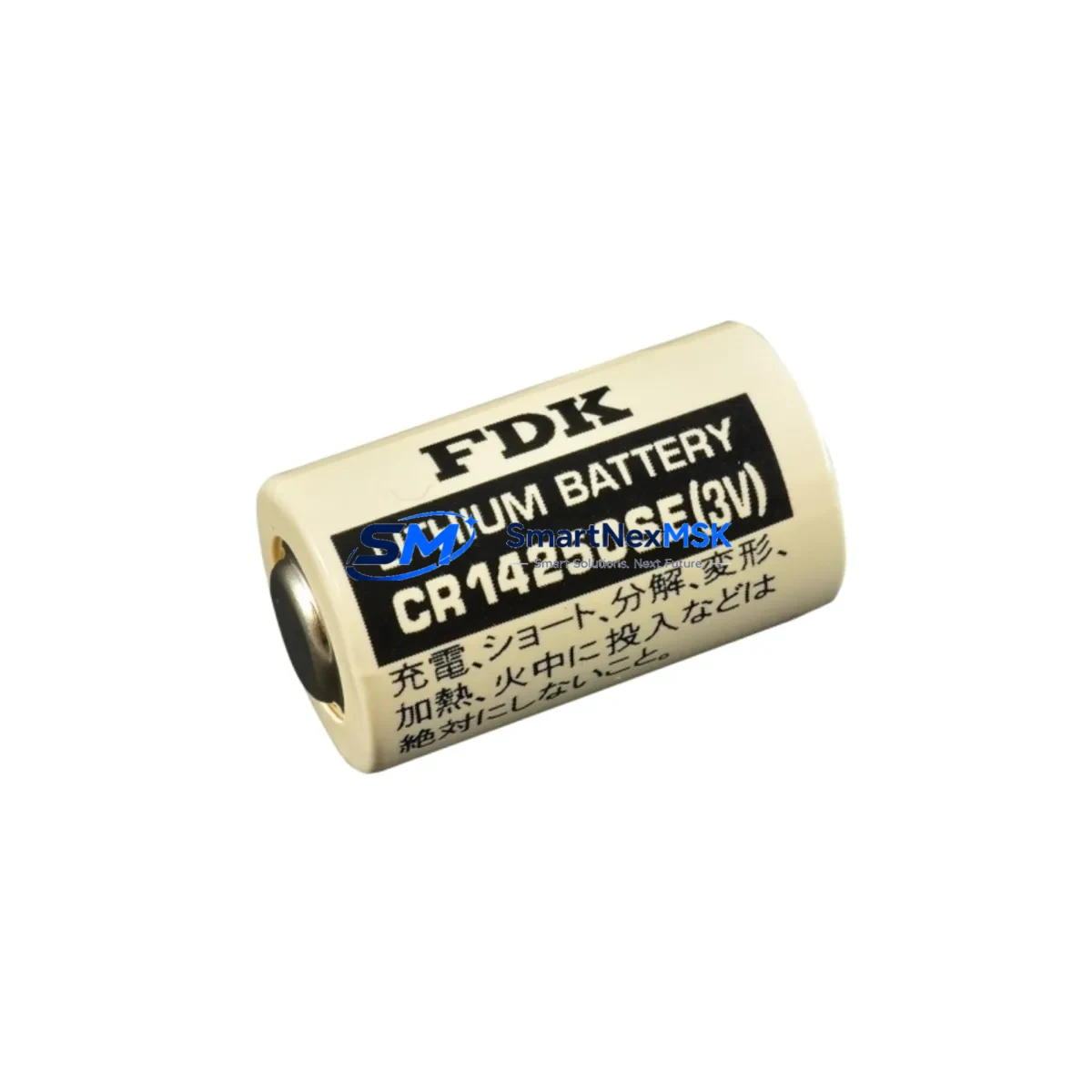
FDK CR14250SE Maintenance-Ready Spare for SL Series Automation
The FDK CR14250SE is a 3.6V lithium thionyl chloride (Li-SOCl₂) 1/2 AA-format battery engineered for continuous backup power in industrial PLC and DCS control systems. As a genuine SL Series spare, it delivers the stable, low-self-discharge performance that maintenance engineers depend on to protect SRAM data retention, real-time clock modules, and program memory across Siemens S7-200/S7-300, Mitsubishi FX and Q Series, Omron CJ/CS Series, and compatible third-party controllers. Sourced directly from FDK Corporation Japan, every unit shipped by SMARTNEXMSK is tested, sealed, and covered by a 12-month warranty.
For maintenance planners managing aging control infrastructure, the CR14250SE is a cornerstone spare. Its 1200 mAh nominal capacity and operating range of −40 °C to +85 °C make it suitable for harsh panel environments — from outdoor distribution cabinets to high-temperature machine rooms. Procurement engineers can stock this battery with confidence: FDK’s SL Series has a proven 10-year shelf life, making it ideal for strategic buffer inventory without risk of premature degradation.
Spare Maintenance Table
| Parameter | Specification |
|---|---|
| Part Number / SKU | CR14250SE |
| Brand | FDK Corporation (Japan) |
| Series | SL Series (Li-SOCl₂) |
| Nominal Voltage | 3.6 V |
| Nominal Capacity | 1200 mAh |
| Format | 1/2 AA (14.5 mm × 25.0 mm) |
| Chemistry | Lithium Thionyl Chloride (Li-SOCl₂) |
| Operating Temperature | −40 °C to +85 °C |
| Shelf Life | Up to 10 years (sealed, stored at 20 °C) |
| Compatibility | Siemens S7-200 / S7-300, Mitsubishi FX / Q Series, Omron CJ / CS Series, and SL-Series compatible PLCs |
| Application | PLC SRAM backup, RTC retention, program memory protection, DCS node backup |
| Installation | Snap-in battery holder or solder-tab variant; polarity-marked housing |
| Origin | Japan |
| Certification | UL, CE, RoHS compliant |
| Warranty | 12 Months — SMARTNEXMSK Tested & Verified |
Maintenance Planning for Continuous Operation
When scheduling a planned replacement of the CR14250SE in a PLC control cabinet, experienced maintenance engineers treat the battery swap as a trigger for a broader panel inspection. A low or failed backup battery is rarely an isolated event — it often signals that adjacent components have been operating under stress or have exceeded their recommended service intervals.
Begin by verifying the 24 VDC power supply module output voltage and ripple, as an unstable supply accelerates battery drain and can corrupt SRAM data even when the battery is new. Check the CPU module firmware version and confirm that the battery-low alarm threshold is correctly configured in the PLC diagnostics. Inspect the digital input (DI) and digital output (DO) I/O modules for signs of terminal oxidation or loose wiring — these faults often go undetected until a system restart following a battery replacement exposes latent I/O errors.
For systems using communication modules such as PROFIBUS DP adapters, Ethernet CP modules, or RS-485 serial interfaces, confirm that network parameters stored in non-volatile memory are intact after the battery swap. If the control cabinet includes signal isolators or loop-powered transmitters, verify 4–20 mA loop integrity before returning the system to service. Relay output modules — particularly those driving motor starters or solenoid valves — should be tested for contact resistance and coil response time as part of the same maintenance window.
Facilities running Mitsubishi Q Series or Omron CS1 Series systems should also inspect the base unit backplane and module seating, as vibration over time can cause partial disconnection that only manifests after a cold restart. For Siemens S7-300 installations, check the front connector wiring and confirm that the memory card (MMC) is properly seated alongside the CR14250SE replacement. HMI panels connected to the PLC — whether Siemens TP series, Mitsubishi GOT, or Omron NS series — should be power-cycled and communication re-verified as part of the post-replacement checklist.
Stocking the CR14250SE alongside complementary spares — including fuse modules, terminal block sets, and 24 VDC DIN rail power supplies — ensures that a single maintenance visit can resolve the most common causes of unplanned downtime in aging PLC panels.
Site Replacement Workflow
Step 1 — Pre-Replacement Backup: Before removing the CR14250SE, use the PLC programming software (STEP 7, GX Works2, or CX-Programmer as applicable) to upload and save the current program, data blocks, and retentive memory to an offline backup. Do not rely solely on the existing battery for data retention during the swap.
Step 2 — Safe Isolation: Follow site LOTO (Lockout/Tagout) procedures. The CPU module does not need to be fully de-energized for a battery swap on most SL-Series compatible PLCs, but confirm this against the OEM manual for your specific model. Replacement time should not exceed 30 seconds on live systems to avoid SRAM data loss.
Step 3 — Physical Replacement: Remove the old CR14250SE from its holder, noting polarity orientation. Insert the new FDK CR14250SE, confirm the positive terminal seating, and close the battery compartment. The battery-low LED or diagnostic flag should clear within one PLC scan cycle.
Step 4 — Post-Replacement Verification: Confirm that the RTC (real-time clock) retains the correct date and time. Verify that all retentive data registers and counters hold their pre-swap values. Run a short I/O diagnostic cycle and confirm communication with all networked devices before returning the system to automatic mode.
Step 5 — Documentation: Log the replacement date, battery lot number, and technician ID in the equipment maintenance record. Schedule the next preventive replacement at 3–5 years depending on ambient temperature and duty cycle, or at the first battery-low alarm — whichever comes first.
Spare Parts Support FAQ
Q1: Is the FDK CR14250SE a direct drop-in replacement for OEM batteries in Siemens S7-300 and Mitsubishi FX Series PLCs?
Yes. The CR14250SE meets the 3.6 V / 1/2 AA form factor and capacity specifications required by Siemens S7-300 CPU modules and Mitsubishi FX Series controllers. Always verify the battery holder type (axial leads vs. snap-in) against your specific CPU model before installation.
Q2: How does SMARTNEXMSK verify authenticity and electrical performance before shipment?
Every CR14250SE unit is sourced from authorized FDK distribution channels and undergoes open-circuit voltage verification and visual inspection prior to packaging. Units are shipped in original sealed packaging with lot traceability. A 12-month warranty covers any defect in materials or performance under normal operating conditions.
Q3: What is the recommended inventory strategy for facilities with multiple PLC panels?
For facilities operating 10 or more PLC nodes, we recommend maintaining a minimum buffer stock of 2–3 CR14250SE units per 5 panels, with a maximum shelf age of 5 years from manufacture date. Rotate stock on a FIFO basis and store at 15–25 °C in a dry, low-humidity environment to preserve the 10-year shelf life.
Q4: Can the CR14250SE be used in DCS systems and safety controllers beyond standard PLCs?
Yes, provided the host system specifies a 3.6 V Li-SOCl₂ 1/2 AA cell. The CR14250SE is used in a range of industrial applications including DCS node backup, safety relay memory retention, and field instrument configuration storage. Always cross-reference the OEM battery specification sheet and confirm compatibility before installation in SIL-rated safety systems.
© 2026 SMARTNEXMSK. All rights reserved.
Original Source: https://smartnexmsk.com
Contact: [email protected] | +86 18259474341