
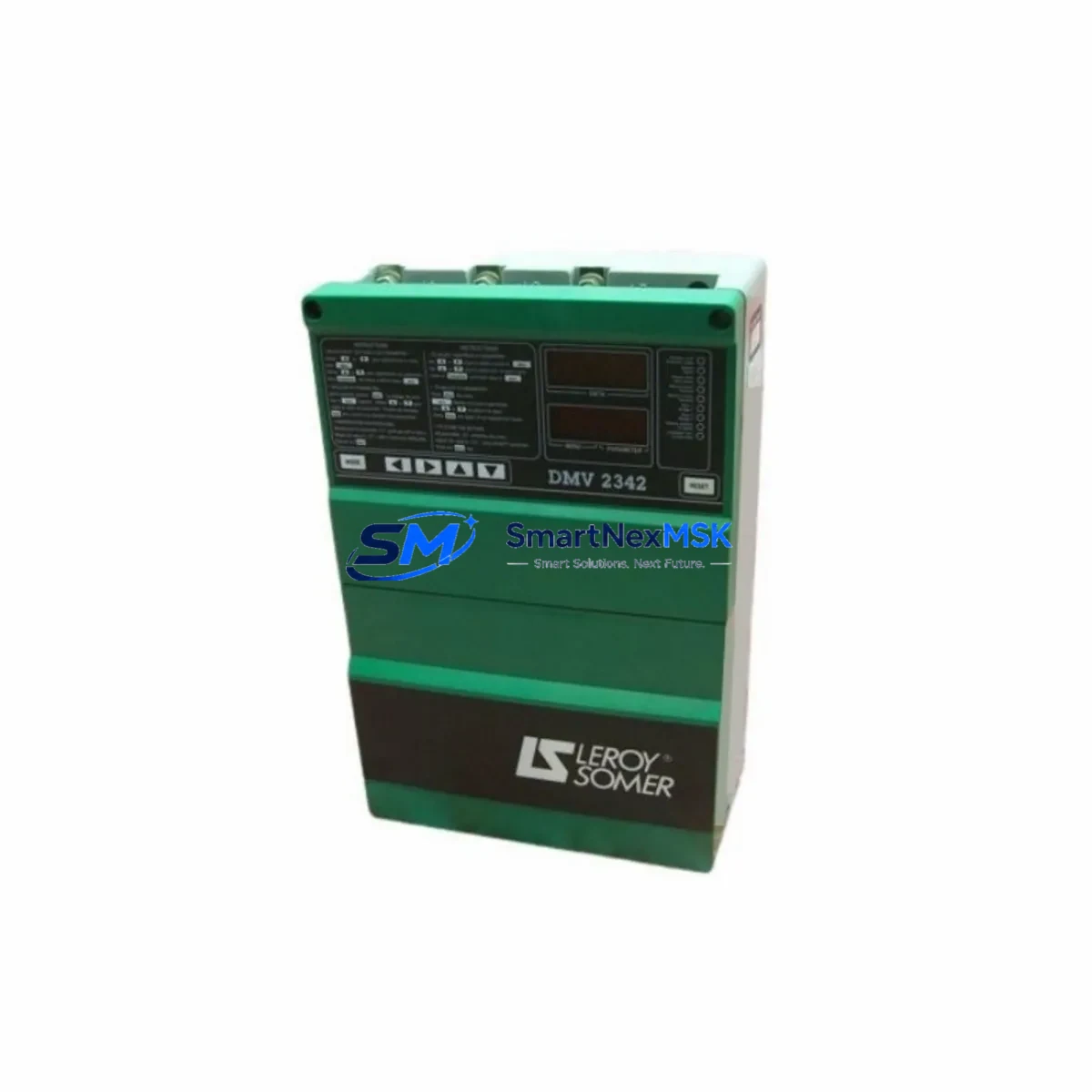
LEROY SOMER DMV2322-550A Retrofit-Ready DC Drive for DMV 2322 Control Systems
The LEROY SOMER DMV2322-550A is a high-performance DC drive controller engineered for seamless retrofit integration into legacy DMV 2322 Series control systems. Rated at 550A continuous output current, this unit is purpose-built to replace aging or discontinued DMV 2322 drives without requiring full panel redesign or PLC reprogramming. Whether you are managing a planned upgrade cycle or responding to an unplanned drive failure on a critical production line, the DMV2322-550A delivers the electrical compatibility, mechanical form factor, and communication interface alignment that industrial maintenance teams require to restore operations with minimal downtime.
LEROY SOMER’s DMV 2322 platform has been widely deployed across paper mills, steel processing lines, extruder drives, winding machines, and heavy-duty conveyor systems throughout Europe, Asia, and the Americas. As original equipment reaches end-of-life, sourcing a verified replacement that maintains backward compatibility with existing field wiring, terminal layouts, and motor feedback circuits becomes the primary engineering challenge. The DMV2322-550A addresses this directly: its terminal block arrangement mirrors the original DMV 2322 pinout, the armature and field circuit ratings are preserved, and the analog reference input (0–10 V / 4–20 mA) remains fully compatible with upstream PLC analog output modules and existing HMI setpoint configurations.
Upgrade Compatibility Table
| Parameter | Original DMV 2322 | DMV2322-550A (Replacement) | Retrofit Notes |
|---|---|---|---|
| Output Current Rating | 550A | 550A | Direct match — no derating required |
| Supply Voltage | 3-phase 380–480V AC | 3-phase 380–480V AC | Verify incoming supply tolerance ±10% |
| Field Supply Output | Integrated field regulator | Integrated field regulator | Confirm field current setpoint matches motor nameplate |
| Terminal Block Layout | DMV 2322 standard pinout | Compatible pinout | Label and photograph existing wiring before removal |
| Analog Reference Input | 0–10V / 4–20mA | 0–10V / 4–20mA | No PLC analog output reconfiguration needed |
| Digital I/O | Run/Stop, Fault Reset, Speed Ref Select | Run/Stop, Fault Reset, Speed Ref Select | Verify PLC output card wiring assignments |
| Serial Communication | RS-485 / Modbus RTU (optional) | RS-485 / Modbus RTU compatible | Confirm baud rate and node address settings |
| Mounting / Form Factor | Panel-mount chassis | Panel-mount chassis | Verify DIN rail or back-panel bolt pattern |
| Cooling Requirement | Forced air / heatsink | Forced air / heatsink | Inspect existing cabinet ventilation before commissioning |
| Warranty | — | 12 Months | Covers manufacturing defects; includes pre-shipment functional test |
Retrofit Planning for Existing Automation Systems
A successful DMV2322-550A retrofit begins well before the replacement unit arrives on site. The first step is a thorough audit of the existing control cabinet: document the incoming power supply ratings, verify the transformer secondary voltage under load, and confirm that the upstream circuit breaker or fused disconnect is rated for the 550A drive’s inrush and continuous current demands. In many legacy installations, the power distribution board also feeds a LEROY SOMER Unidrive SP or a Mentor MP DC drive in an adjacent cabinet — these units share the same AC bus, so any voltage fluctuation during the changeover must be accounted for in the shutdown sequence.
Terminal wiring is the most time-sensitive task during a live-line retrofit. Before disconnecting the original DMV 2322, photograph every terminal row and cross-reference against the original wiring diagram. Pay particular attention to the armature circuit connections (A1/A2), the field winding terminals (F1/F2), the tachogenerator or encoder feedback wiring, and the enable/inhibit signal lines routed from the safety relay or PLC output card. If the existing installation uses a LEROY SOMER Proxidrive or a third-party I/O expansion module for speed reference selection, verify that the signal common (0V reference) is correctly bonded to avoid ground loop interference after the new drive is energized.
For sites running a Modbus RTU network, the DMV2322-550A must be assigned the same node address as the original drive before the RS-485 cable is reconnected. The PLC — whether a Schneider Electric Modicon M340, a Siemens S7-300, or an Allen-Bradley ControlLogix — will poll the drive at the configured address on every scan cycle. A node address mismatch will generate a communication fault within seconds of power-up, triggering an emergency stop on the associated motor circuit. Confirm the baud rate (typically 9600 or 19200 bps), parity, and stop-bit settings in the drive parameter menu before closing the cabinet door.
HMI screen updates are often overlooked during drive replacements. If the existing SCADA or operator panel — such as a Schneider Electric Magelis, a Siemens TP700, or a LEROY SOMER-compatible panel interface — displays drive-specific fault codes or parameter values read via Modbus, verify that the register map of the DMV2322-550A matches the original. Minor register offset differences between firmware revisions can cause incorrect speed readbacks or spurious fault displays on the operator screen. A brief functional test of all HMI-linked data points should be included in the commissioning checklist before handing the line back to production.
Where the retrofit involves I/O expansion — for example, adding a digital input module to support additional speed presets or integrating a fieldbus gateway for Profibus DP or DeviceNet connectivity — the DMV2322-550A’s parameter structure supports these extensions without requiring a new PLC program download. Existing ladder logic or function block diagrams developed for the original DMV 2322 remain valid, provided the drive’s control word and status word bit assignments are preserved. This is a critical compatibility checkpoint that should be verified against the drive’s technical manual before sign-off.
Downtime Control During System Migration
Minimizing production downtime during a DC drive replacement requires a structured pre-outage preparation protocol. Begin by staging the DMV2322-550A in the workshop at least 48 hours before the planned maintenance window. Perform a bench power-up test using a variable AC supply to confirm that the drive initializes correctly, displays no factory fault codes, and responds to a low-level analog speed reference signal. Pre-configure all drive parameters — including speed reference scaling, acceleration and deceleration ramps, current limit settings, and field weakening thresholds — to match the values recorded from the original DMV 2322 before it is removed from service. This pre-configuration step alone can reduce on-site commissioning time by 60–70%.
During the physical swap, use a structured lockout/tagout (LOTO) procedure to isolate the incoming AC supply, the DC bus, and all control signal circuits. Retain the original drive’s parameter printout or backup file as a reference. Once the DMV2322-550A is mechanically installed and all terminal connections are verified against the wiring photograph record, restore power in stages: energize the control supply first, confirm the drive’s display and communication link, then apply the main AC supply and perform a no-load motor run at reduced speed reference before returning to full production speed. This staged energization approach protects both the motor and the connected mechanical load from unexpected torque transients during the first run cycle.
For critical continuous-process applications — such as paper machine drives, extruder lines, or winding systems where a mid-run stop causes material waste — consider maintaining the original DMV 2322 as a cold standby unit in parallel with the new DMV2322-550A during the first production shift after commissioning. This parallel standby arrangement, while requiring additional switching infrastructure, provides an immediate fallback path if an unexpected parameter incompatibility is discovered under full-load conditions. All units supplied by SMARTNEXMSK are pre-tested under load conditions prior to shipment and covered by a 12-month warranty against manufacturing defects, reducing the risk of infant-failure events in the field.
Retrofit Support FAQ
Q1: Is the DMV2322-550A a direct drop-in replacement for the original LEROY SOMER DMV 2322-550A?
Yes. The DMV2322-550A is designed as a form-fit-function replacement for the DMV 2322-550A. The terminal layout, current rating, field supply circuit, and analog reference input are compatible with the original unit. Minor parameter adjustments may be required to match site-specific speed scaling or current limit settings, but no rewiring or PLC program modification is typically necessary.
Q2: What pre-shipment testing is performed on each unit?
Every DMV2322-550A unit supplied by SMARTNEXMSK undergoes a functional power-up test and basic parameter verification before dispatch. Units are inspected for physical damage, connector integrity, and correct firmware initialization. A 12-month warranty covering manufacturing defects is included with each shipment. Test records are available upon request for quality-critical applications.
Q3: Can the DMV2322-550A communicate with my existing PLC via Modbus RTU?
Yes, provided the RS-485 communication option is fitted. Before reconnecting the Modbus cable, confirm that the node address, baud rate, parity, and stop-bit settings in the drive’s parameter menu match the configuration expected by your PLC. For Schneider Electric Modicon, Siemens S7, or Allen-Bradley ControlLogix systems, the existing Modbus function blocks will communicate with the replacement drive without modification once the address settings are aligned.
Q4: What should I verify regarding wiring compatibility before installation?
Priority checks include: (1) armature terminal polarity (A1/A2) and conductor cross-section rating for 550A; (2) field winding terminal connections (F1/F2) and field current setpoint; (3) tachogenerator or encoder feedback wiring and signal voltage level; (4) enable/inhibit signal wiring from the safety relay or PLC output card; and (5) analog reference signal common (0V) bonding to prevent ground loops. Photograph all terminal connections before removing the original drive and cross-reference against the site wiring diagram during reinstallation.
© 2026 SMARTNEXMSK. All rights reserved.
Original Source: https://smartnexmsk.com
Contact: [email protected] | +86 18259474341