
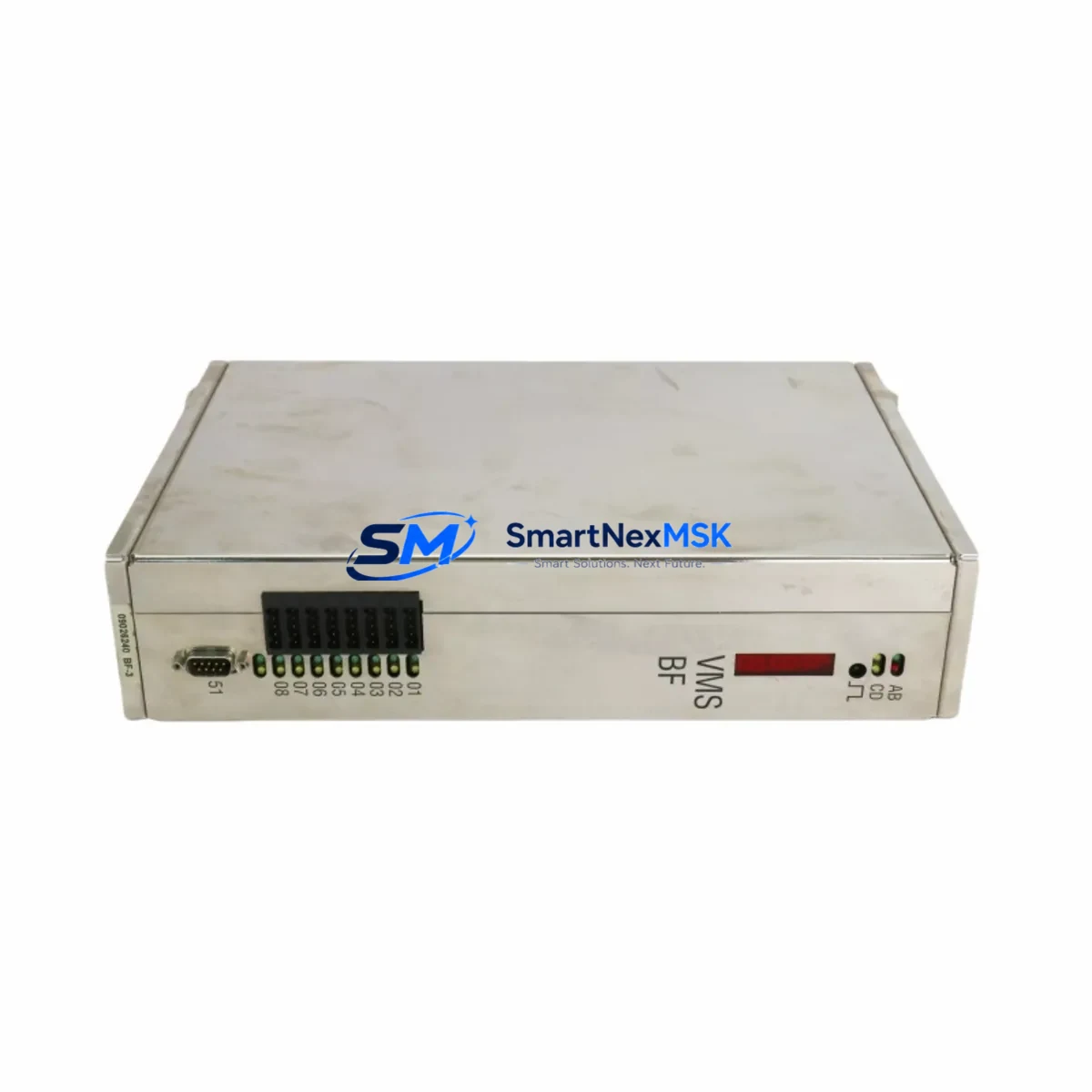
ORAM LPS 850 295-900913-00 Retrofit-Ready DCS Power Supply: Compatible Modernization & Legacy System Smooth Upgrade
The ORAM LPS 850 (part numbers 295-900913-00 / 740-805201-02 / R36SSNA-R2-NS-NV-06) is a proven DCS power supply module engineered for seamless retrofit integration into aging distributed control system architectures. As original OEM units reach end-of-life and factory-new stock becomes increasingly scarce, the LPS 850 serves as a critical drop-in replacement for facilities operating legacy ORAM control platforms — enabling production continuity without the cost and risk of full system overhaul.
Industrial plants running older ORAM DCS backplanes frequently encounter power supply degradation as the primary failure mode in control cabinet aging. The LPS 850 addresses this directly: its regulated DC output rails are designed to match the original voltage and current specifications of the predecessor units it replaces, minimizing re-engineering effort during installation. Before commissioning, engineers should verify the existing backplane slot assignment, confirm terminal block wiring compatibility against the original I/O wiring diagram, and validate that the module address configuration matches the system’s rack addressing scheme. Where the original unit used a dedicated power bus connector, the LPS 850 retains the same backplane interface geometry, reducing mechanical adaptation requirements.
In retrofit projects involving ORAM DCS controller racks, the LPS 850 is commonly deployed alongside the ORAM R36SSNA controller module, which shares the same rack form factor and power bus architecture. Facilities upgrading from earlier-generation ORAM power supplies should also audit the associated ORAM I/O expansion modules — including analog input cards, digital output cards, and communication interface modules — to confirm that the aggregate current draw across all populated slots remains within the LPS 850’s rated output capacity. Overloading a replacement power supply is a leading cause of premature failure in retrofit deployments and must be calculated before energizing the rack.
For systems that include ORAM communication modules handling Modbus RTU, PROFIBUS DP, or HART protocol links, the power supply replacement window should be coordinated with the site’s DCS network administrator to ensure that communication watchdog timers are suspended or extended during the swap. Failure to do so may trigger spurious fault alarms in the HMI supervisory layer, requiring manual acknowledgment and potentially initiating unplanned process shutdowns. Where the facility uses an ORAM operator workstation or third-party HMI connected via OPC-DA or OPC-UA, the HMI faceplate associated with the affected controller node should be placed in maintenance mode prior to the physical module exchange.
Program logic compatibility is a key concern in any DCS power supply retrofit. The LPS 850 replacement does not alter the controller’s memory contents or application program — provided the controller module (such as the ORAM R36SSNA or equivalent) retains battery-backed RAM during the power interruption. Engineers should confirm battery backup status on the controller module before beginning work, and perform a full program upload to the engineering workstation as a precautionary backup. If the site uses an ORAM programming cable or USB-to-serial adapter for direct controller access, this connection should be established and verified before the power supply is removed from service.
Terminal wiring adaptation is straightforward for most LPS 850 installations: the module uses standard DIN rail-compatible terminal blocks consistent with ORAM’s rack wiring conventions. However, where the original installation used custom wire ferrules or non-standard lug sizes, the replacement terminal connections should be inspected and re-terminated to current IEC 60947-7-1 standards. Grounding continuity between the module chassis and the control cabinet earth bar must be verified with a low-resistance ohmmeter before energization — a step frequently overlooked in field retrofit work that can introduce noise into sensitive analog I/O channels served by ORAM analog input modules in the same rack.
Facilities managing multi-rack DCS architectures — where a single process unit may include a primary controller rack, one or more I/O expansion racks, and a dedicated communications rack — should plan the LPS 850 installation as part of a coordinated rack-by-rack power audit. Each rack’s power supply should be load-tested under simulated full-slot conditions before the retrofit is declared complete. This is particularly important in systems where ORAM redundant power supply configurations were originally specified: the replacement unit must be validated in both primary and standby roles before the redundancy switchover test is performed.
Downtime planning for an LPS 850 swap in a live production environment typically targets a 30–90 minute maintenance window, depending on the complexity of the wiring terminations and the number of I/O points that must be verified post-restoration. Sites with hot-standby controller configurations can reduce this window significantly by pre-staging the replacement module, pre-verifying all terminal connections on a bench unit, and executing the physical swap as a single coordinated action. Post-installation, the commissioning checklist should include output voltage measurement at the backplane bus, current draw verification under live load, alarm status review at the HMI, and a communication link health check for all connected ORAM communication modules and field devices.
SMARTNEXMSK maintains verified stock of the ORAM LPS 850 (295-900913-00 / 740-805201-02 / R36SSNA-R2-NS-NV-06) with pre-shipment functional testing, full 12-month warranty coverage, and documented traceability. Units are available for immediate dispatch from our Xiamen warehouse, with export documentation prepared for international shipments. Our technical team can provide wiring reference data, compatibility confirmation, and retrofit planning support upon request.
Upgrade Compatibility Table
| Parameter | Detail |
|---|---|
| Part Numbers | 295-900913-00 / 740-805201-02 / R36SSNA-R2-NS-NV-06 |
| Module Type | DCS Power Supply Module |
| Brand / Series | ORAM / LPS 850 |
| Backplane Interface | Compatible with ORAM DCS rack backplane bus (same slot geometry as OEM unit) |
| Installation Requirement | DIN rail / rack-mount; verify slot address and terminal block wiring before installation |
| Communication Compatibility | Passive power module — no protocol dependency; compatible with Modbus RTU, PROFIBUS DP, HART environments |
| Replacement Recommendation | Direct drop-in for OEM 295-900913-00 and 740-805201-02; confirm aggregate rack current draw before energizing |
| Commissioning Focus | Output voltage check, load current verification, HMI alarm review, communication link health test |
| Warranty | 12-Month Warranty — covers manufacturing defects and functional failure under normal operating conditions |
| Origin | China (CN) — pre-shipment tested, export documentation available |
Retrofit Planning for Existing Automation Systems
A successful LPS 850 retrofit begins well before the maintenance window opens. The planning phase should include a full inventory of all modules installed in the affected rack: controller modules such as the ORAM R36SSNA, analog input modules, digital output modules, PROFIBUS DP communication cards, HART multiplexer modules, and any specialty function modules. Each module’s current consumption specification must be summed against the LPS 850’s rated output to confirm headroom. Where the rack includes an ORAM redundant controller pair, both controller modules’ power draw must be included in the calculation.
The physical retrofit sequence should follow a documented procedure: isolate the rack from field power, disconnect field wiring at the terminal blocks (photographing or labeling each connection), remove the failed or end-of-life power supply, install the LPS 850, reconnect field wiring in reverse order, and restore power in a controlled sequence. Where the rack includes an ORAM I/O bus extender connecting to a remote I/O expansion rack, the bus extender’s power state should be monitored throughout the procedure to avoid bus fault propagation. Programming cables and ORAM engineering workstation connections should remain active throughout to capture any controller fault codes generated during the power restoration sequence.
Downtime Control During System Migration
Minimizing unplanned downtime during a DCS power supply replacement requires pre-staging, parallel verification, and a clear rollback plan. For the LPS 850 installation, the recommended approach is to bench-test the replacement unit against a known-good load before bringing it to site — confirming output voltage stability, ripple characteristics, and thermal behavior under load. This eliminates the risk of installing a second faulty unit into a live rack.
On-site, the maintenance team should coordinate with the process control room to place the affected controller node in manual control mode, ensuring that field actuators — control valves, motor starters, and interlock outputs driven by ORAM digital output modules — remain in their last commanded state during the power interruption. HMI operators should be briefed on the expected alarm burst that will occur when the controller node goes offline and returns to service, to prevent misinterpretation of transient alarms as process upsets. Where the system includes ORAM redundant controller pairs, the switchover to the standby controller should be executed before the power supply is removed, reducing the effective process impact to a single controller switchover event rather than a full node outage.
Post-restoration, the commissioning sequence should be executed methodically: verify DC bus voltage at the backplane, confirm all I/O modules have returned to normal scan status, check communication link health for all connected ORAM communication modules, and perform a live I/O verification pass against the process P&ID before returning the controller node to automatic control. Total elapsed time for a well-planned LPS 850 swap in a single-rack configuration is typically 30–60 minutes from isolation to return-to-service.
Retrofit Support FAQ
Q1: Is the ORAM LPS 850 (295-900913-00) a direct replacement for the 740-805201-02 and R36SSNA-R2-NS-NV-06 part numbers?
Yes. The 295-900913-00, 740-805201-02, and R36SSNA-R2-NS-NV-06 are cross-reference part numbers for the same ORAM LPS 850 power supply module. All three designations refer to the same physical unit with identical electrical specifications and backplane interface geometry. Customers should confirm the rack slot assignment and terminal wiring against their original installation documentation before installation.
Q2: What pre-installation checks are required before fitting the LPS 850 into an existing ORAM DCS rack?
Prior to installation, verify: (1) aggregate current draw of all installed rack modules does not exceed the LPS 850’s rated output; (2) terminal block wiring matches the original unit’s connection diagram; (3) backplane slot address is correctly set if the module includes address configuration switches; (4) controller module battery backup is functional to preserve program memory during the power interruption; and (5) HMI and communication watchdog timers are suspended or extended for the duration of the swap.
Q3: Does the LPS 850 replacement affect the existing PLC/DCS program or I/O configuration?
No. The LPS 850 is a passive power supply module and does not interact with the controller’s application program, I/O configuration, or communication settings. Provided the controller module retains battery-backed RAM during the power interruption, the program logic, tag database, and I/O mapping will be preserved intact. A precautionary program upload to the engineering workstation is recommended before beginning work.
Q4: What does the 12-month warranty cover, and what is the shipping lead time?
The 12-month warranty covers manufacturing defects and functional failure under normal operating conditions from the date of shipment. It does not cover damage resulting from incorrect installation, overvoltage events, or operation outside the module’s rated environmental specifications. Units are pre-shipment tested and dispatched from our Xiamen warehouse; standard international lead time is 3–7 business days depending on destination. Express shipping options are available for urgent retrofit requirements. Contact [email protected] or +86 18259474341 for availability confirmation and shipping quotation.
© 2026 SMARTNEXMSK. All rights reserved.
Original Source: https://smartnexmsk.com
Contact: [email protected] | +86 18259474341