
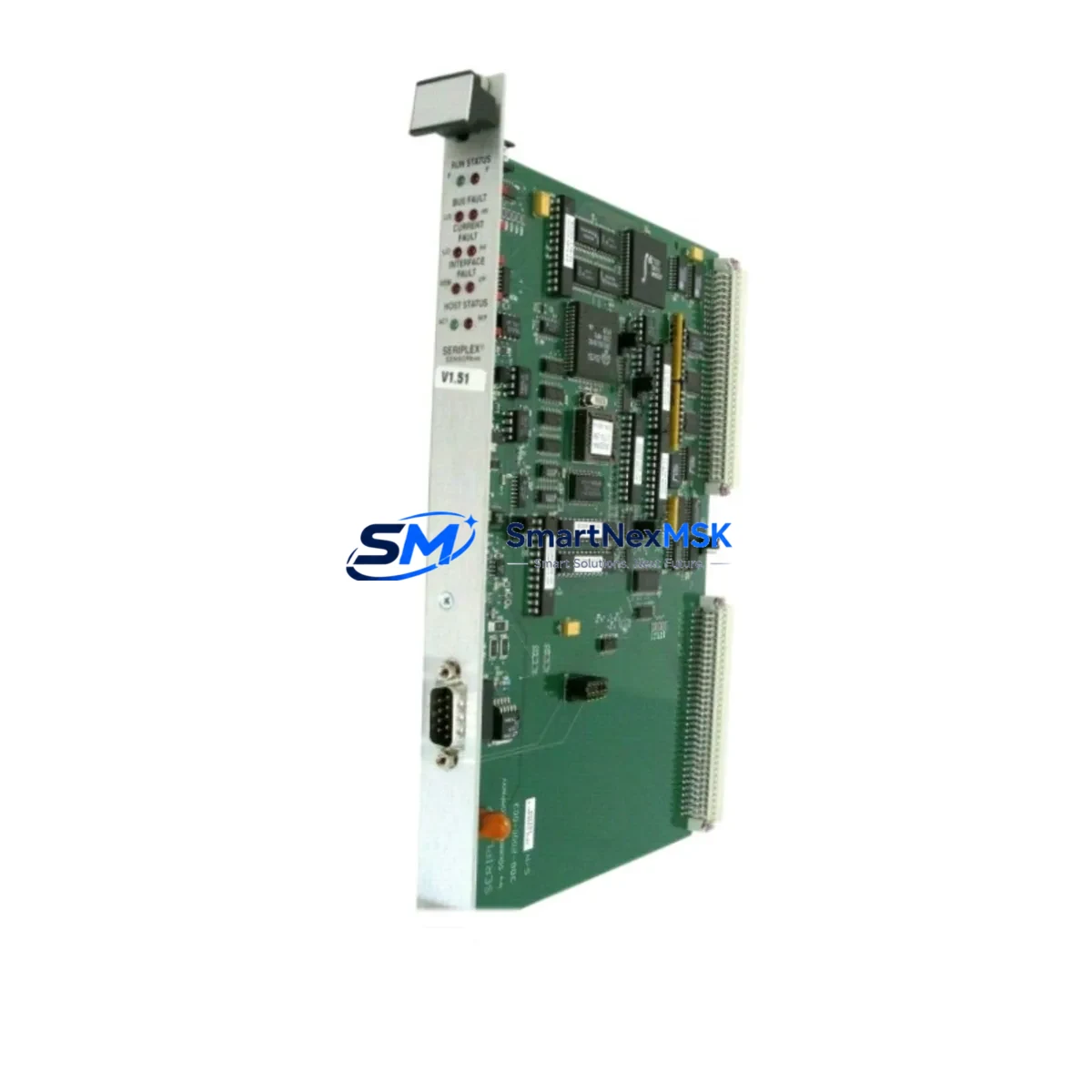
SERIPLEX 388-2000-003 Retrofit-Ready VME I/O Module: Seamless Compatibility for Legacy VMEbus Control System Upgrades
The SERIPLEX 388-2000-003 is a serial multiplexed I/O interface card designed for VMEbus-based distributed control architectures. As industrial facilities face the challenge of maintaining aging automation infrastructure, this module serves as a proven retrofit solution for engineers tasked with replacing discontinued components, upgrading control cabinets, and restoring operational continuity without full system replacement. Whether you are managing a phased modernization program or responding to an emergency parts failure, the 388-2000-003 provides a reliable, specification-matched replacement path for VMEbus platforms that remain in active service across process industries, utilities, and discrete manufacturing.
SERIPLEX’s SERIPLEX bus technology underpins this module’s architecture, enabling high-density I/O expansion over a single twisted-pair cable. This design philosophy makes the 388-2000-003 particularly valuable in retrofit scenarios where conduit space is limited, wiring modifications must be minimized, and the existing SERIPLEX network topology — including field-mounted sensor nodes, actuator interfaces, and distributed I/O pods — must be preserved. Engineers replacing a failed or end-of-life VME interface card can install the 388-2000-003 into the existing VME backplane without rerouting field wiring, provided the backplane slot assignment and module address configuration are correctly matched to the original installation.
Upgrade Compatibility Table
| Parameter | Details |
|---|---|
| SKU / Part Number | 388-2000-003 |
| Brand | SERIPLEX |
| Series / Platform | VMEbus (IEEE 1014) |
| Module Function | Serial Multiplexed I/O Interface Card |
| Bus Interface | VMEbus (J1/J2 connector), A24/D16 addressing |
| I/O Protocol | SERIPLEX serial multiplexed bus |
| Installation Requirement | Standard 6U VME card cage; backplane slot assignment must match original address map |
| Communication Compatibility | Compatible with SERIPLEX network topologies; supports existing field node wiring |
| Replacement Suitability | Direct replacement for failed or discontinued 388-2000-003 units in VMEbus racks |
| Commissioning Notes | Verify module base address DIP switch settings; confirm SERIPLEX bus termination; validate I/O map in host controller software |
| Warranty | 12-Month Warranty — covers manufacturing defects and functional failure under normal operating conditions |
| Condition | New / Refurbished (tested and verified prior to shipment) |
| Origin | China (Xiamen) |
Retrofit Planning for Existing Automation Systems
A successful retrofit using the SERIPLEX 388-2000-003 begins with a thorough audit of the existing VMEbus rack configuration. Most VMEbus installations in process control environments include a combination of CPU boards, memory modules, communication cards, and I/O interface modules occupying a shared backplane. Before removing the failed card, engineers should document the slot position, DIP switch address settings, and any jumper configurations on the original 388-2000-003. This information is critical for ensuring the replacement module is configured identically, preventing address conflicts with other cards in the rack such as the VME CPU module or co-resident communication boards.
The SERIPLEX bus network connected to the 388-2000-003 typically includes a chain of field-mounted SERIPLEX nodes — small, low-cost I/O devices that interface directly with sensors and actuators. These nodes communicate over a single twisted-pair cable back to the VME interface card. During the retrofit, the field wiring to these nodes does not need to be disturbed, provided the replacement card is configured to the same bus address and the SERIPLEX network termination resistor remains in place at the far end of the cable run. Engineers should also verify that the SERIPLEX bus power supply — often a dedicated 24 VDC rail within the control cabinet — is within specification before powering up the replacement module.
In many VMEbus-based DCS and SCADA installations, the host controller software maintains an I/O map that associates physical SERIPLEX node addresses with process variables in the control database. After installing the 388-2000-003, the commissioning technician must verify that the I/O map remains intact and that the host software — whether running on a VME CPU board, an industrial PC, or a dedicated controller — correctly reads and writes to the SERIPLEX network through the new interface card. If the facility uses a VME-based HMI system, operators should confirm that HMI display pages continue to reflect live process data following the card swap, as communication interruptions during the replacement can sometimes trigger alarm states or cause HMI faceplates to display stale values.
For facilities undertaking a broader control system modernization, the 388-2000-003 can serve as a bridge component during a phased migration. Rather than replacing the entire VMEbus rack in a single outage, engineers can maintain the existing SERIPLEX field network while upgrading the host controller platform incrementally. This approach is commonly used when migrating from legacy VMEbus controllers to modern PLC platforms, where a SERIPLEX-to-Ethernet gateway or a SERIPLEX-to-Modbus converter is introduced alongside the existing VME interface card to allow parallel operation during the transition period. Related components frequently encountered in this migration path include VME power supply modules, VME backplane assemblies, SERIPLEX network power injectors, 24 VDC DIN rail power supplies for field node power, and RS-232 or RS-485 programming cables used for host controller configuration and diagnostics.
Procurement teams sourcing the 388-2000-003 as a long-term spare should also consider stocking complementary components that share the same failure profile in VMEbus environments: VME bus arbitration modules, SERIPLEX bus repeaters for extended cable runs, and VME chassis fan tray assemblies that protect sensitive electronics from thermal stress. Maintaining a small buffer inventory of these items alongside the 388-2000-003 significantly reduces the risk of extended downtime caused by secondary component failures discovered during a primary card replacement.
Downtime Control During System Migration
Minimizing production downtime during a VMEbus card replacement requires careful pre-staging and a disciplined commissioning sequence. Before the scheduled maintenance window, the replacement 388-2000-003 should be bench-tested using a VME card cage and a SERIPLEX network simulator or a known-good field node to verify that the module powers up correctly, responds to bus transactions, and communicates with attached SERIPLEX devices. This pre-shipment functional test — which is performed on every unit supplied by SMARTNEXMSK — reduces the risk of discovering a defective replacement module after the original card has already been removed from the live system.
During the replacement window, the host controller program should be placed in a safe hold state before the VME rack is de-energized. For process control applications where outputs must remain in a defined safe position during the card swap, engineers should verify that the SERIPLEX field nodes are configured to hold their last commanded output state or default to a safe de-energized condition when communication with the VME interface card is interrupted. This behavior is typically configured in the SERIPLEX node firmware and should be confirmed in the system documentation before the maintenance window begins.
After installing the 388-2000-003 and restoring power to the VME rack, the commissioning sequence should follow a structured verification checklist: confirm module power-on LED status, verify SERIPLEX bus communication indicators, check host controller I/O diagnostics for any reported faults, and perform a point-by-point I/O verification against the process I/O list before returning the system to automatic control. For facilities with a DCS historian or SCADA data logging system, engineers should also verify that process variable trending resumes correctly following the card replacement, as data gaps or timestamp anomalies in the historian can complicate post-maintenance reporting.
SMARTNEXMSK maintains ready stock of the SERIPLEX 388-2000-003 to support urgent replacement requirements, with standard lead times of 3–7 business days for international shipments from Xiamen. All units are shipped with functional test documentation and are covered by a 12-month warranty against manufacturing defects and operational failure under normal service conditions.
Retrofit Support FAQ
Q1: Is the SERIPLEX 388-2000-003 a direct drop-in replacement for the original module?
Yes. The 388-2000-003 is a form-fit-function replacement for the original SERIPLEX VMEbus serial multiplexed I/O interface card. It uses the same VMEbus J1/J2 connector interface, occupies a standard 6U VME slot, and communicates using the SERIPLEX serial multiplexed bus protocol. The replacement module must be configured with the same base address DIP switch settings as the original to ensure correct operation within the existing I/O map.
Q2: What commissioning steps are required after installing the replacement card?
After physical installation, verify the module base address DIP switch configuration matches the original. Power up the VME rack and confirm the module’s status LEDs indicate normal operation. Check the host controller’s I/O diagnostic display for any reported communication faults on the SERIPLEX network. Perform a point-by-point I/O verification to confirm all field nodes are communicating correctly. If the system uses an HMI, confirm that all associated display pages are showing live data before returning the system to automatic control.
Q3: Can the 388-2000-003 be used during a phased migration to a modern PLC platform?
Yes. The 388-2000-003 can continue to serve as the SERIPLEX network interface during a phased migration, allowing the existing field wiring and SERIPLEX nodes to remain in service while the host controller platform is upgraded. In many migration projects, a SERIPLEX gateway or protocol converter is introduced alongside the VME interface card to enable parallel operation of the legacy and new control systems during the transition period, minimizing the scope of any single cutover outage.
Q4: What does the 12-month warranty cover, and what is the return process?
The 12-month warranty covers manufacturing defects and functional failure under normal operating conditions from the date of shipment. If a unit fails within the warranty period, contact SMARTNEXMSK at [email protected] with the order reference and a description of the fault. SMARTNEXMSK will arrange for evaluation and, where the fault is confirmed as a manufacturing defect, will provide a replacement unit or credit at no additional charge. Warranty does not cover damage resulting from incorrect installation, overvoltage, or physical mishandling.
© 2026 SMARTNEXMSK. All rights reserved.
Original Source: https://smartnexmsk.com
Contact: [email protected] | +86 18259474341