
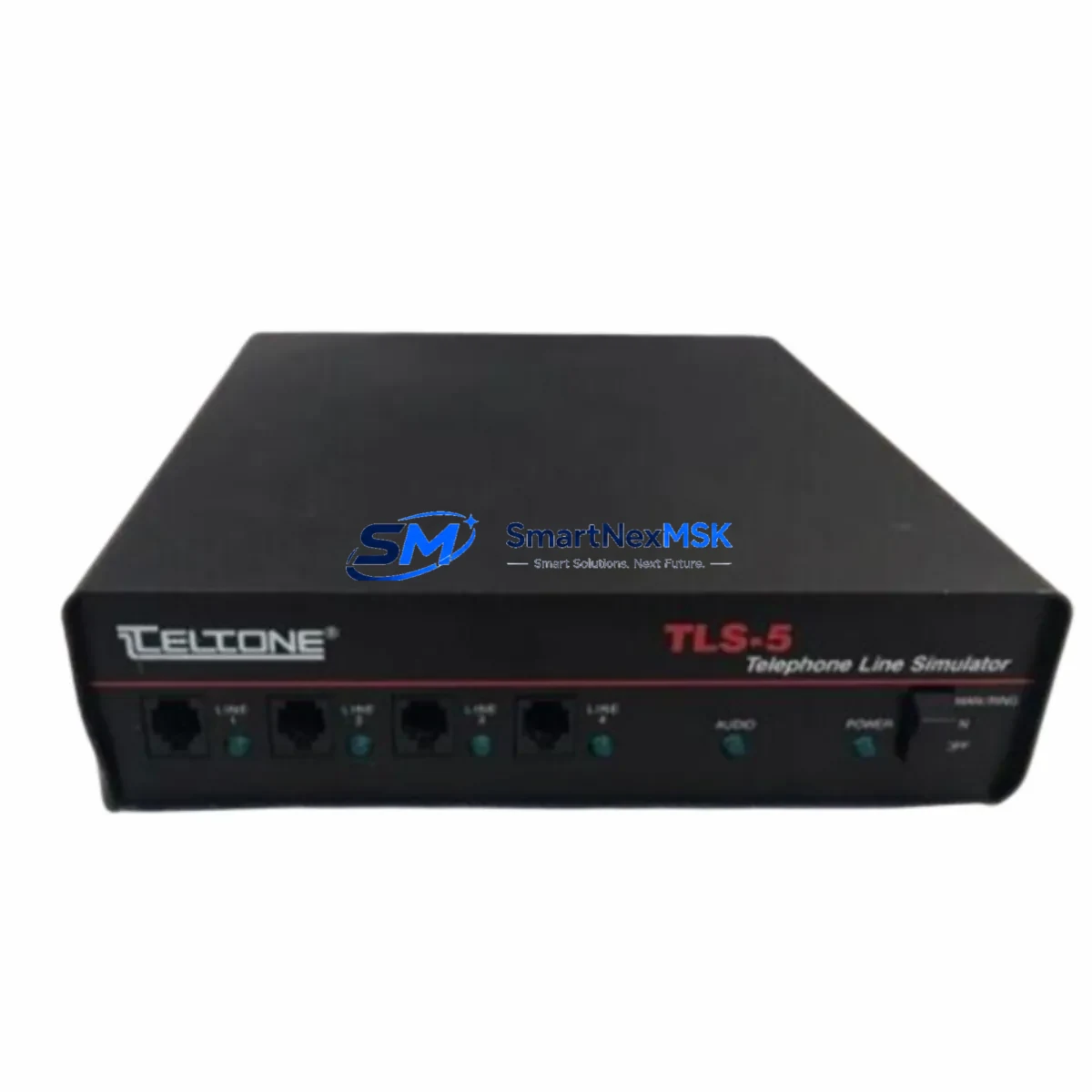
TELTONE TLS-5C-01 Retrofit-Ready Analog Line Simulator for TLS-5C Control Systems
The TELTONE TLS-5C-01 is a precision analog line simulator engineered for seamless integration into legacy telecommunications and industrial control environments. As original TLS-5C series units reach end-of-life or become increasingly difficult to source, the TLS-5C-01 provides a verified, drop-in retrofit solution that preserves existing wiring infrastructure, terminal block layouts, and signal conditioning parameters — eliminating the need for costly panel redesigns or full system overhauls.
For engineers managing aging PSTN test benches, subscriber line emulation rigs, or analog loop simulation platforms, the TLS-5C-01 delivers the same two-wire loop characteristics, impedance matching, and ring voltage generation as the original TLS-5C hardware. Whether you are replacing a failed unit on a live test rack, upgrading a multi-channel analog simulation cabinet, or migrating a legacy telephony validation system to a modernized platform, the TLS-5C-01 is the technically sound, cost-effective choice.
Before proceeding with a retrofit installation, engineers should verify several critical parameters. Power supply compatibility is the first checkpoint: confirm that the existing bench supply or rack-mounted power module delivers the correct DC voltage and current capacity for the TLS-5C-01. Many legacy installations use dedicated linear power supplies; if the original unit drew from a shared rail alongside other TELTONE modules such as the M/8-01 modem card or the TLS-4 line simulator, load calculations must be revisited to ensure rail stability after substitution.
Terminal wiring and connector pinout must be confirmed against the TLS-5C-01 datasheet before any physical installation. The TLS-5C series uses a standardized two-wire tip-and-ring interface, but terminal block positions and screw-clamp torque specifications may differ between chassis generations. If the existing installation uses a TELTONE TLS-5 or TLS-5A chassis, adapter brackets or terminal jumper reassignment may be required. Technicians should also inspect the backplane interface if the unit is installed in a multi-slot rack — slot addressing, ground plane continuity, and card-edge connector seating are common sources of intermittent faults during module substitution.
Module addressing and DIP switch configuration on the TLS-5C-01 must match the addressing scheme of the unit being replaced. In multi-channel test systems where several TLS-5C modules share a common controller bus, address conflicts will cause erratic loop behavior or complete loss of channel control. Document all existing switch positions before removing the original module.
Program and test script compatibility is equally critical. Automated test equipment (ATE) scripts written for the TLS-5C series — including loop current profiles, ring cadence sequences, and on/off-hook simulation routines — are generally compatible with the TLS-5C-01, but any custom firmware extensions or proprietary command sets should be validated in a bench environment before deployment on a production test rack. If the system interfaces with an HMI panel or supervisory control display, verify that channel status indicators, alarm thresholds, and loop state readbacks are correctly mapped to the new module’s output registers.
Communication link integrity should be confirmed end-to-end after installation. In systems where the TLS-5C-01 feeds signal into downstream TELTONE M/8 modem modules, DTMF receivers, or external protocol analyzers, the analog loop parameters — including loop current, line voltage, and AC impedance — must be re-verified under load to ensure downstream equipment operates within specification. Field calibration using a certified loop current meter and an impedance bridge is recommended before returning the system to service.
Upgrade Compatibility Table
| Parameter | TLS-5C (Original) | TLS-5C-01 (Retrofit) | Notes |
|---|---|---|---|
| Interface Type | 2-Wire Analog (Tip/Ring) | 2-Wire Analog (Tip/Ring) | Direct electrical compatibility |
| Loop Current Range | 20–120 mA | 20–120 mA | No recalibration required in standard installations |
| Ring Voltage Output | ~90 Vrms @ 20 Hz | ~90 Vrms @ 20 Hz | Verify with downstream DTMF or ring detector modules |
| DC Feed Voltage | 48 VDC nominal | 48 VDC nominal | Confirm shared rail capacity if co-located with M/8-01 |
| Terminal Block | Screw-clamp, 2-pos | Screw-clamp, 2-pos | Check torque spec; re-terminate if insulation is aged |
| Backplane / Rack Slot | TELTONE standard card edge | TELTONE standard card edge | Verify slot address DIP switches before insertion |
| Communication Protocol | Analog loop / proprietary bus | Analog loop / proprietary bus | ATE script compatibility confirmed for standard command sets |
| Replacement Recommendation | — | Direct drop-in for TLS-5C, TLS-5A, TLS-5 | Minor wiring adaptation may be needed for TLS-5/TLS-5A chassis |
| Commissioning Requirement | — | Loop current verification + impedance check | Use certified loop meter and impedance bridge |
| Warranty | — | 12-Month Warranty | Covers manufacturing defects; excludes physical damage |
Retrofit Planning for Existing Automation Systems
A successful TLS-5C-01 retrofit begins with a thorough audit of the existing rack assembly. In a typical multi-channel telephony test cabinet, the TLS-5C-01 will share rack space with components such as the TELTONE M/8-01 modem card, TLS-4 two-wire line simulator, TLF-2 loop filter module, and TLC-1 loop current controller. Each of these modules draws from the same backplane power distribution, so a power budget review is mandatory before adding or substituting any card.
In installations where the TLS-5C-01 is used alongside TELTONE TRM-1 ring module or TDT-1 dial tone generator units, signal timing and cadence coordination must be re-validated after the swap. The TRM-1 in particular relies on a synchronized ring voltage trigger from the line simulator; any change in the simulator’s ring output timing — even within specification — can cause false ring detection at the subscriber endpoint.
For systems that include a TELTONE TLS-5C-02 dual-channel variant or a TLS-5C-04 quad-channel chassis, the TLS-5C-01 can be used to restore individual failed channels without replacing the entire multi-channel assembly. This approach significantly reduces both parts cost and system downtime, as only the affected channel card needs to be swapped and re-addressed.
Wiring adaptation is straightforward in most cases. The tip-and-ring terminals on the TLS-5C-01 accept standard 22–26 AWG twisted pair, consistent with the wiring gauge used in legacy TELTONE installations. If the existing cable runs use older PVC-insulated wire that has become brittle, this is an appropriate time to re-terminate with fresh cable to prevent intermittent contact faults after the module is returned to service. Technicians should also inspect the TELTONE rack frame ground bus and ensure chassis ground continuity is maintained throughout the retrofit process, as floating ground conditions are a common source of noise and loop instability in analog simulation systems.
Downtime Control During System Migration
Minimizing downtime during a TLS-5C-01 installation requires a structured pre-swap checklist. Before powering down the rack, capture a full snapshot of the existing system state: document all DIP switch positions on the outgoing TLS-5C module, record the current loop current setpoint and ring voltage calibration values, and export any ATE test scripts or HMI configuration files that reference the channel being replaced.
Where possible, pre-configure the TLS-5C-01 on a bench fixture before bringing it to the installation site. Set the module address switches to match the outgoing unit, apply power, and verify loop current output and ring voltage generation against the documented baseline values. This bench pre-check typically takes 15–30 minutes and eliminates the most common causes of extended downtime — address conflicts and calibration drift — before the module ever enters the live rack.
During the physical swap, observe standard ESD precautions. The TLS-5C-01 contains sensitive analog circuitry that can be damaged by electrostatic discharge during handling. Use a grounded wrist strap and an ESD-safe mat when removing the old module and inserting the replacement. After seating the TLS-5C-01 in the rack slot, restore power incrementally if the rack supports staged power-up sequencing — this protects downstream modules from inrush current transients during initialization.
Post-installation verification should include a full end-to-end loop test: apply an on-hook condition, confirm correct loop current, apply an off-hook condition, verify current draw within specification, trigger a ring cycle, and confirm ring voltage and cadence at the subscriber endpoint. If the system uses an HMI panel for channel status monitoring, verify that the TLS-5C-01’s status outputs are correctly mapped and that alarm conditions clear after successful initialization. Total verified swap time for an experienced technician is typically under two hours, including bench pre-check and post-installation loop testing.
Retrofit Support FAQ
Q: Is the TLS-5C-01 a direct replacement for the original TLS-5C?
A: Yes. The TLS-5C-01 is designed as a functional replacement for the TLS-5C, maintaining the same two-wire analog interface, loop current range, ring voltage output, and backplane connector format. Minor DIP switch reconfiguration may be required to match the address of the outgoing unit. For TLS-5 or TLS-5A chassis installations, verify terminal block pinout before final wiring.
Q: What commissioning steps are required after installation?
A: After physical installation and power-up, perform a loop current measurement under on-hook and off-hook conditions, verify ring voltage output at 20 Hz, and confirm module address recognition on the controller bus. If the system includes ATE scripts or HMI channel mappings, run a full functional test cycle before returning the channel to production service. Document all measured values for the maintenance record.
Q: How do I verify wiring compatibility before ordering?
A: Confirm that your existing installation uses a standard two-wire tip-and-ring interface with 22–26 AWG twisted pair wiring and a 48 VDC feed voltage. Check the terminal block position and screw-clamp format against the TLS-5C-01 datasheet. If your rack uses a TELTONE standard card-edge backplane, no mechanical adaptation is required. Contact our technical team with your existing module part number and chassis model for a pre-order compatibility confirmation.
Q: What does the 12-month warranty cover?
A: The TLS-5C-01 carries a 12-month warranty from the date of shipment, covering manufacturing defects in materials and workmanship. Each unit undergoes functional testing prior to dispatch, including loop current verification and ring voltage output confirmation. The warranty does not cover damage resulting from incorrect installation, overvoltage conditions, ESD damage, or physical mishandling. Warranty claims are processed with a return authorization; replacement units are dispatched within 3–5 business days of confirmed defect verification.
© 2026 SMARTNEXMSK. All rights reserved.
Original Source: https://smartnexmsk.com
Contact: [email protected] | +86 18259474341