
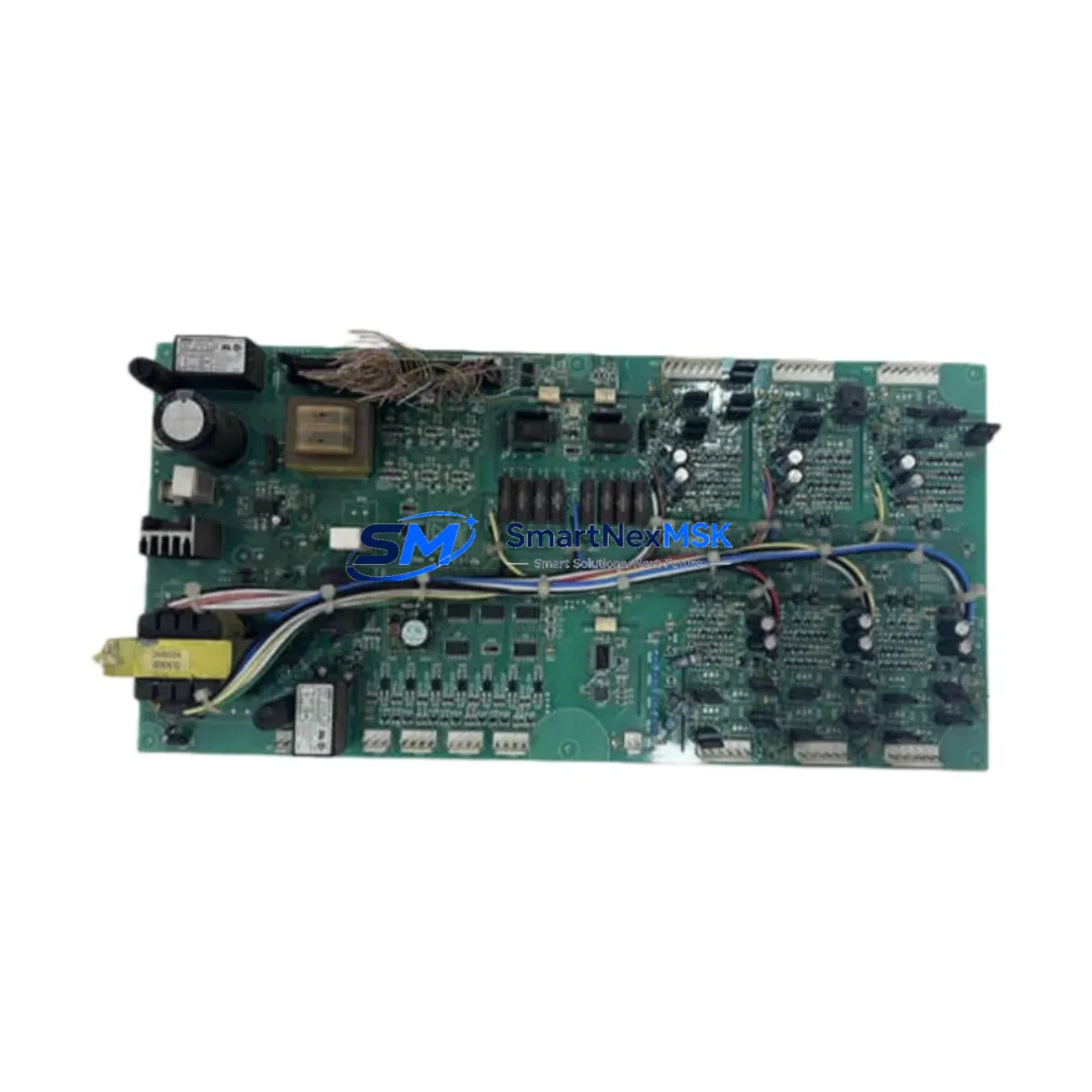
TMEIC ARND-3119 Retrofit-Ready Drive Control Board for TMdrive Series Control Systems
The TMEIC ARND-3119 is a master drive control board engineered for seamless integration into TMdrive series variable frequency drive systems. As legacy TMdrive units approach end-of-life and OEM support windows close, the ARND-3119 has become a critical retrofit component for engineers tasked with sustaining continuous production without full drive replacement. Whether you are managing a planned upgrade cycle or responding to an unplanned board failure, the ARND-3119 provides a wiring-compatible, firmware-consistent replacement path that minimizes engineering rework and commissioning time.
This board is designed to slot directly into the existing TMdrive control chassis, preserving the original backplane interface and terminal block layout. Engineers replacing a failed ARND-3119 in the field can retain the existing wiring harness, provided terminal assignments are verified against the installed drive revision. The board interfaces with the TMdrive gate driver board and power supply module through the standard internal bus, eliminating the need for custom cabling or adapter brackets during installation.
Before installation, it is essential to confirm the power supply capacity of the existing control cabinet. The ARND-3119 draws regulated DC power from the drive’s internal SMPS unit, and any degradation in the power supply module output can cause intermittent faults or initialization failures after board swap. If the existing power supply module shows signs of aging — particularly capacitor bulge or output voltage drift — replacement of the power supply in parallel with the control board is strongly recommended to avoid repeat failures.
Program compatibility is a key concern during any TMdrive control board retrofit. The ARND-3119 stores drive parameters and application logic in onboard non-volatile memory. Prior to removal of the failed board, engineers should attempt a full parameter backup using the TMdrive programming tool or compatible HMI panel. If the original board is non-functional, parameter reconstruction from the drive’s commissioning documentation or the site’s control system archive will be required. Restoring the correct motor nameplate data, PID tuning values, acceleration/deceleration ramps, and fault response settings is critical to safe recommissioning.
In multi-drive installations, the ARND-3119 communicates with the plant-level control system via the drive’s communication module. Common protocol configurations include PROFIBUS-DP, Modbus RTU, and DeviceNet, depending on the TMdrive variant and the era of the original installation. During retrofit planning, verify that the replacement board’s firmware revision supports the communication protocol in use. If the site is also migrating from an older fieldbus to a modern Ethernet-based protocol such as PROFINET or EtherNet/IP, the communication module may need to be upgraded alongside the control board — a process that also requires corresponding updates to the PLC program and HMI screen configurations.
For sites running SCADA or DCS integration, the ARND-3119 retrofit should be coordinated with the control room team to ensure that drive status signals, fault codes, and speed references are correctly mapped after the board replacement. Changes in firmware revision can occasionally alter the register map or fault code numbering, which may require minor updates to the PLC ladder logic or function block diagrams that handle drive communication.
Upgrade Compatibility Table
| Parameter | Details |
|---|---|
| Compatible Series | TMEIC TMdrive Series (TMdrive-10, TMdrive-30, TMdrive-70, TMdrive-MVe) |
| Board Function | Master drive control, gate signal generation, parameter storage, communication interface |
| Backplane Interface | Standard TMdrive internal bus connector — direct replacement, no adapter required |
| Terminal Block | Wiring-compatible with original ARND-3119 layout; verify against installed revision |
| Communication Compatibility | PROFIBUS-DP, Modbus RTU, DeviceNet (firmware-dependent; confirm revision before ordering) |
| Installation Requirement | Parameter backup recommended prior to removal; power supply capacity verification required |
| Commissioning Notes | Restore motor data, PID values, ramp settings, and fault response parameters after installation |
| Replacement Recommendation | Direct drop-in for failed or end-of-life ARND-3119 boards in TMdrive control cabinets |
| Warranty | 12-Month Warranty — covers manufacturing defects and functional performance |
| Stock Status | In stock — available for immediate dispatch with pre-shipment functional testing |
Retrofit Planning for Existing Automation Systems
A successful ARND-3119 retrofit begins well before the board arrives on site. The retrofit planning phase should include a full audit of the control cabinet, covering the TMdrive power supply module, the gate driver board, the I/O terminal module, and the communication module. In older installations, it is common to find that the control board failure is symptomatic of broader component aging across the drive assembly. Addressing only the control board while leaving degraded ancillary components in place increases the risk of a secondary failure shortly after recommissioning.
The backplane and rack assembly should be inspected for corrosion, loose connectors, and contamination before the new board is installed. In high-humidity or chemically aggressive environments, connector oxidation can cause intermittent contact resistance that mimics board faults. Cleaning the backplane connectors and verifying rack integrity is a low-cost step that significantly improves retrofit reliability.
For sites that are simultaneously upgrading the HMI, the transition from an older operator panel to a modern touch-screen HMI requires careful attention to the drive’s communication link. The HMI screen pages that display drive speed, current, fault status, and control mode must be re-mapped to the new register addresses if the firmware revision has changed. In some TMdrive installations, the HMI communicates directly with the ARND-3119 via a dedicated serial port, and the cable pinout and baud rate settings must be confirmed during commissioning.
Sites expanding I/O capacity as part of the retrofit should evaluate whether the existing I/O terminal module supports the additional signal count, or whether an I/O expansion module is required. In parallel, the PLC program — typically running on a separate controller that supervises the drive — may need to be updated to handle new I/O assignments, revised interlocking logic, or updated safety function mappings. Programming cables and software licenses for the PLC platform should be confirmed as available before the maintenance window begins.
Where the retrofit is part of a broader control system modernization — for example, migrating from a legacy relay-based control panel to a fully programmable automation architecture — the ARND-3119 replacement is often one step in a sequence that also includes upgrading the main controller, replacing the operator interface, and reconfiguring the communication network. In these projects, the drive control board retrofit should be sequenced to align with the PLC program migration and the HMI screen rebuild, so that the entire system can be validated as an integrated unit during the final commissioning phase.
Downtime Control During System Migration
Minimizing unplanned downtime is the primary operational constraint in any drive control board retrofit. The ARND-3119 replacement process is designed to be completed within a single planned maintenance window, provided that all preparatory steps have been completed in advance. The critical path includes parameter backup, spare parts staging, personnel briefing, and coordination with the process control team to ensure that the affected drive can be safely isolated without disrupting adjacent production lines.
Where a hot-standby or redundant drive configuration is in place, the retrofit can be performed with the process running on the standby drive, eliminating production impact entirely. In single-drive installations, the maintenance window should be scheduled during a planned production break, and the duration should be estimated conservatively to allow time for parameter restoration, functional testing, and a supervised trial run before returning the drive to automatic control.
To protect the original program logic, a verified parameter backup should be stored in at least two locations — typically the site’s control system archive and a portable storage device held by the maintenance team. If the original board is partially functional, a live parameter read should be performed immediately upon fault identification, before the board degrades further. This backup becomes the reference document for the recommissioning engineer and should be reviewed against the drive’s commissioning record to identify any field modifications made since the original installation.
During the commissioning phase following board replacement, the drive should be tested in local manual mode before being returned to remote automatic control. Speed reference tracking, current limit response, fault relay outputs, and communication link status should all be verified before the drive is reintegrated into the production sequence. A supervised trial run at reduced load, followed by a full-load test, provides confidence that the retrofit has been completed successfully and that the control system is operating within its original performance envelope.
Retrofit Support FAQ
Q: Is the ARND-3119 a direct replacement for the original board in my TMdrive unit?
A: Yes. The ARND-3119 is designed as a direct drop-in replacement for the original control board in compatible TMdrive series drives. The backplane connector, terminal block layout, and mounting arrangement are consistent with the original specification. However, we recommend confirming the firmware revision compatibility with your drive’s installed software version before installation, particularly if your site uses a specific communication protocol configuration.
Q: What wiring checks should I perform before installing the replacement board?
A: Before installing the ARND-3119, verify that all control wiring to the terminal block is correctly documented and labeled. Check the power supply module output voltage against the board’s rated input specification. Inspect the backplane connector for contamination or pin damage. Confirm that the gate driver board and I/O terminal module are in serviceable condition, as faults in these components can damage a new control board if not identified prior to installation.
Q: How do I verify communication link compatibility after the board replacement?
A: After restoring drive parameters and completing the initial power-up sequence, verify the communication link status from the PLC or DCS side. Confirm that the drive’s node address, baud rate, and protocol settings match the network configuration. Check that the PLC program is receiving valid drive status data and that the fault register values are consistent with the expected format for your firmware revision. If the HMI displays drive data, verify that all screen values are updating correctly before returning the drive to automatic control.
Q: What does the 12-month warranty cover, and what is the testing process before shipment?
A: Every ARND-3119 unit is functionally tested prior to shipment to verify board initialization, communication interface operation, and output signal integrity. The 12-month warranty covers manufacturing defects and functional performance failures under normal operating conditions. Warranty claims are supported by our technical team, and replacement units are dispatched promptly to minimize site downtime. For warranty service, retain the original packaging and shipment documentation.
© 2026 SMARTNEXMSK. All rights reserved.
Original Source: https://smartnexmsk.com
Contact: [email protected] | +86 18259474341