
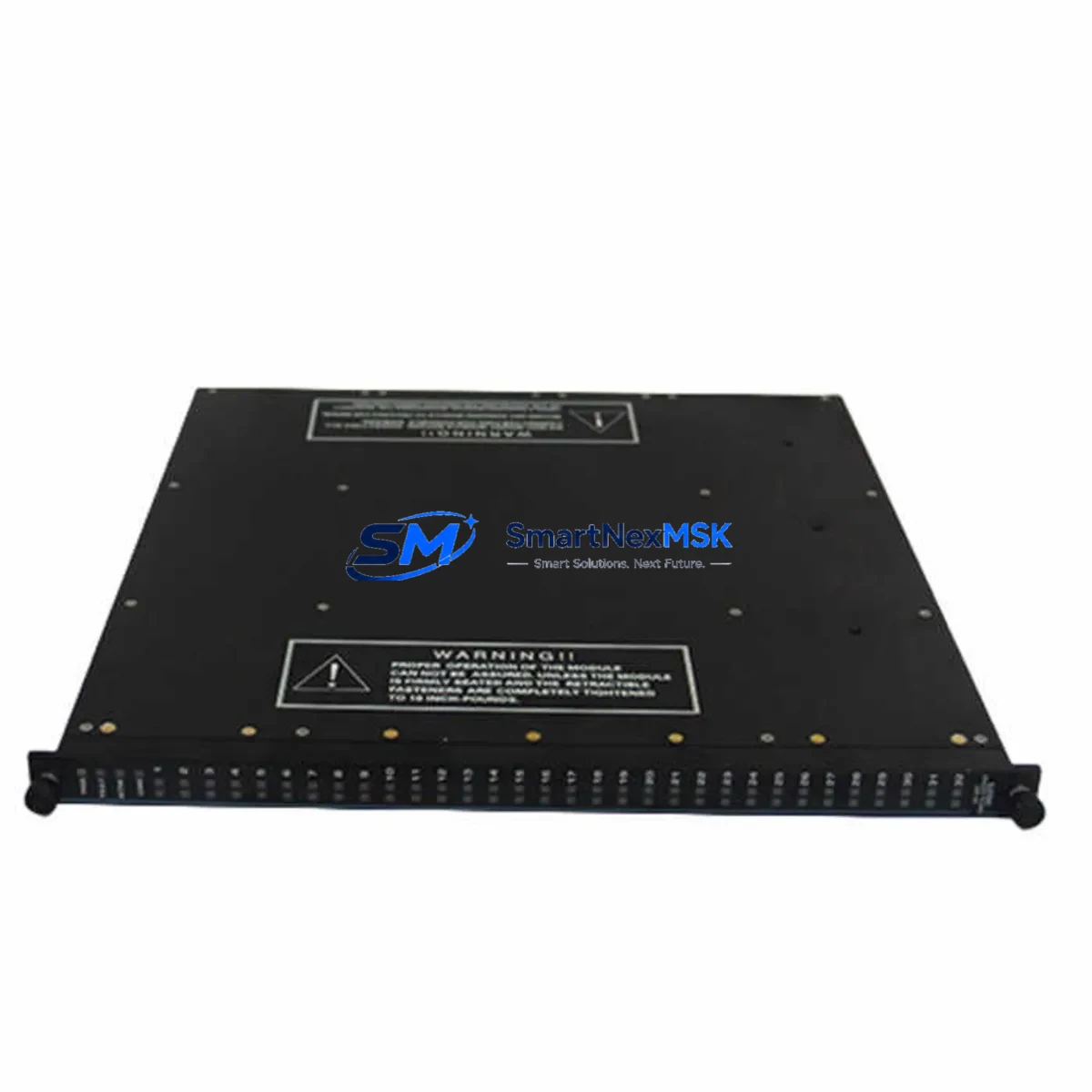
TRI-SEN AI3281E Retrofit-Ready Analog Input Module for DCS Control Systems
The TRI-SEN AI3281E is a high-reliability analog input module engineered for seamless integration into distributed control system (DCS) architectures. Designed as a retrofit-ready replacement for discontinued or end-of-life analog input cards, the AI3281E supports 4–20 mA current loop signals and is fully compatible with the TRI-SEN DCS backplane and rack infrastructure. Whether you are modernizing an aging control cabinet, recovering from an unplanned module failure, or executing a planned system upgrade, the AI3281E delivers the signal fidelity, electrical isolation, and protocol compatibility required for mission-critical industrial environments.
Industrial facilities operating legacy DCS platforms frequently encounter the challenge of sourcing reliable analog input modules when original equipment manufacturers discontinue production. The AI3281E addresses this gap directly — providing a verified drop-in replacement that eliminates the need for costly full-system overhauls. Engineers can install the AI3281E into the existing rack without modifying the backplane wiring harness, preserving the original terminal block layout and reducing installation time significantly.
Before commissioning the AI3281E in a retrofit application, engineers should verify several critical parameters: confirm the power supply capacity of the existing DCS power module (typically a TRI-SEN PM series unit) to ensure it can support the additional current draw; inspect the backplane connector alignment and slot addressing to confirm the module address matches the configuration stored in the DCS controller; and validate that the field wiring terminal assignments on the existing marshalling cabinet are compatible with the AI3281E’s channel-to-terminal mapping. In most TRI-SEN DCS installations, the AI3281E occupies a standard I/O slot and communicates over the internal backplane bus without requiring additional communication cabling.
For sites migrating from older analog input cards — including earlier-generation TRI-SEN AI series modules — the AI3281E maintains backward compatibility with the DCS engineering workstation configuration database. Existing function block diagrams, PID loop assignments, and HMI tag bindings typically require no modification, allowing operators to maintain continuous process visibility throughout the changeover. The HMI display screens linked to analog input tags will continue to reflect live process values immediately after the module is seated and powered.
In control systems where the AI3281E interfaces with a TRI-SEN communication gateway or remote I/O coupler, engineers should confirm that the firmware version of the gateway supports the module’s signal range and diagnostic reporting format. Sites using HART-enabled field instruments should also verify that the AI3281E’s HART pass-through capability is enabled in the DCS configuration tool, ensuring that handheld communicators and asset management software can continue to access device-level diagnostics without interruption.
Every AI3281E unit shipped by SMARTNEXMSK undergoes pre-shipment functional testing, including channel-by-channel signal verification across the full 4–20 mA input range, isolation resistance measurement, and backplane connector integrity inspection. Units are supplied with a 12-month warranty covering manufacturing defects and functional failures under normal operating conditions. Stock is maintained for immediate dispatch, supporting urgent maintenance scenarios where minimizing process downtime is the primary objective.
Upgrade Compatibility Table
| Parameter | Detail |
|---|---|
| Module SKU | AI3281E |
| Brand / Manufacturer | TRI-SEN |
| Module Type | Analog Input Module (DCS) |
| Signal Range | 4–20 mA (current loop), configurable per channel |
| Backplane Interface | TRI-SEN DCS standard backplane bus — direct slot insertion |
| Rack / Chassis Compatibility | Compatible with TRI-SEN DCS I/O rack and expansion chassis |
| Communication Protocol | Internal DCS backplane bus; HART pass-through supported |
| Terminal Wiring | Retains original field wiring terminal layout — no rewiring required in standard retrofit |
| Module Address Configuration | Slot-based addressing; must match existing DCS controller configuration |
| HMI / SCADA Compatibility | Existing tag bindings and HMI screens remain valid post-replacement |
| Program Logic Compatibility | Function block and PID loop assignments preserved without modification |
| Power Requirement | Supplied via DCS backplane; verify PM module capacity before installation |
| Country of Origin | China (CN) |
| Pre-Shipment Testing | Full channel signal verification, isolation test, connector inspection |
| Warranty | 12 months from date of shipment |
| Availability | In stock — ready for immediate dispatch |
Retrofit Planning for Existing Automation Systems
A successful AI3281E retrofit begins with a thorough audit of the existing control cabinet. Engineers should document the current DCS rack layout, noting which slots are occupied by analog input cards, digital output modules, and communication interface modules. In a typical TRI-SEN DCS installation, the rack may also house a redundant controller module, a system power module, and one or more I/O bus extension modules connecting remote I/O panels. Understanding the full rack population ensures that the AI3281E is installed in the correct slot without disrupting adjacent modules.
Field wiring connected to the existing analog input card should be labeled and photographed before removal. The marshalling cabinet terminal blocks — often a TRI-SEN TB series or equivalent — should be inspected for corrosion, loose terminations, or insulation degradation that may have developed over years of service. Replacing the analog input module is an ideal opportunity to address any wiring deficiencies that could compromise signal quality after the new module is commissioned.
For sites that also need to upgrade communication infrastructure, the AI3281E retrofit can be coordinated with the replacement of a TRI-SEN communication module or the migration from a legacy serial protocol to a modern fieldbus or industrial Ethernet standard. If the DCS controller is being upgraded in parallel — for example, replacing an older TRI-SEN controller card with a current-generation processor module — the AI3281E’s configuration data can be exported from the legacy engineering workstation and imported into the new controller project, preserving all channel scaling, alarm limits, and engineering unit assignments.
Sites operating HART-enabled field transmitters — such as pressure transmitters, temperature transmitters, or flow meters wired to the AI3281E channels — should confirm that the HART multiplexer or asset management server is reconfigured to poll the new module after installation. In systems where a TRI-SEN HART gateway or a third-party asset management platform is in use, the module’s device descriptor may need to be updated to reflect the AI3281E’s diagnostic register map.
When the retrofit scope extends beyond a single module replacement to include I/O expansion — for example, adding new analog input channels to accommodate additional field instruments — engineers should evaluate whether the existing rack has available slots or whether an additional I/O expansion chassis is required. TRI-SEN DCS expansion racks connect to the main chassis via a backplane extension cable, and the system controller must be configured to recognize the expanded I/O address range before the new AI3281E modules are brought online.
Downtime Control During System Migration
Minimizing process downtime during an AI3281E module replacement requires careful pre-planning and a structured execution sequence. The recommended approach is to complete all preparatory work — including module configuration, wiring documentation, and spare parts staging — before the maintenance window begins. Where the process permits, analog input channels should be placed in manual control mode at the DCS workstation prior to module removal, ensuring that PID controllers relying on those inputs do not respond to signal loss with uncontrolled output changes.
The physical module swap — removing the existing analog input card and seating the AI3281E — typically takes less than fifteen minutes in a standard TRI-SEN DCS rack. The module’s backplane connector is designed for tool-free insertion, and the front panel locking mechanism secures the module in place without requiring additional fasteners. Once the AI3281E is seated, the DCS controller will detect the new module during its next I/O scan cycle and begin acquiring analog input data immediately, provided the slot address and channel configuration match the stored controller project.
After the module is installed, engineers should perform a channel-by-channel verification at the DCS workstation, confirming that each analog input channel is reading the expected process value within the calibrated range. Field instruments should be checked for correct 4–20 mA loop current, and any HART communication links should be re-established and verified. HMI screens displaying the affected process variables should be monitored for a stabilization period before the affected control loops are returned to automatic mode.
For critical processes where even brief signal interruption is unacceptable, a hot-standby or redundant I/O configuration may be appropriate. In redundant DCS architectures, the AI3281E can be installed in the standby slot while the primary module remains active, allowing a bumpless switchover once the replacement module is confirmed operational. SMARTNEXMSK can advise on redundancy configuration requirements based on the specific TRI-SEN DCS platform version in use at your facility.
Retrofit Support FAQ
Q: Is the TRI-SEN AI3281E a direct drop-in replacement for earlier TRI-SEN analog input modules?
A: In most TRI-SEN DCS installations, the AI3281E is compatible with the standard backplane slot and terminal wiring layout used by earlier-generation analog input cards. Engineers should verify the slot address configuration and confirm that the DCS controller firmware version supports the AI3281E’s module descriptor before installation. SMARTNEXMSK provides pre-shipment documentation to assist with compatibility verification.
Q: What commissioning steps are required after installing the AI3281E?
A: After seating the module, confirm slot address recognition at the DCS workstation, verify channel-by-channel signal readings against known process values, re-establish any HART communication links, and return affected control loops to automatic mode after a stabilization period. A commissioning checklist is available upon request.
Q: Can the AI3281E be used in a system where the DCS controller is also being upgraded?
A: Yes. The AI3281E’s channel configuration data — including scaling, alarm limits, and engineering units — can be exported from the legacy engineering workstation and imported into the new controller project. This preserves existing logic and HMI tag bindings, reducing re-engineering effort during a parallel controller upgrade.
Q: What does the 12-month warranty cover?
A: The warranty covers manufacturing defects and functional failures under normal operating conditions for 12 months from the date of shipment. Each unit is tested prior to dispatch, including full channel signal verification and backplane connector inspection. Warranty claims are handled directly by SMARTNEXMSK — contact [email protected] for support.
© 2026 SMARTNEXMSK. All rights reserved.
Original Source: https://smartnexmsk.com
Contact: [email protected] | +86 18259474341