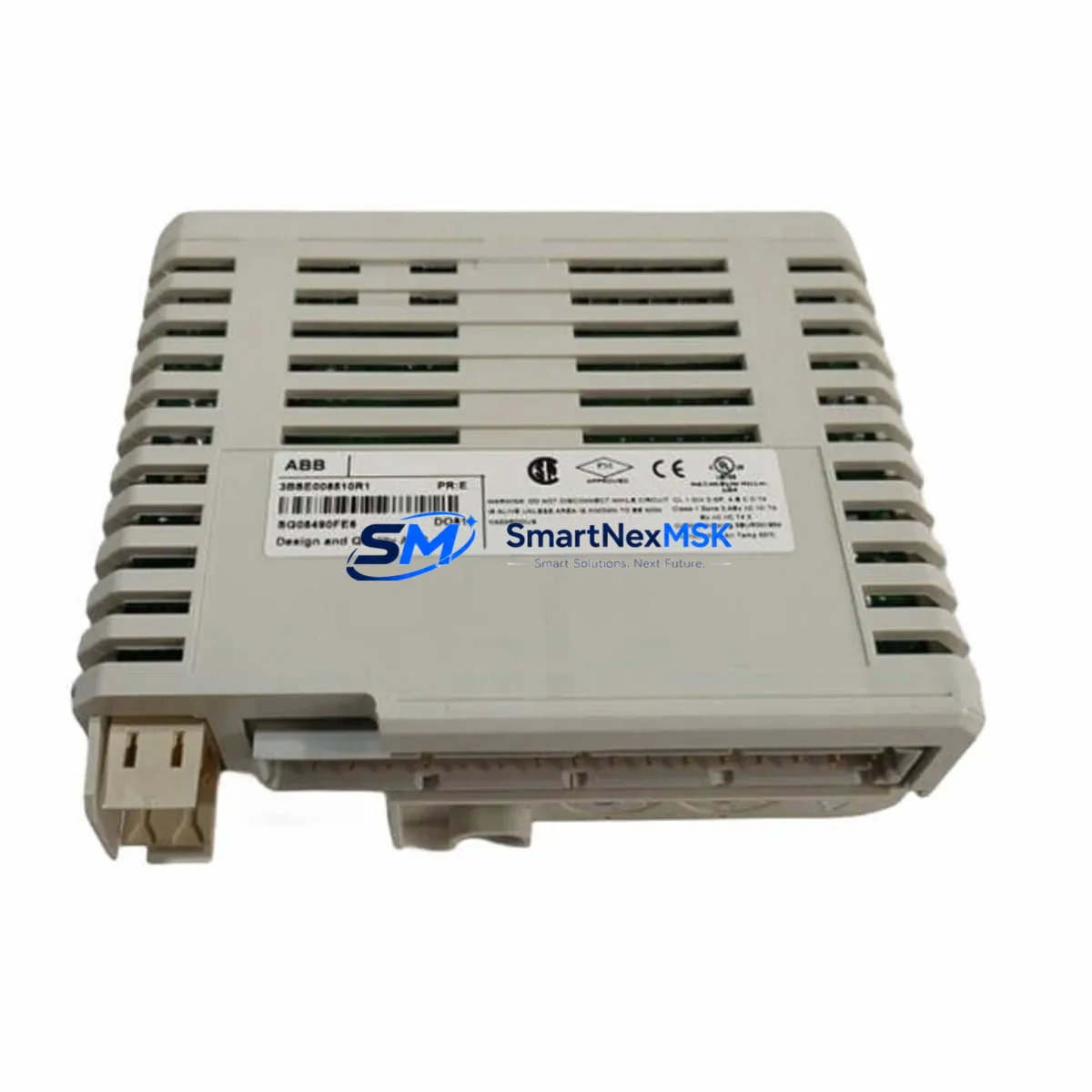
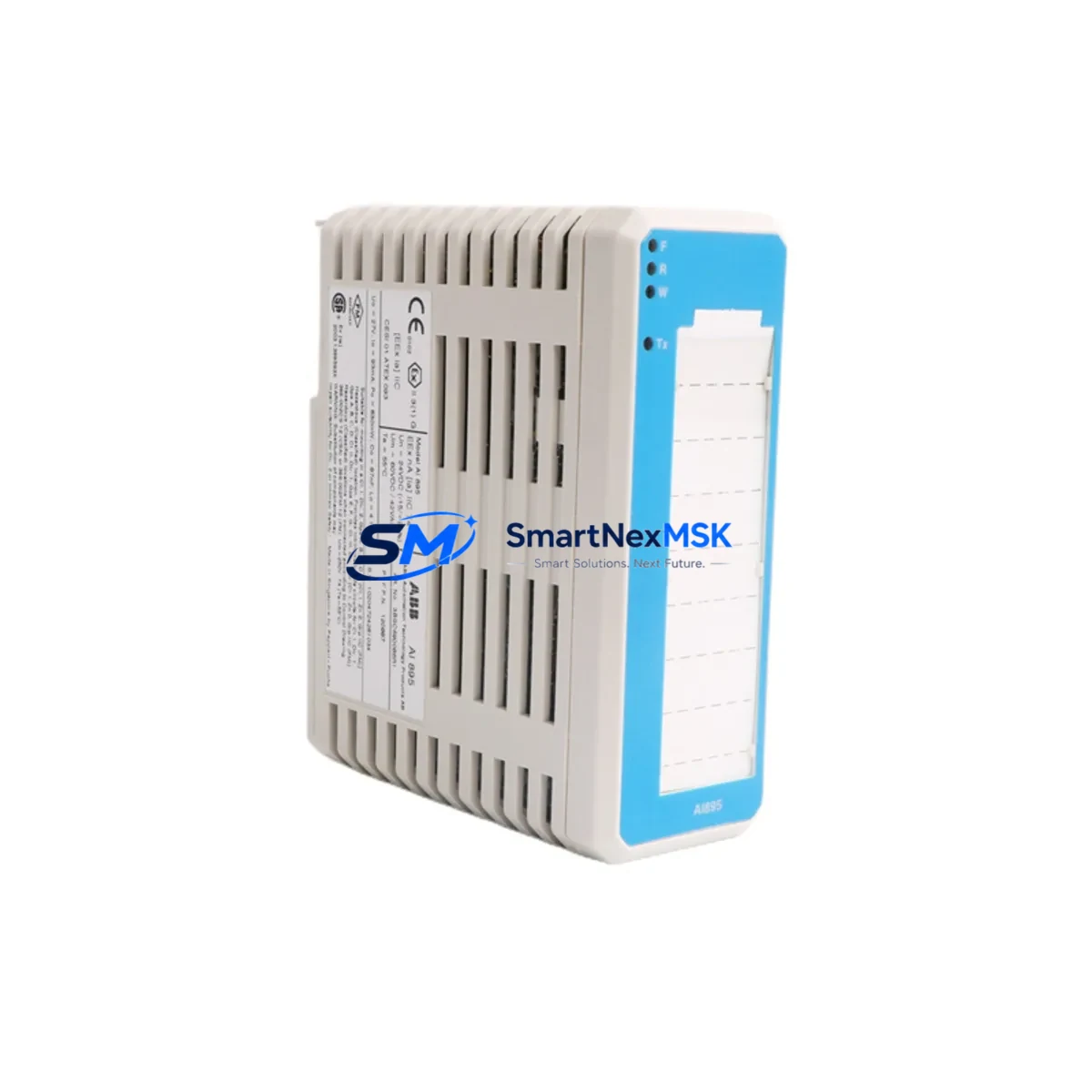
ABB AI895 3BSC690086R1 Retrofit-Ready Analog Input Module: Compatible Modernization and Smooth S800 I/O System Upgrade
The ABB AI895 (3BSC690086R1) is an 8-channel, 16-bit analog input module engineered for the ABB S800 I/O platform — one of the most widely deployed distributed I/O systems in process automation, power generation, and continuous manufacturing environments. As legacy S800 installations age and original ABB AI895 units reach end-of-life or become difficult to source, this retrofit-ready replacement module provides a verified drop-in solution that preserves existing wiring, backplane connections, and control logic without requiring a full system redesign.
For engineers managing aging DCS infrastructure built around the ABB AC800M controller or earlier AC800F platforms, the AI895 3BSC690086R1 is a critical stocking item. Its compatibility with the S800 I/O bus — including the TB820V2 ModuleBus Modem and CI854 PROFIBUS communication interface — means that replacement can be executed during a planned maintenance window without reprogramming the control strategy in ABB Control Builder M. Signal ranges, channel addressing, and module parameterization remain consistent with the original hardware specification.
When planning a retrofit or emergency replacement, engineers must verify several key parameters before installation. Power consumption from the S800 I/O station’s SD821 or SD822 power supply must be recalculated to confirm the station budget accommodates the replacement module alongside existing cards such as the AO895 analog output module and DI885 digital input module. Terminal block wiring on the TB810 or TB811 I/O terminal unit should be documented and photographed prior to removal of the legacy module. Backplane slot addressing must be confirmed in the hardware configuration tree to ensure the replacement AI895 is recognized at the correct logical address by the AC800M controller.
Program compatibility is a primary concern during any S800 I/O module swap. In most cases, the AI895 3BSC690086R1 replacement requires no changes to the IEC 61131-3 function block logic in Control Builder M, provided the hardware configuration file is updated to reflect the new module serial number and firmware revision. HMI faceplates built in ABB 800xA System or third-party SCADA platforms referencing the analog input channels will continue to display correctly once the module is online and the I/O database is refreshed. For sites using Freelance 800F or older Advant OCS architectures, additional compatibility verification with the engineering team is recommended before committing to the replacement.
Communication link integrity is another critical checkpoint. The S800 I/O bus operates over the ModuleBus protocol, and the CI854A PROFIBUS DP interface or CI855 ModuleBus optical modem connecting the I/O station to the controller must be confirmed as operational before and after module replacement. Any interruption to the bus during hot-swap procedures should be coordinated with the control room to prevent spurious alarms or process upsets. Where the site uses PROFIBUS PA segment couplers alongside the S800 I/O station, the segment topology should be reviewed to confirm that the analog input signals from field transmitters are correctly mapped through the replacement module.
Field commissioning after installation involves verifying each of the eight analog input channels against known process values or calibrated signal sources. Channel scaling, filter time constants, and fault detection thresholds configured in the original module should be re-entered or imported from the backup hardware configuration. Sites with ABB Asset Monitor or condition monitoring integrations should confirm that the new module’s diagnostic data is correctly reported to the asset management layer. A full loop check across all connected field instruments — including pressure transmitters, temperature sensors, and flow meters wired to the AI895 — is standard practice before returning the I/O station to automatic control.
Upgrade Compatibility Table
| Parameter | Detail |
|---|---|
| Module SKU | AI895 / 3BSC690086R1 |
| Brand | ABB |
| Series | S800 I/O |
| Channels | 8 Analog Input Channels |
| Resolution | 16-bit |
| Signal Range | 4–20 mA / 0–10 V (configurable per channel) |
| Backplane Interface | S800 ModuleBus (compatible with TB810 / TB811 terminal units) |
| Compatible Controllers | AC800M, AC800F, Freelance 800F |
| Compatible Communication Interfaces | CI854, CI854A, CI855, TB820V2 |
| Installation Requirement | Drop-in replacement; no wiring modification required |
| Programming Impact | Hardware config update in Control Builder M; no logic rewrite required |
| HMI Compatibility | ABB 800xA, third-party SCADA (tag remapping may be required) |
| Commissioning | Full 8-channel loop check; calibration verification recommended |
| Warranty | 12 Months from date of shipment |
| Stock Status | Available — ships from verified inventory |
Retrofit Planning for Existing Automation Systems
A successful S800 I/O retrofit begins with a complete audit of the existing I/O station configuration. Engineers should export the current hardware configuration from Control Builder M and cross-reference each module slot against the physical rack. In a typical S800 station supporting a process unit, the AI895 analog input module coexists with the AO895 analog output module, DI885 digital input module, DO895 digital output module, and in some installations, the AI893 HART-enabled analog input module for field device diagnostics. The SD821 24 VDC power supply module feeding the station must be load-checked to confirm it can support the replacement AI895 alongside all co-installed modules.
Terminal unit selection is equally important. The AI895 mounts on either the TB810 passive terminal unit or the TB811 active terminal unit, depending on whether the site requires local signal conditioning. Wiring documentation from the original installation should be retrieved from the site’s engineering document management system before any physical work begins. Where documentation is incomplete, a field survey of the terminal block wiring is mandatory. The CI854A PROFIBUS DP interface module connecting the S800 station to the AC800M controller should be confirmed as healthy via the controller’s diagnostic display before and after the module swap. For stations using the TB820V2 ModuleBus Modem for optical bus extension, the fiber link integrity should be verified with an optical power meter prior to the maintenance window.
Where the retrofit scope extends beyond a single module replacement to a full I/O station upgrade, the engineering team should evaluate whether the existing S800 I/O backplane and rack assembly can accommodate additional modules for I/O expansion. In some legacy installations, the rack is fully populated, and I/O expansion requires adding a new S800 station connected via an additional CI854A or TB820V2 link. This planning step prevents scope creep during the maintenance window and ensures that the control system architecture remains within the AC800M’s supported I/O station count.
Downtime Control During System Migration
Minimizing unplanned downtime during an S800 I/O module replacement requires a structured pre-outage preparation protocol. Before the maintenance window opens, the engineering team should complete a full backup of the AC800M application program and hardware configuration database. The backup should be stored on both the engineering workstation and an offline medium to protect against workstation failure during the outage. All analog input channels on the AI895 being replaced should be placed in manual mode at the DCS level, with the control room operators informed of the expected duration of the maintenance window and the signals that will be unavailable.
During the physical replacement, the S800 I/O station should be powered down in a controlled sequence: first isolating the field wiring at the terminal unit, then removing the AI895 module from the backplane slot. The replacement AI895 3BSC690086R1 should be inspected for shipping damage and firmware version before installation. Once seated in the backplane, the station power is restored and the controller’s hardware configuration is updated to recognize the new module. The AC800M will perform an automatic module recognition cycle; engineers should monitor the controller’s diagnostic log for any mismatch errors before releasing the channels back to automatic control.
For sites where continuous process control is critical and a cold swap is not acceptable, a parallel wiring strategy can be employed: the replacement AI895 is pre-wired on a spare terminal unit and tested with a signal simulator before the live module is removed. This approach extends the preparation time but reduces the actual process interruption to the duration of the backplane swap and controller recognition cycle — typically under 15 minutes for an experienced commissioning team. Maintaining the original program logic intact throughout the process ensures that the control strategy resumes automatically once the replacement module is confirmed online.
Retrofit Support FAQ
Q1: Is the ABB AI895 3BSC690086R1 a direct drop-in replacement for the original AI895 module?
Yes. The AI895 3BSC690086R1 is the standard catalog replacement for the original ABB AI895 analog input module. It uses the same backplane connector, terminal unit interface, and ModuleBus protocol, making it a direct drop-in replacement in any S800 I/O station. No wiring modifications are required at the TB810 or TB811 terminal unit.
Q2: Will I need to reprogram the AC800M controller after replacing the AI895?
In most cases, no reprogramming is required. The IEC 61131-3 application logic in Control Builder M does not need to be modified. However, the hardware configuration file must be updated to reflect the replacement module, and the updated configuration must be downloaded to the AC800M. All channel scaling, filter settings, and fault detection parameters should be verified against the original configuration after the download.
Q3: What wiring checks should be performed before and after installation?
Before removal of the legacy module, photograph and document all field wiring at the TB810 or TB811 terminal unit. Verify signal polarity and shielding continuity for each of the eight analog input channels. After installation of the replacement AI895, perform a full loop check by injecting a known 4–20 mA or 0–10 V signal at each channel and confirming the correct engineering unit value is displayed in the DCS. Check for any ground loops introduced by the new module’s shielding connection.
Q4: What warranty coverage is provided, and has the module been tested before shipment?
All AI895 3BSC690086R1 modules supplied by SMARTNEXMSK carry a 12-month warranty from the date of shipment. Each unit undergoes functional testing prior to dispatch, including power-on verification, channel continuity checks, and communication bus recognition testing. A test report is available upon request. Modules are shipped in anti-static packaging with appropriate cushioning to prevent transit damage.
© 2026 SMARTNEXMSK. All rights reserved.
Original Source: https://smartnexmsk.com
Contact: [email protected] | +86 18259474341