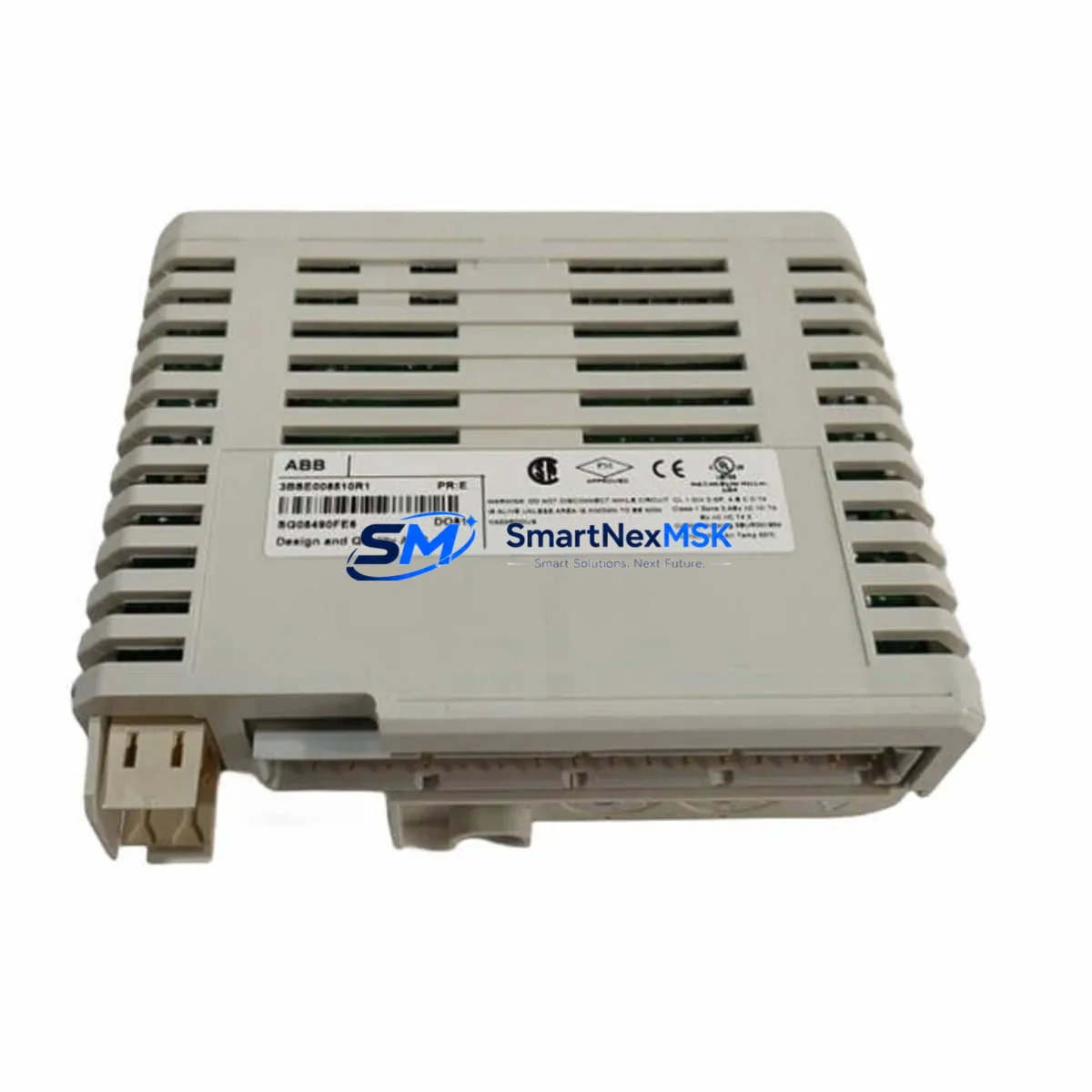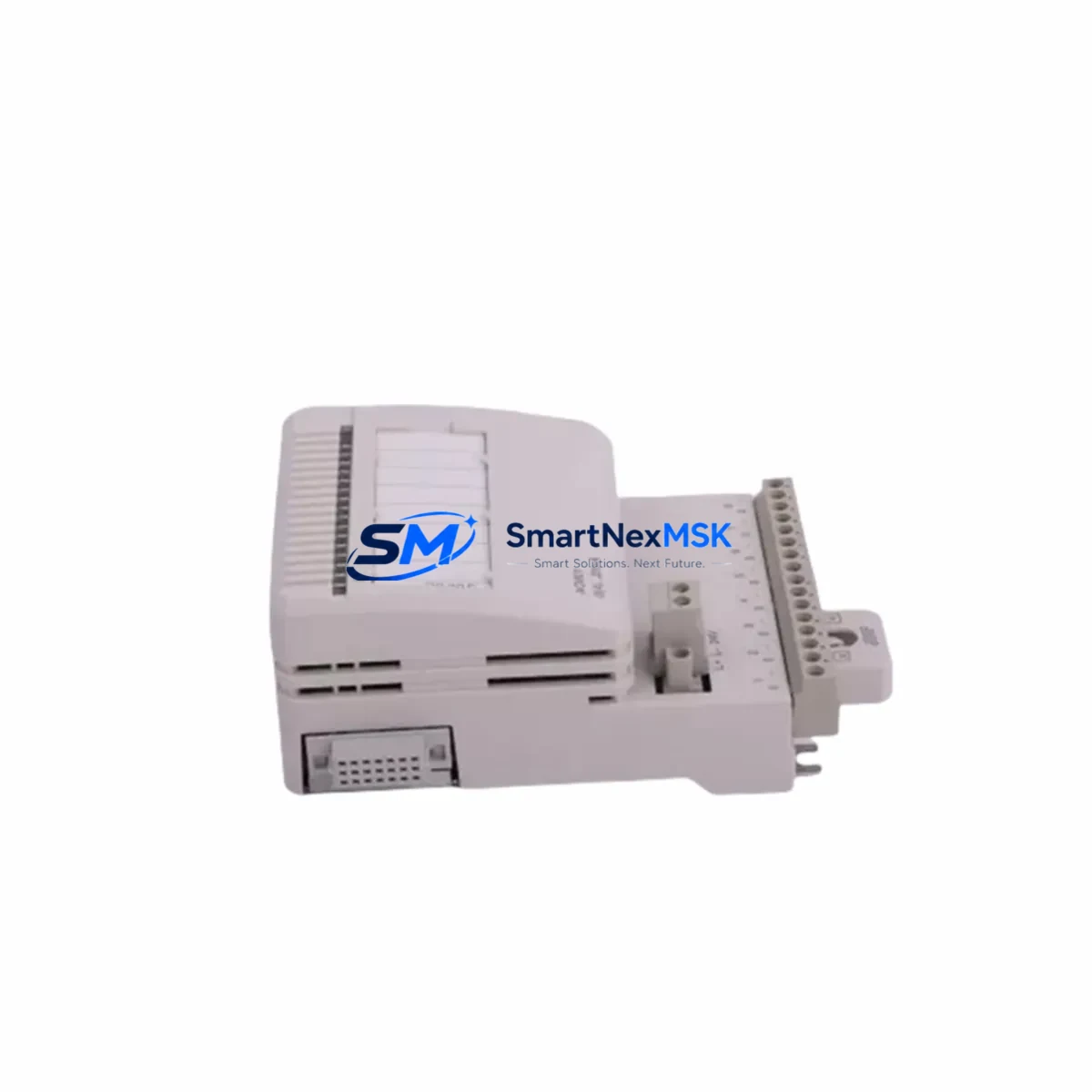
ABB AO801 3BSE020514R1 Maintenance-Ready Spare for S800 Automation
The ABB AO801 (catalog reference 3BSE020514R1) is an original analog output module engineered for the S800 I/O system and AC800M Distributed Control System platform. In process industries — oil & gas, power generation, pulp & paper, and chemical manufacturing — the AO801 drives 4–20 mA or 0–10 V analog signals to final control elements such as control valves, variable-speed drives, and positioners. Holding a verified spare unit on the shelf is the single most effective measure a maintenance team can take to eliminate unplanned downtime caused by analog output channel failure.
Every AO801 3BSE020514R1 unit dispatched by SMARTNEXMSK undergoes pre-shipment functional verification: channel-by-channel output accuracy, loop resistance tolerance, and communication handshake with the S800 bus interface module. Units are shipped in anti-static packaging with full traceability documentation and are covered by a 12-month warranty against manufacturing defects.
Spare Maintenance Table
| Parameter | Specification |
|---|---|
| Part Number | AO801 / 3BSE020514R1 |
| Manufacturer | ABB (Germany) |
| Module Type | Analog Output Module |
| Compatible Platform | S800 I/O System, AC800M DCS |
| Output Channels | 8 channels, individually configurable |
| Output Signal | 4–20 mA / 0–10 V (HART-capable channels) |
| Resolution | 16-bit D/A conversion |
| Supply Voltage | 24 V DC via S800 backplane / MTU |
| Isolation | Channel-to-channel and channel-to-bus galvanic isolation |
| Operating Temperature | 0 °C to +55 °C |
| Mounting | S800 I/O rail, plug-in module, hot-swap capable |
| Communication | S800 optical bus via TB820V2 or TB840A Bus Interface Module |
| Certifications | CE, UL, ATEX (zone 2 with appropriate housing) |
| Country of Origin | Germany |
| Warranty | 12 months from date of shipment |
| Pre-shipment Test | Full functional verification, channel accuracy, bus handshake |
| Typical Application | Control valve positioner drive, VFD speed reference, DCS analog loop |
Maintenance Planning for Continuous Operation
When a maintenance or reliability engineer schedules a planned outage to replace an AO801 3BSE020514R1, the replacement task should be treated as an opportunity to inspect the entire analog output loop and the surrounding control cabinet infrastructure. Experienced DCS maintenance teams follow a systematic checklist that extends well beyond the module itself.
Begin with the TB820V2 or TB840A Bus Interface Module — the optical communication backbone that connects the S800 I/O cluster to the AC800M controller. A degraded BIM can cause intermittent channel faults that are misdiagnosed as AO801 failures. Inspect the optical fiber connectors for contamination and verify the BIM firmware revision is compatible with the installed AC800M controller version.
Next, examine the SD802 or SD831 power distribution modules supplying 24 V DC to the S800 rail. Voltage sag under full load is a common root cause of analog output drift. Use a calibrated multimeter to confirm rail voltage is within ±1% of nominal before inserting the new AO801.
Check the MTU (Module Termination Unit) — specifically the TB810 or TB811 field termination assembly — for corroded screw terminals, loose wire ferrules, and insulation breakdown on field cables. A faulty MTU will cause the replacement AO801 to exhibit the same fault symptoms as the failed unit, leading to unnecessary repeat replacements.
For HART-enabled loops, verify that the CI854A or CI858 HART multiplexer module is communicating correctly with the field instruments. HART device descriptors should be re-read after the AO801 swap to confirm device recognition.
Inspect adjacent AI810 or AI820 analog input modules in the same I/O cluster. Analog input and output modules in the same process loop share common grounding references; a ground fault on an input channel can inject noise into output channels on the same rail segment.
Review the AC800M PM860 or PM864A processor module event log for any prior analog output channel alarms, watchdog resets, or communication timeouts that may indicate a systemic issue rather than an isolated module failure. Clearing historical alarms after a verified repair prevents false diagnostics during the next maintenance cycle.
For cabinets operating in high-humidity or coastal environments, inspect the cabinet door seals, anti-condensation heaters, and thermostat controllers. Moisture ingress is the leading cause of premature analog module failure in S800 installations outside climate-controlled control rooms.
Finally, update the spare parts register to reflect the consumed AO801 unit and initiate a replenishment order. Best practice for critical DCS analog output modules is to maintain a minimum of two units on-site: one installed spare and one sealed shelf spare. For multi-train facilities, a ratio of one spare per four installed modules is a widely adopted industry benchmark.
Site Replacement Workflow
The AO801 3BSE020514R1 supports hot-swap replacement on a live S800 I/O rail, provided the AC800M controller is in RUN mode and the affected channels have been placed in manual/fallback mode via the DCS operator station. The following workflow minimizes loop disturbance and reduces total replacement time to under 15 minutes for a trained technician.
Step 1 — Pre-replacement preparation: In the AC800M Control Builder or DCS operator interface, set all eight AO801 output channels to manual mode and confirm that downstream final control elements (valves, drives) have accepted the fallback setpoint. Document the current output values for post-replacement verification.
Step 2 — Module extraction: Release the AO801 locking lever and slide the module out of the S800 rail. The MTU field wiring remains connected throughout; no field cable disconnection is required for a standard module swap.
Step 3 — Replacement insertion: Insert the new AO801 3BSE020514R1 until the locking lever engages. The module will perform a self-test and establish communication with the BIM within approximately 10 seconds. Confirm the module status LED transitions from red/amber to green.
Step 4 — Channel verification: From the DCS engineering station, force each of the eight output channels to a known test value (e.g., 4 mA, 12 mA, 20 mA) and verify the corresponding field instrument reading. This step confirms MTU wiring integrity and module calibration.
Step 5 — Return to automatic: Release all channels from manual mode and confirm process control resumes normally. Log the replacement in the CMMS with the new module serial number and the date of installation.
This workflow is equally applicable when upgrading from an older AO801 revision to a current-production 3BSE020514R1 unit, ensuring backward compatibility with existing S800 rail configurations and AC800M application programs without requiring controller re-download.
Spare Parts Support FAQ
Q1: Is the AO801 3BSE020514R1 compatible with all AC800M controller revisions?
The AO801 3BSE020514R1 is compatible with all AC800M controller variants (PM860, PM861A, PM864A, PM866) when used with a TB820V2 or TB840A Bus Interface Module running firmware version 5.0 or later. For legacy installations using the TB820 (non-V2) BIM, confirm the BIM firmware revision before installation. SMARTNEXMSK can provide compatibility verification support prior to shipment.
Q2: What pre-shipment testing does each AO801 unit undergo?
Every unit is tested for channel-by-channel output accuracy across the full 4–20 mA range, loop resistance compliance, galvanic isolation integrity, and S800 bus communication handshake. A test report is available upon request. Units that do not pass all test criteria are not dispatched. The 12-month warranty covers all verified manufacturing defects identified after installation.
Q3: Can the AO801 replace older or discontinued ABB analog output module variants?
The 3BSE020514R1 is the current production revision of the AO801 and is a direct drop-in replacement for earlier AO801 revisions. It is not a direct replacement for AO810V2 or AO820 modules, which use different channel counts and termination configurations. If you are migrating from a non-AO801 module type, contact SMARTNEXMSK with your existing module part number for a compatibility assessment.
Q4: What is the recommended spare parts stocking strategy for S800 analog output modules?
For continuous-process facilities, the recommended minimum stock is one AO801 spare per control cabinet containing S800 I/O, with an additional pooled spare for every four installed AO801 modules across the plant. Spares should be stored in sealed anti-static bags in a climate-controlled environment (15–25 °C, <60% RH). SMARTNEXMSK offers long-term supply agreements and priority dispatch programs for facilities requiring guaranteed availability of critical DCS spare parts.
© 2026 SMARTNEXMSK. All rights reserved.
Original Source: https://smartnexmsk.com
Contact: [email protected] | +86 18259474341