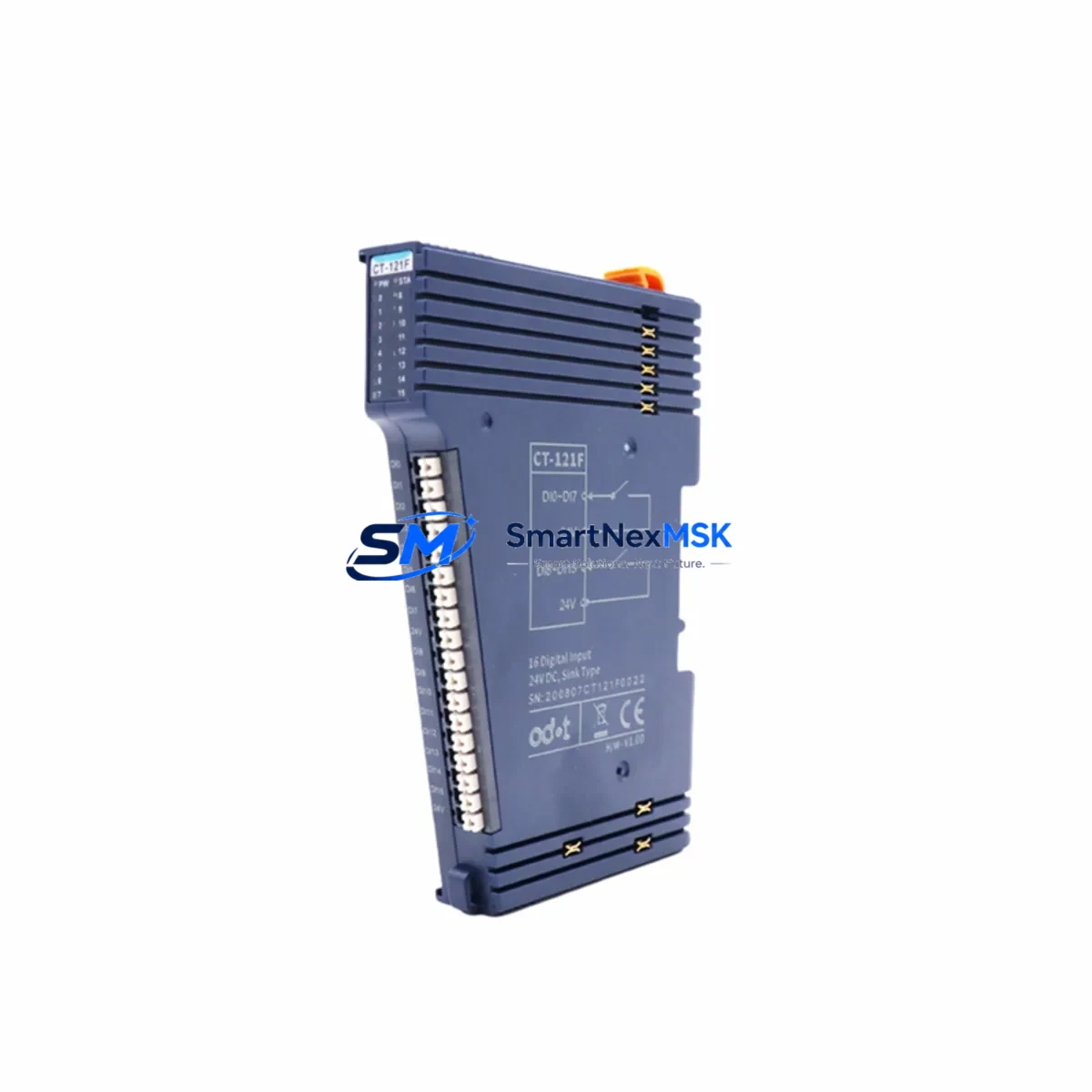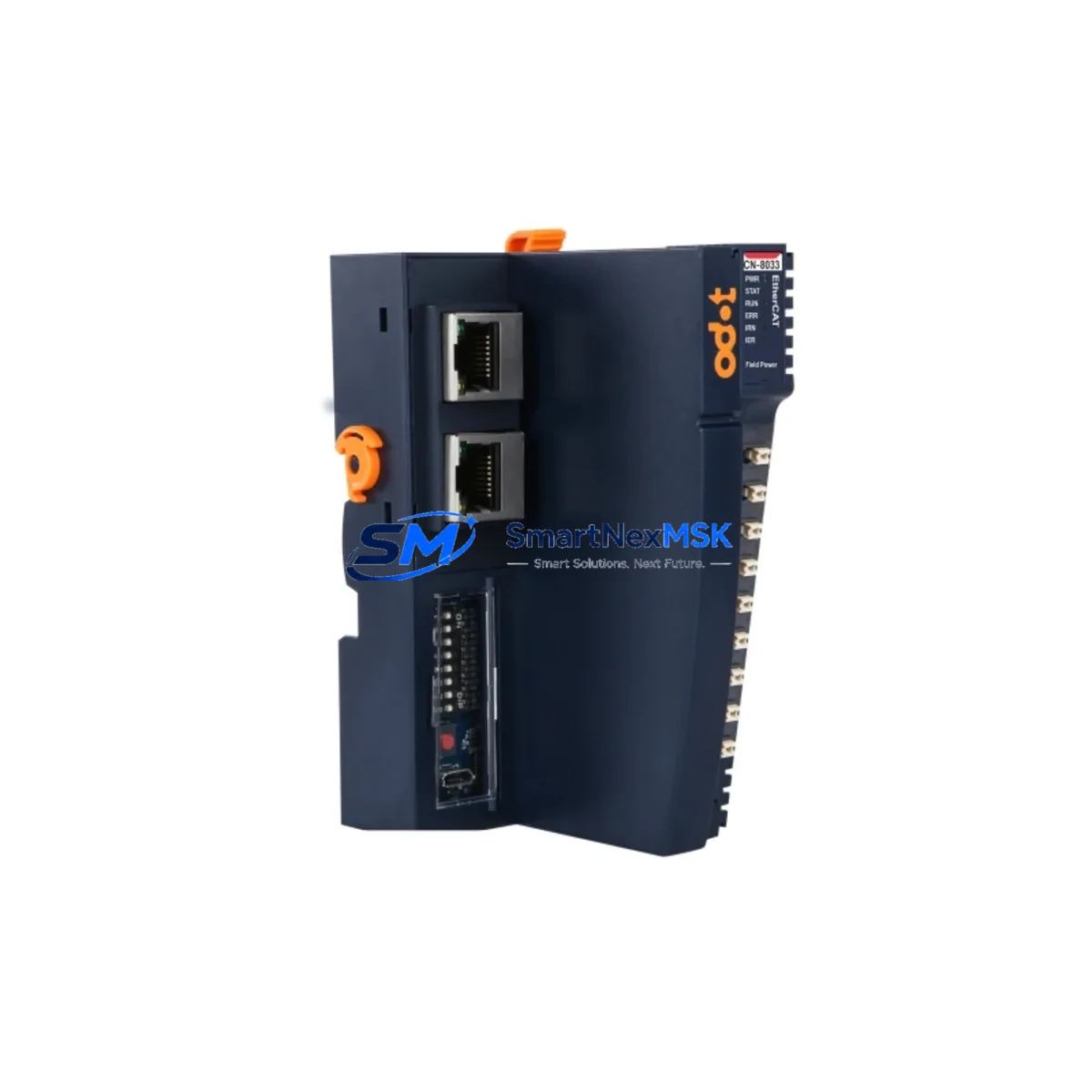
ODOT CT-4234 Maintenance-Ready Spare for CT Series Automation
The ODOT CT-4234 is a 4-channel analog output module designed for the ODOT CT Series distributed I/O platform. In industrial automation environments — from process manufacturing to discrete assembly lines — analog output modules are among the most maintenance-critical components in any control cabinet. A failed CT-4234 can interrupt 4–20 mA or 0–10 V command signals to variable-frequency drives, control valves, positioners, and proportional actuators, causing immediate process deviation or unplanned shutdown.
Sourced as an original ODOT spare part, the CT-4234 held in your maintenance inventory is your fastest path to downtime recovery. Each unit shipped by SMARTNEXMSK undergoes pre-shipment functional verification, is packaged in anti-static protection, and is backed by a 12-month warranty. Long-term supply continuity is maintained through direct sourcing relationships, ensuring availability even as CT Series hardware enters its extended lifecycle phase.
Spare Maintenance Table
| Parameter | Specification |
|---|---|
| SKU / Part Number | CT-4234 |
| Brand | ODOT Automation |
| Series | CT Series Distributed I/O |
| Module Type | Analog Output Module |
| Output Channels | 4 channels |
| Output Signal Types | 4–20 mA / 0–10 V (configurable per channel) |
| Resolution | 12-bit (typical for CT Series AO) |
| Power Supply | 24 V DC (via CT Series backplane bus) |
| Communication Interface | CT Series backplane (EtherCAT / Modbus RTU depending on coupler) |
| Operating Temperature | -20°C to +60°C |
| Protection Rating | IP20 (panel-mount, DIN rail) |
| Country of Origin | China (CN) |
| Compatibility | ODOT CT Series couplers and backplane assemblies |
| Installation | DIN rail, snap-fit onto CT Series bus coupler |
| Warranty | 12 Months — SMARTNEXMSK |
| Pre-shipment Test | Yes — functional output verification |
| Condition | Original, new-in-box |
Maintenance Planning for Continuous Operation
When a CT-4234 analog output module is flagged during a control cabinet inspection or fails during operation, experienced maintenance engineers know that the fault rarely exists in isolation. A systematic replacement workflow should extend beyond the module itself to cover the surrounding electrical circuit and system components.
Begin by verifying the 24 V DC bus power supply feeding the CT Series backplane — a degraded or undersized power supply is a common root cause of intermittent analog output faults. Inspect the CT Series bus coupler (such as the CT-1001 EtherCAT coupler or CT-1002 Modbus TCP coupler) for firmware version compatibility and communication health before inserting the replacement CT-4234. A coupler with corrupted configuration can cause a new module to report errors immediately after installation.
Check the CT-4114 or CT-4124 analog input modules in the same cabinet — in closed-loop control architectures, analog input and output modules share the same process loop, and a degraded AI module can mask or mimic an AO fault. Similarly, inspect any CT-2114 or CT-2124 digital output modules that share the same backplane segment, as backplane communication errors can affect multiple modules simultaneously.
For signal integrity, examine the field wiring terminals and terminal blocks connected to the CT-4234’s output channels. Corroded or loose terminals on 4–20 mA loops are a frequent cause of signal drift that is misdiagnosed as module failure. If the system uses signal isolators or loop-powered isolators between the CT-4234 and field instruments, verify isolator output range and power consumption — an overloaded isolator can clamp the analog signal below the expected range.
In systems where the CT Series rack communicates upstream to a host PLC or DCS via Modbus RTU or EtherCAT, confirm that the communication module’s process image mapping still correctly references the CT-4234’s channel addresses after module replacement. Incorrect address mapping after a hot-swap can result in the new module receiving no setpoint commands. If the control system includes an HMI panel with analog output trend displays, verify that the HMI tag database reflects the correct engineering unit scaling for the replacement module’s output range.
Finally, review the fuse or circuit protection on the 24 V supply rail. A blown fuse upstream of the CT Series backplane is often the first indicator of a short-circuit event that may have damaged the original CT-4234. Replacing the module without restoring proper circuit protection risks immediate re-failure.
Site Replacement Workflow
Step 1 — Isolate and document: Before removing the failed CT-4234, record the current channel configuration (output type, range, scaling) from the engineering workstation or coupler web interface. This prevents reconfiguration errors after replacement.
Step 2 — Power-down sequence: De-energize the CT Series backplane segment or the full rack if hot-swap is not supported by your coupler firmware version. Verify 0 V on the backplane bus before module removal.
Step 3 — Physical replacement: Disengage the CT-4234 from the bus coupler by releasing the locking tab and sliding the module off the DIN rail. Insert the replacement CT-4234, ensuring the backplane connector is fully seated. Re-engage the locking tab.
Step 4 — Restore and verify: Re-energize the backplane. Confirm the coupler recognizes the new module (LED status green, no error codes). Download or re-apply the channel configuration. Issue a known test setpoint (e.g., 12 mA / 5 V) and verify the field instrument responds correctly using a loop calibrator or multimeter.
Step 5 — Return to service: Resume automatic control. Monitor the first 15–30 minutes of operation for any signal instability. Log the replacement in the maintenance management system with the new module’s serial number and installation date.
This workflow minimizes mean time to repair (MTTR) and ensures the replacement CT-4234 is fully validated before the process returns to closed-loop control — reducing the risk of a second unplanned shutdown.
Spare Parts Support FAQ
Q1: Is the CT-4234 a direct drop-in replacement for older CT Series analog output modules?
Yes. The CT-4234 is designed for direct physical and electrical compatibility with the ODOT CT Series backplane. No hardware modification is required. Channel configuration parameters (output type, range) should be verified and re-applied after installation, as configuration is stored in the coupler, not the module itself.
Q2: How does SMARTNEXMSK verify CT-4234 units before shipment?
Each CT-4234 undergoes a functional output test prior to packaging. Output channels are verified across the full 4–20 mA and 0–10 V ranges. Units that do not meet specification are quarantined and not shipped. Test records are available upon request for quality-critical procurement.
Q3: What is the recommended spare parts stocking strategy for CT Series analog output modules?
For production-critical systems, we recommend maintaining a minimum of one CT-4234 per active backplane segment as a cold standby. For facilities with multiple CT Series racks, a shared pool of 2–3 units is typically sufficient to cover emergency replacement needs while a replenishment order is in transit. Long lead times from OEM channels make distributor stock essential for rapid response.
Q4: What does the 12-month warranty cover, and how is a warranty claim processed?
The 12-month warranty covers manufacturing defects and functional failure under normal operating conditions. It does not cover damage caused by incorrect installation, overvoltage, or physical impact. To initiate a warranty claim, contact SMARTNEXMSK with the order number, installation date, and a description of the failure symptom. Replacement units are dispatched upon claim approval, with failed units returned for analysis.
© 2026 SMARTNEXMSK. All rights reserved.
Original Source: https://smartnexmsk.com
Contact: [email protected] | +86 18259474341