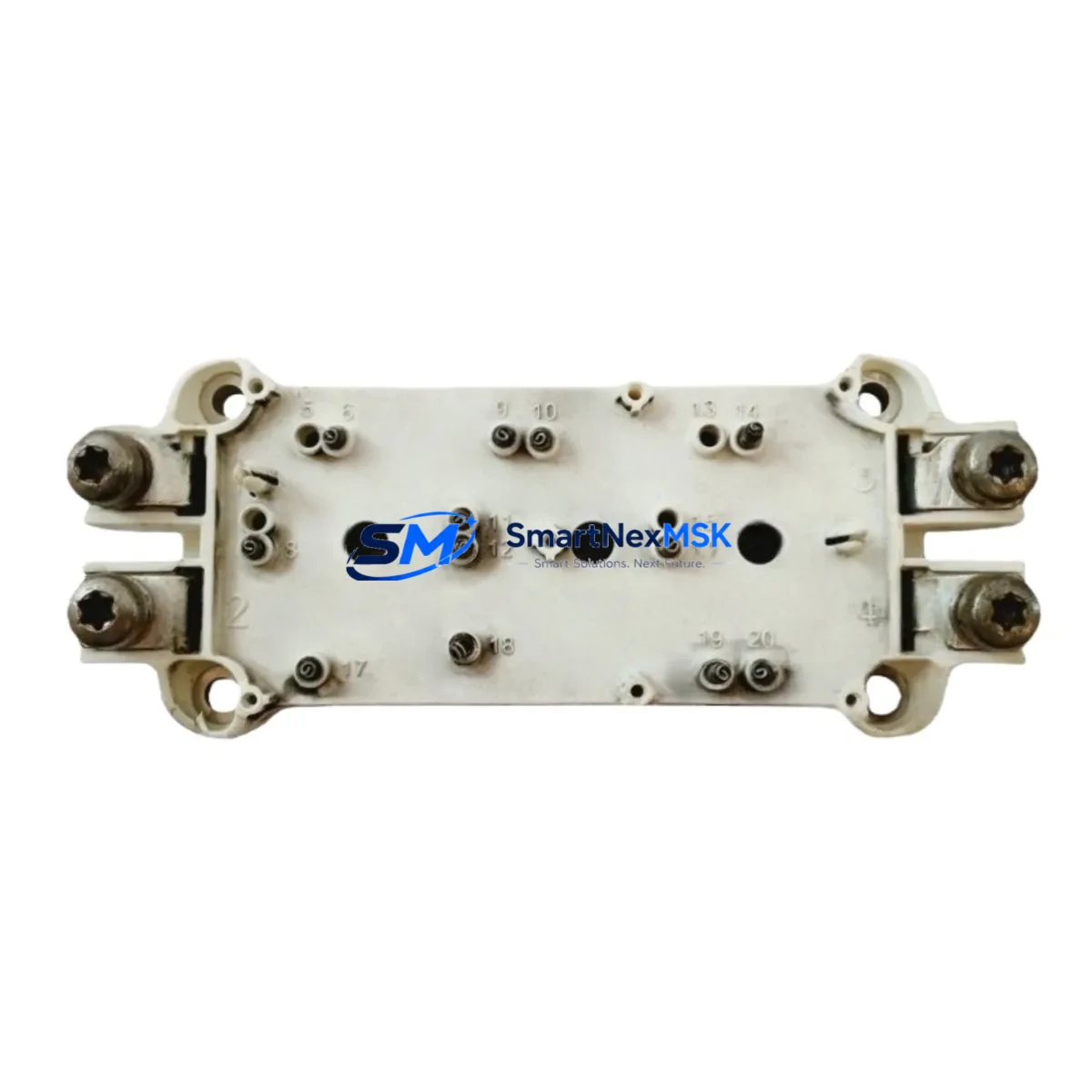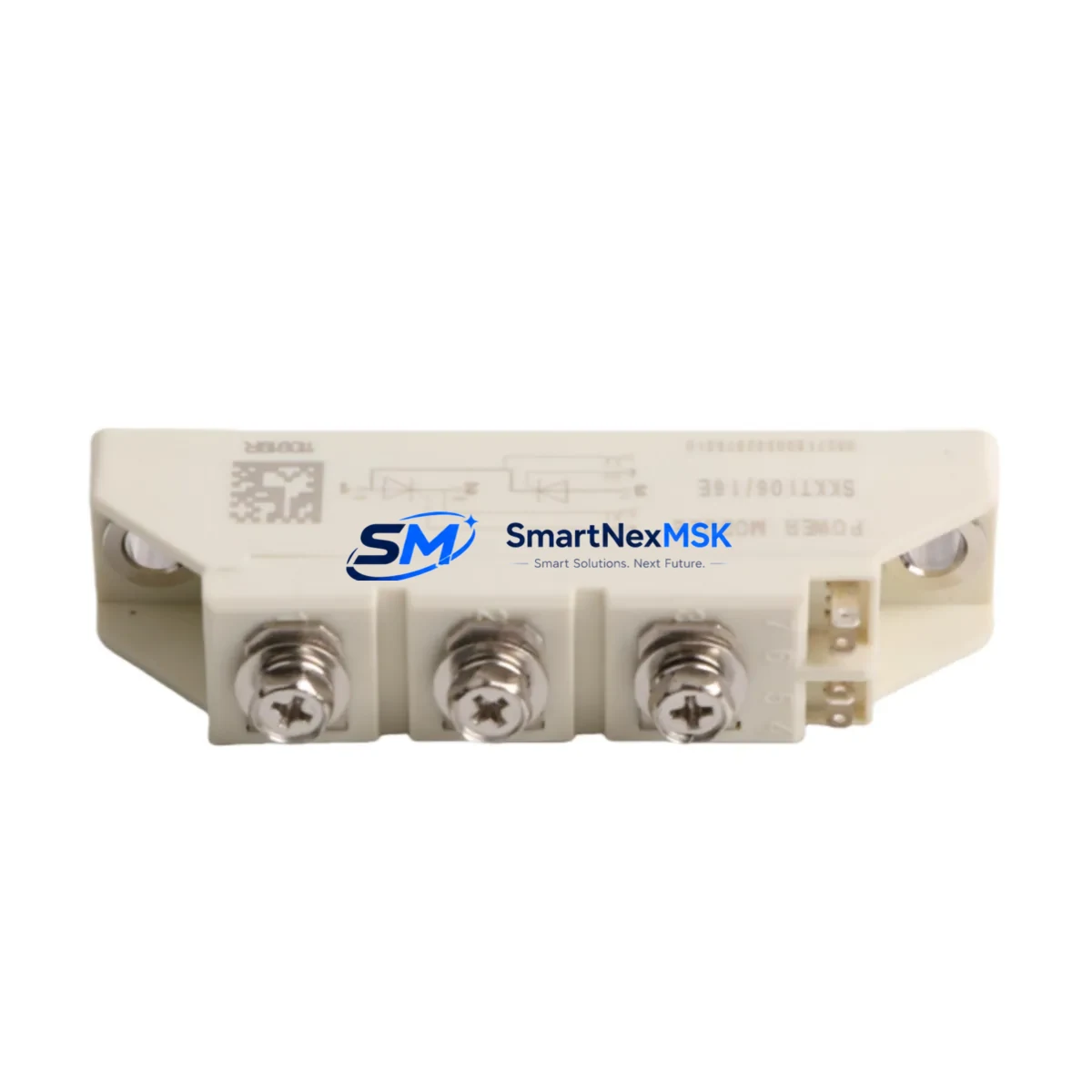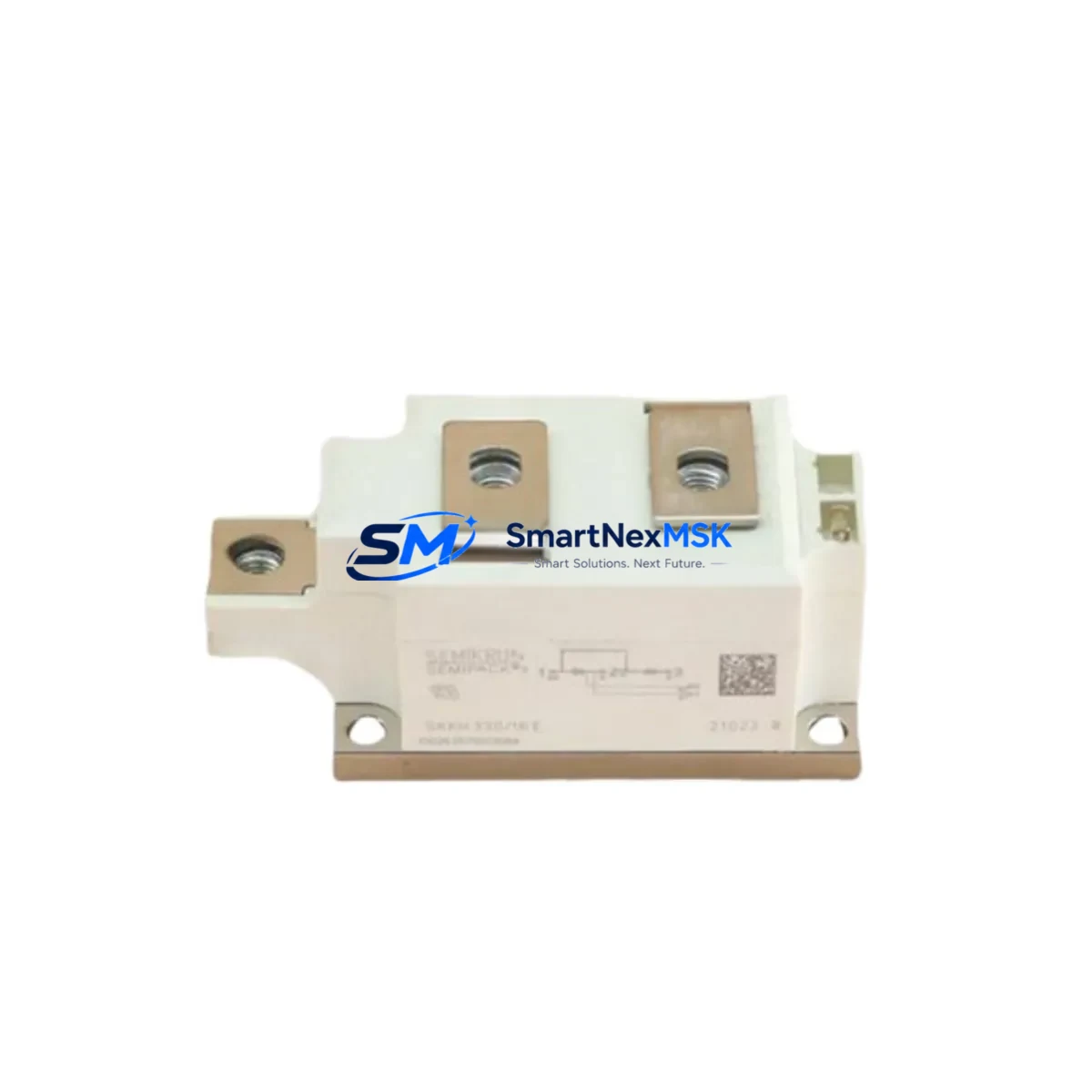
SEMIKRON SKKH330/16 Retrofit-Ready SCR Module for SKKH Series Control Systems
The SEMIKRON SKKH330/16 is a high-current SCR (Silicon Controlled Rectifier) thyristor module rated at 330A / 1600V, housed in the industry-standard SEMIPACK3 package. Designed for demanding industrial power conversion and motor drive applications, this module serves as a verified drop-in retrofit replacement for legacy SKKH Series assemblies that have reached end-of-life or are no longer supported under active production schedules. Whether you are managing a planned system upgrade or responding to an unplanned component failure on an active production line, the SKKH330/16 provides the electrical and mechanical compatibility required to restore full system operation with minimal engineering rework.
Industrial facilities operating older rectifier bridges, DC motor drives, crane control systems, and electrochemical process lines frequently encounter the challenge of sourcing discontinued power semiconductor modules. The SKKH330/16 addresses this directly by maintaining dimensional compatibility with the SEMIPACK3 footprint, allowing direct substitution into existing heatsink assemblies without mechanical modification. Engineers responsible for retrofit planning should verify the gate trigger current requirements against the existing firing board — SEMIKRON’s SKT and SKKH families share similar gate characteristics, but confirmation against the original drive circuit schematic is recommended before commissioning.
Upgrade Compatibility Table
| Parameter | SKKH330/16 Specification | Retrofit Notes |
|---|---|---|
| Package Type | SEMIPACK3 | Direct fit into existing SEMIPACK3 heatsink slots; no mechanical modification required |
| Repetitive Peak Reverse Voltage (VRRM) | 1600V | Confirm AC supply voltage and surge margin before substitution |
| Average On-State Current (ITAV) | 330A | Verify thermal derating at actual operating ambient temperature |
| Gate Trigger Current (IGT) | ≤150mA (typ.) | Check compatibility with existing firing board output stage |
| Mounting Interface | Screw-mount, M6 terminals | Torque to SEMIKRON specification; re-apply thermal compound |
| Communication Compatibility | N/A (power module) | Firing signal interface via existing thyristor drive board |
| Replacement Scope | SKKH330/16, SKKH330-16, legacy SKKH Series | Cross-reference against original BOM part number before ordering |
| Warranty | 12 Months | Covers manufacturing defects; includes pre-shipment functional test report |
Retrofit Planning for Existing Automation Systems
A successful retrofit of the SKKH330/16 into an existing control system requires a structured approach that addresses both the power circuit and the surrounding control architecture. In most legacy DC drive cabinets, the thyristor module operates alongside a SEMIKRON SKT330/16 or similar SCR in a back-to-back anti-parallel configuration for four-quadrant operation. Before removing the failed module, document the existing wiring layout, terminal torque values, and heatsink surface condition.
The firing board — often a SEMIKRON SKHI22A or equivalent thyristor gate driver — must be inspected for output integrity. A degraded gate driver can cause premature failure of a newly installed module, so replacing or bench-testing the driver in parallel with the power module swap is strongly recommended. In systems where the drive controller is a legacy analog or early digital platform, engineers should also audit the DC bus capacitor bank and the AC input fusing to ensure they remain within specification for the restored current rating.
For systems integrated with older PLCs or DCS platforms, the retrofit window also presents an opportunity to evaluate the control signal interface. Many legacy installations use 4–20mA analog speed references routed through terminal blocks to the drive’s reference input. Verifying signal integrity and ground loop isolation at this stage prevents nuisance trips after recommissioning. Where the existing drive controller communicates via RS-485 Modbus RTU or a proprietary fieldbus, confirm that the replacement module’s installation does not disturb the communication cable routing or introduce ground potential differences that could corrupt the data link.
In multi-drive installations — such as those using a common SEMIKRON SKKD 46/16 rectifier bridge on the AC input side — the shared DC bus voltage must be monitored during the retrofit to prevent back-feeding into the module under replacement. Isolating the affected drive section using the appropriate DC bus contactor or disconnect switch is mandatory before any module handling. Systems using SEMIKRON MCC95-16io1 or similar thyristor assemblies in parallel configurations require particular attention to current sharing balance after module replacement.
Terminal block re-termination should follow the original wiring diagram precisely. In high-current applications, even minor deviations in conductor routing can introduce inductive asymmetry that affects current sharing between parallel thyristor paths. After mechanical installation and wiring, a cold insulation resistance test between power terminals and the heatsink (chassis ground) should be performed before energizing the system.
Downtime Control During System Migration
Minimizing production downtime during a thyristor module replacement requires pre-staging all replacement components before the maintenance window begins. For the SKKH330/16, this means having the module, thermal interface compound, torque wrench, and a verified spare firing board available on-site before the line is taken offline. In facilities operating continuous processes — such as electroplating, aluminum smelting, or paper mill drives — even a two-hour unplanned outage carries significant cost, making pre-verified spare inventory a critical operational asset.
The original PLC or DCS program logic does not require modification for a like-for-like thyristor module replacement. The control program’s speed reference ramps, current limit parameters, and fault response logic remain valid provided the replacement module’s electrical characteristics fall within the original design envelope. Engineers should, however, perform a controlled low-speed run test before returning the drive to full production load, confirming that the firing angle response, current feedback signal, and thermal sensor readings are all within expected ranges.
Where the retrofit is part of a broader system modernization — for example, migrating from an analog drive controller to a digital platform such as a Siemens SINAMICS DCM or equivalent — the thyristor module replacement can be sequenced as the first step, restoring immediate production capability while the control system upgrade is planned and executed in a subsequent maintenance window. This phased approach protects production continuity and allows the engineering team to validate the new control platform in a parallel test environment before cutover.
Pre-shipment functional testing of the SKKH330/16 is performed at our facility prior to dispatch. Each unit is tested for forward voltage drop, gate trigger response, and leakage current, with results documented in a test report that ships with the module. This eliminates the risk of installing a latent-defective component and provides baseline data for future condition monitoring comparisons.
Retrofit Support FAQ
Q1: Is the SKKH330/16 a direct replacement for the SKKH330-16 and other SKKH Series variants?
Yes. The SKKH330/16 and SKKH330-16 are the same module with equivalent electrical ratings and SEMIPACK3 mechanical dimensions. It is compatible with all standard SKKH Series heatsink assemblies and firing board interfaces. Always cross-reference the original part number from your BOM or nameplate before ordering to confirm the voltage class and current rating match your application.
Q2: What commissioning checks are required after installing the SKKH330/16?
After mechanical installation and wiring, perform an insulation resistance test, verify gate trigger signal continuity from the firing board, and conduct a no-load energization test before applying full production current. Confirm heatsink temperature rise during the initial loaded run and compare against the original thermal baseline. Any deviation from expected temperature rise may indicate insufficient thermal compound application or heatsink surface contamination.
Q3: Can the SKKH330/16 be used in parallel configurations to increase current capacity?
Yes, parallel operation is supported, but requires careful attention to current sharing. Modules used in parallel should be from the same production batch where possible to minimize threshold voltage variation. External current-sharing inductors or matched gate resistors may be required depending on the original system design. Consult the SEMIKRON application note for parallel thyristor operation before proceeding.
Q4: What does the 12-month warranty cover, and what documentation is provided?
The 12-month warranty covers manufacturing defects in materials and workmanship from the date of shipment. Each unit ships with a pre-shipment functional test report confirming gate trigger response, forward voltage drop, and leakage current measurements. Warranty claims require the original test report and a description of the failure mode. Field damage resulting from incorrect installation, overvoltage events, or thermal management failures is not covered under the manufacturing warranty.
© 2026 SMARTNEXMSK. All rights reserved.
Original Source: https://smartnexmsk.com
Contact: [email protected] | +86 18259474341