
Cabinet Fan Spares: Check Airflow Under Resistance
Separate free-air ratings from installed duty when qualifying cabinet fan spares, filter assemblies and the evidence needed for acceptance.
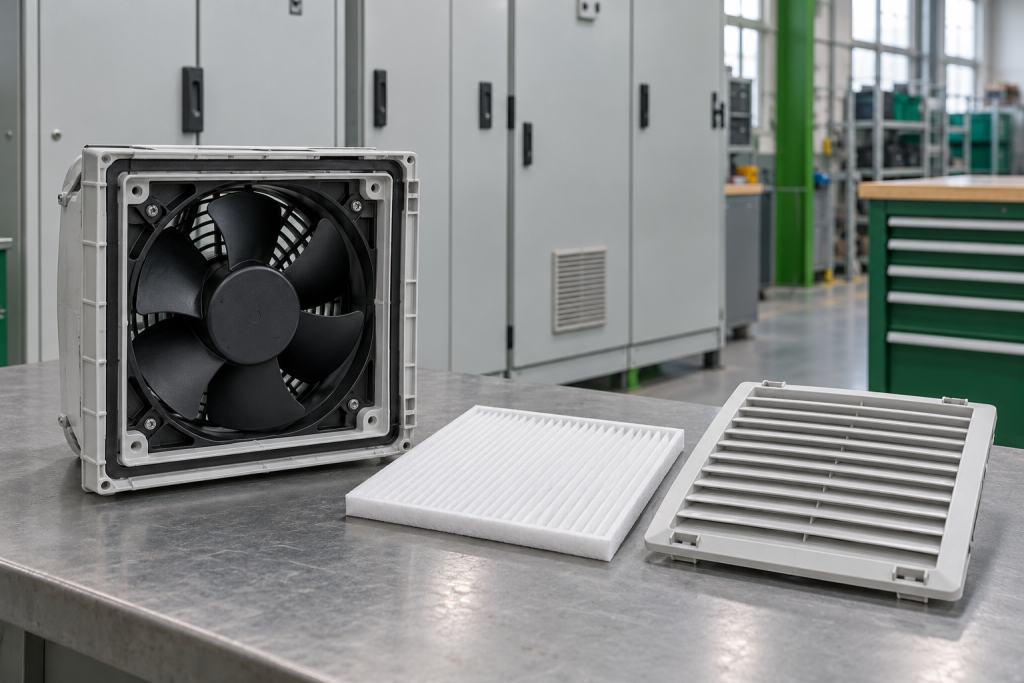
A cabinet fan spare can fit the opening, start normally and still leave the original cooling problem unresolved. A quotation showing only voltage, frame size and a large airflow figure does not establish what the replacement will deliver through the installed filter, grille and air path. For maintenance and procurement teams, the missing item is often the operating condition behind that figure.
Qualifying cabinet cooling fan spares therefore requires two connected records: the identity of the offered assembly and the conditions under which it must move air. Keep those records together before treating a substitute as an outage-ready replacement.
Separate free-air capacity from installed performance
ebm-papst’s fan-performance FAQ explains that filters and grilles introduce resistance. The installed operating point is where the fan performance curve meets the system resistance curve. A free-air figure is not that operating point, and a fan airflow curve must be read with its pressure conditions.
Ask the supplier to identify the exact curve, supply frequency and speed condition supporting the offer. Record whether the quoted flow describes a bare fan, a fan-and-filter assembly or a particular accessory combination. If the old equipment record contains only a free-air value, mark the installed-duty evidence as missing. Do not quietly turn an incomplete record into an accepted requirement.
Define the assembly that is actually being replaced
Separate enclosure ventilation from an internal drive, rack or equipment fan. Similar dimensions do not establish the same application. The spare request should show the complete nameplate, manufacturer designation, suffix, mounting arrangement and equipment location. Include photographs of the assembly and its connections taken under the site’s approved safe-access procedure.
For a fan-and-filter unit, list the housing, grille, filter insert, seals and outlet arrangement, not just the motor. For an internal equipment fan, retain the equipment manufacturer’s assembly reference and replacement instructions. State explicitly whether the offer includes a complete assembly or a component that still requires other approved parts.
The industrial cooling fan category is a sourcing starting point, not evidence that every listed fan suits a cabinet opening. Use the installed reference and manufacturer documentation to narrow the request before making a model-specific purchase decision.
Keep filtration inside the replacement decision
Rittal’s August 2024 filter-systems white paper distinguishes fan-and-filter units, which admit ambient air, from separated-circuit cooling arrangements. It also describes the trade-off between filter selection and air throughput. A filter fan replacement should therefore be reviewed as a combination, rather than judged by filter appearance alone.
Record the approved filter reference and the contamination conditions the cabinet faces. Ask whether an offered alternative changes the documented airflow or protection arrangement. Do not infer the enclosure’s protection rating from the fan motor’s rating. A visually similar insert or a finer-looking medium is not, by itself, evidence of an equivalent complete assembly.
Carry unresolved filter questions into the purchase approval. Removing a filter to make a spare appear more capable is not an acceptable substitute for qualification. Equally, a quotation should not promise a universal filter-change interval without the relevant operating and maintenance basis.
Compare electrical and monitoring requirements separately
Keep supply voltage, phase, frequency and permissible operating conditions on separate lines of the comparison. ebm-papst directs users to the model’s label, data sheet and instructions for voltage and frequency, and notes that not every fan accepts both 50 and 60 Hz.
Also request the exact connector assignment, control-input specification and alarm or speed-feedback functions where applicable. Matching the connector shell does not confirm the electrical interface. An unconnected monitoring lead can leave a replacement spinning while the control system still lacks its expected status signal. Any changed interface belongs in an engineering review, not an assumption made during ordering.
Make acceptance reproduce the agreed configuration
Before ordering, agree which evidence comes from the supplier and which must be established on site. A bench start check can support a limited functional observation; it does not prove the thermal performance of the assembled cabinet. Define the intended acceptance configuration, including covers, filters and the normal air path, in the approved site procedure.
Assign the responsible engineer, required operating conditions, temperature-observation locations, relevant equipment limits and response to an unsuccessful check. Keep manufacturer limits distinct from site acceptance criteria. No generic airflow, temperature or observation-time threshold can replace that application review. Installation and testing require qualified personnel following the equipment instructions and site isolation procedures, including stored-energy and unexpected-start hazards.
At receipt, preserve identity photographs, the referenced documents and any deviations alongside the automation spare receiving checklist. A clearly documented hold is more useful than a spare marked ready while its installed-duty evidence remains unresolved.
FAQ
Does a higher free-air rating prove a better replacement?
No. Compare the documented performance under the required resistance and configuration. A larger headline value does not close missing installed-duty evidence.
Is a spinning fan enough for acceptance?
No. It demonstrates only the observed function under that check’s conditions. Assembly suitability, monitoring and cabinet thermal acceptance remain separate responsibilities.
Can a similar filter insert be accepted by size alone?
No. Confirm the approved combination and its documented airflow and protection requirements. Physical fit does not establish equivalent filtration or assembly performance.
Should an internal drive fan be treated as a cabinet filter fan?
No. Identify the equipment-specific assembly and instructions. A drive’s internal cooling path is not automatically interchangeable with enclosure ventilation.
Prepare the spare review
Send the complete model, nameplate and assembly photos, any obsolete-part replacement requirement, and the required delivery date to [email protected] or WhatsApp/Phone +86 18259474341. Include the fan curve or original equipment reference when available, and distinguish exact replacement from a proposed alternative requiring engineering approval.
Route this topic into a sourcing request
Connect the article topic to a model number, category, brand, quantity, and destination before opening the RFQ.
Related Insights
Continue with sourcing and model matching guides
 Nov 28, 2026
Series 90-30 Spares: Check the RX3i Rack Boundary
Separate exact Series 90-30 spares from the verified RX3i rack, processor and retained I/O needed for a planned migration.
Read guide Nov 27, 2026
HMI Screen Spares: Identify the Failed Layer
Separate surface damage, touch input and the supported display assembly before specifying an HMI hardware spare.
Read guide Nov 26, 2026
Motor Brake Rectifier Spares: Match the Coil
Check the fitted brake coil and approved control function before treating a motor brake rectifier as an exact spare.
Read guide