
Series 90-30 Spares: Check the RX3i Rack Boundary
Separate exact Series 90-30 spares from the verified RX3i rack, processor and retained I/O needed for a planned migration.
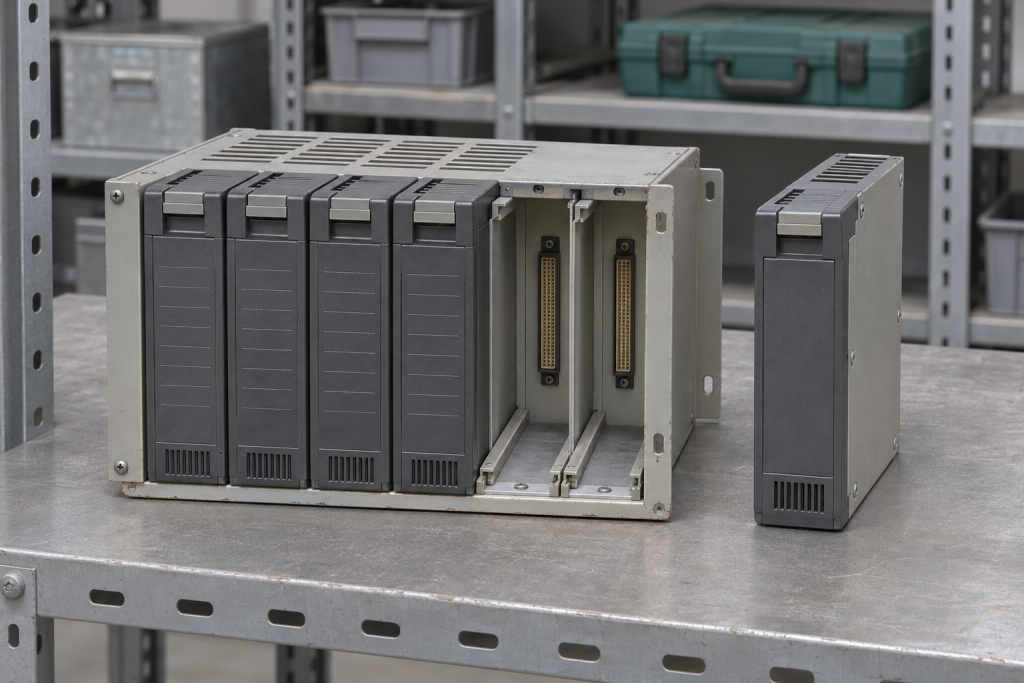
A failed controller leaves a plant with two different decisions: buy an exact spare for the old rack or advance the migration already on the maintenance plan. If a quote promises a newer RX3i CPU and says that Series 90-30 I/O can be reused, it is tempting to treat the upgrade as a CPU purchase. That leaves the most expensive question unanswered: which parts of the installed system would actually remain?
Plan Series 90-30 spares against the outage that they are meant to cover. A verified spare for the existing system can be useful while a conversion is being engineered. An RX3i migration quote needs a different bill of materials. The distinction matters even when both options name the same I/O cards.
Identify the rack that actually carries the CPU
Separate the CPU rack from every expansion or remote rack in the equipment record. For each legacy PLC backplane, record the full catalog number and hardware suffix, which supply feeds it, and what modules are fitted. Do not describe two baseplates as interchangeable simply because their photos show the same number of slots. The original GE Fanuc hardware manual GFK-0356Q distinguishes CPU, expansion and remote baseplates within the Series 90-30 family.
The original GE RX3i product information GFK-2420Q, available as a distributor mirror, illustrates the boundary for the IC695CMU310: the Series 90-30 main rack is not an RX3i rack, and a Series 90-30 CPU does not operate in an RX3i rack. The same document describes optional Series 90-30 expansion racks and supported legacy modules for that example. For the proposed CPU and module revisions, use the applicable hardware documentation rather than treating the example as a compatibility list.
Turn possible I/O reuse into a checked list
Put each installed module on its own line and record the proposed rack, the exact variant, and the manufacturer reference that supports that combination. Use the Emerson RX3i system manual entry and the processor-specific product information rather than a generic family description. For uncertain modules, mark the row unresolved. A short list of exceptions is easier to review than a paragraph saying that most cards will transfer.
Keep communication, motion and specialty modules visible in the list. A retained I/O card can have different dependencies from a retained application. Note the existing module roles, addressing and interfaces used by the plant, then ask the controls owner to define the required acceptance evidence. Pay particular attention to the parts that are hard to verify on an isolated bench. A recognized module on a bench is not proof that the receiving system, application and field device still agree on what a value or command means.
Put an end point on the like-for-like spare
When maintenance buys a spare to bridge the time to migration, agree what that time means. It may cover one planned outage or the period until a funded conversion is ready. Record the installed CPU and rack identity, the accepted software and backup environment, and the remaining risks if the spare is used. An exact part number makes the offer easier to evaluate but does not demonstrate that recovery files are current or available to the staff on call.
For the planned change, ask for a separate list of items to replace, retain conditionally or retire. Include the proposed CPU, backplane, power supply and every unresolved expansion or specialty item. The Emerson lifecycle services page treats migration as a system change. It is not a dated notice for each old catalog number. Verify any lifecycle date on the exact item with the manufacturer rather than applying a family-wide last-buy or support date.
Give every retained item an owner and every unresolved item a decision date. For example, if the catalog number of a remote baseplate is missing, the quote should show that retention is unconfirmed. Do not turn that blank into a purchasing assumption. Record which backup revision and rack drawing describe the installed system, and keep the proposed records separately. That makes discrepancies visible before the old hardware is no longer available as a reference.
Give purchasing two quote scopes
The first request should name the exact spare required to restore the existing rack and the documentation needed to accept it. The second should describe the target rack and the inventory that engineering proposes to reuse. Compare supplier exclusions against the rack list before releasing either order. Use the PLC CPU replacement RFQ checklist for identity and evidence fields, and the PLC and controller collection for sourcing inquiries. Neither is a cross-reference or a substitute for the plant’s acceptance decision.
Frequently asked questions
Can I install an RX3i CPU in the existing Series 90-30 main rack?
No for the processor covered by the cited GE example. For the actual migration, confirm the approved backplane and revision for the proposed CPU rather than inferring fit from the installed I/O family.
Does support for legacy I/O mean the whole old rack can stay?
No. The role of the rack matters, and individual modules have their own requirements. Inventory the main, expansion and remote racks separately before deciding what to retain.
Should I buy an exact Series 90-30 spare while migration is planned?
It can make sense if it covers a defined exposure and the team can restore the existing configuration. Keep that purchase separate from the migration order and set a date to review whether the spare remains useful.
Does a converted application prove the plant will run as before?
No. The controls owner still needs evidence that the retained hardware, application and plant interfaces behave as required. Set those acceptance criteria before committing to the conversion parts.
For help identifying a spare, send the CPU and rack model numbers, available nameplate photos, any discontinued-part replacement requirement and your required delivery date to [email protected] or WhatsApp/Phone +86 18259474341.
Route this topic into a sourcing request
Connect the article topic to a model number, category, brand, quantity, and destination before opening the RFQ.
Related Insights
Continue with sourcing and model matching guides
 Nov 27, 2026
HMI Screen Spares: Identify the Failed Layer
Separate surface damage, touch input and the supported display assembly before specifying an HMI hardware spare.
Read guide Nov 26, 2026
Motor Brake Rectifier Spares: Match the Coil
Check the fitted brake coil and approved control function before treating a motor brake rectifier as an exact spare.
Read guide Nov 25, 2026
Magnetic Flowmeter Spares: Keep the Sensor Record
Separate transmitter identity, sensor calibration and plant signal configuration before ordering magnetic flowmeter spares.
Read guide