
Magnetic Flowmeter Spares: Keep the Sensor Record
Separate transmitter identity, sensor calibration and plant signal configuration before ordering magnetic flowmeter spares.
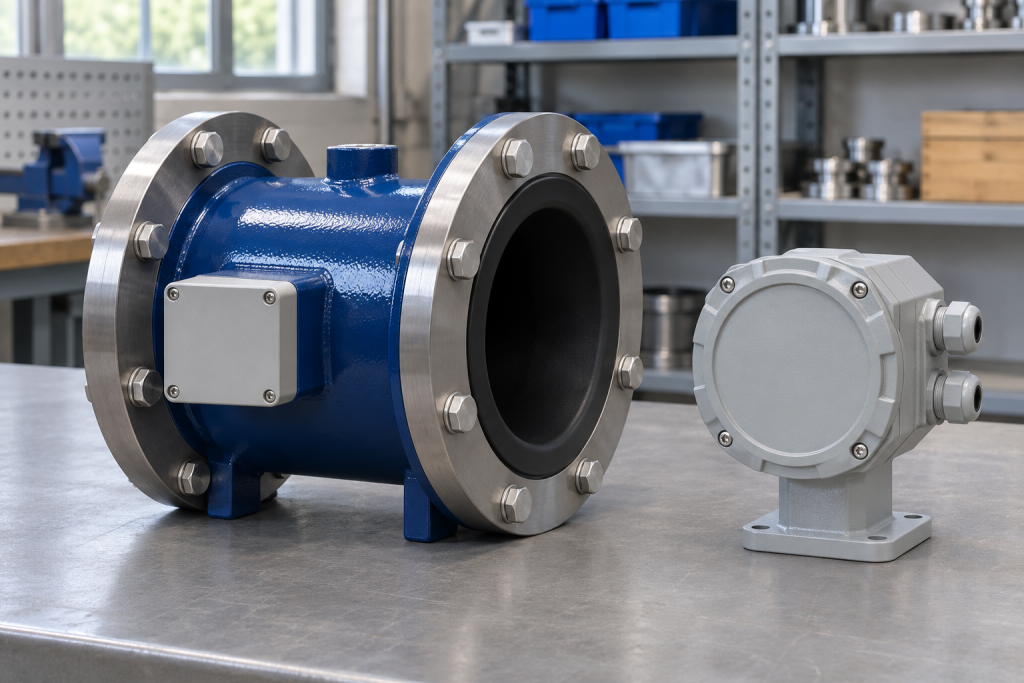
A magnetic flowmeter transmitter can fail while the sensor in the pipe is still serviceable. The purchasing decision sounds straightforward: buy the electronics and keep the wet end. The trouble starts when the quote names only the meter family and nobody can tie the installed sensor to its calibration record. A replacement that powers up and reports a plausible number is not, on that evidence alone, ready to be accepted as the same measurement.
Identify the sensor and transmitter separately
Start with the tag on the instrument register, then distinguish the two things that make up the measurement: the sensor in the process line and the transmitter that interprets its signal. On a compact assembly they may look like one purchasing item. A remote installation makes the split more obvious, but the transmitter enclosure can still carry a different order code and serial number from the sensor. Record both labels where they are accessible under the site’s procedures. If the quote covers a whole assembly, make the supplier say which components and records are included.
This distinction also changes the work scope. An electronics-only purchase may leave the existing sensor and process connections in place. A sensor change is also a process equipment change: the responsible engineer needs to review the lining, electrode materials, process connection, approvals and site requirements. Treat those as separate decisions. Do not use the transmitter’s enclosure or catalog family to infer the process-side specification.
Find the calibration record before ordering
Ask where the existing sensor’s calibration information is kept and what identifies it. For example, the Siemens MAG 5000/6000 operating instructions describe a sensor calibration certificate and calibration data stored in SENSORPROM memory. The Endress+Hauser Promag 10 replacement-sensor instructions list an S+T-DAT as part of specified sensor sets. Those examples explain why the record is worth asking for. They are not a rule that a memory device can be transferred between families or that every option uses the same replacement process.
In the purchasing file, distinguish three things: the existing sensor’s identity, its calibration evidence, and the manufacturer-approved way for the proposed combination to use that evidence. A loose memory device in a parts bin is not useful evidence without a link to the correct sensor. Likewise, a certificate for a donor sensor does not establish the calibration of the installed one. If the information cannot be tied back to the installed serial number, record the gap and ask the manufacturer or instrument owner to resolve it before treating the quote as an exact replacement.
Keep a separate record of how the plant uses the reading
Sensor calibration and plant signal configuration answer different questions. The first supports the measurement at the instrument. The second tells the control system what to do with the value. Keep the accepted flow range and units, totalizer meaning, output type, pulse meaning if used, and the receiving point in the PLC, DCS or historian. Record whether the control system applies a separate scale or uses a reported engineering value. Ask the site owner what happens to retained totals during the change; continuity is a separate acceptance decision.
For a planned outage, agree on what evidence will close the job: the matching instrument identity, the preserved or restored configuration, and an approved check that the control system interprets the value and total as intended. This is similar in principle to the pressure transmitter reference check: a signal can be valid in format while conveying the wrong measurement basis. A bench power-up alone does not test that basis in the plant.
Write the quote around what stays and what changes
For magnetic flowmeter spares, give suppliers a scope that lets them identify a mismatch before the purchase order. A short record can do the job:
- Retained equipment: instrument tag, installed sensor code and serial, transmitter code, compact or remote arrangement, and any options relevant to the existing configuration.
- Offered equipment: exact order code and revision where relevant, contents of the quote, and whether it is electronics only, a sensor set, or a complete assembly.
- Evidence and exclusions: supported pairing, what sensor-specific memory or certificate is supplied or retained, and any unresolved question about the receiving signal, approvals or acceptance.
Keep the supplier’s compatibility basis attached to the quote. Where the installed unit is Siemens, the Siemens automation parts collection is a starting point for sourcing inquiries; neither a brand match nor a series name proves that an offered unit is the right version. For a phased migration, preserve the old and proposed configurations separately so the receiver has an unambiguous baseline.
Frequently asked questions
Can I order a transmitter without changing the sensor?
Yes, where the manufacturer documents the combination and the sensor remains suitable for service. Confirm what is included in the offer and how the sensor’s calibration information will remain associated with it. A similar display or housing is not enough.
Is a calibration certificate enough for a flowmeter transmitter replacement?
No. The certificate helps identify the sensor’s calibration basis; it does not establish the transmitter variant, required approvals, PLC scale, or totalizer behavior. Those points need their own review.
Should a remote spare include the sensor cable and connection housing?
Only if the chosen replacement scope and manufacturer documentation call for them. Ask the supplier to list the included items and identify any retained accessory explicitly. A cable, housing and a transmitter are not interchangeable line items.
Can a complete replacement avoid a missing sensor record?
A properly documented matched assembly can provide a new calibration record. It does not eliminate the need to check process fit, signal interpretation or the plant’s acceptance requirements. Where the instrument has a regulated or protective role, refer the selection to the responsible site authority.
For help identifying a spare, send the sensor and transmitter model numbers, clear nameplate photos, any discontinued-part replacement requirement and your required delivery date to [email protected] or WhatsApp/Phone +86 18259474341.
Route this topic into a sourcing request
Connect the article topic to a model number, category, brand, quantity, and destination before opening the RFQ.
Related Insights
Continue with sourcing and model matching guides
 Nov 28, 2026
Series 90-30 Spares: Check the RX3i Rack Boundary
Separate exact Series 90-30 spares from the verified RX3i rack, processor and retained I/O needed for a planned migration.
Read guide Nov 27, 2026
HMI Screen Spares: Identify the Failed Layer
Separate surface damage, touch input and the supported display assembly before specifying an HMI hardware spare.
Read guide Nov 26, 2026
Motor Brake Rectifier Spares: Match the Coil
Check the fitted brake coil and approved control function before treating a motor brake rectifier as an exact spare.
Read guide