
Pressure Transmitter Spares: Check the Reference
Keep pressure reference, range and plant interpretation together when identifying a pressure transmitter spare. Matching the output alone does not prove equivalence.
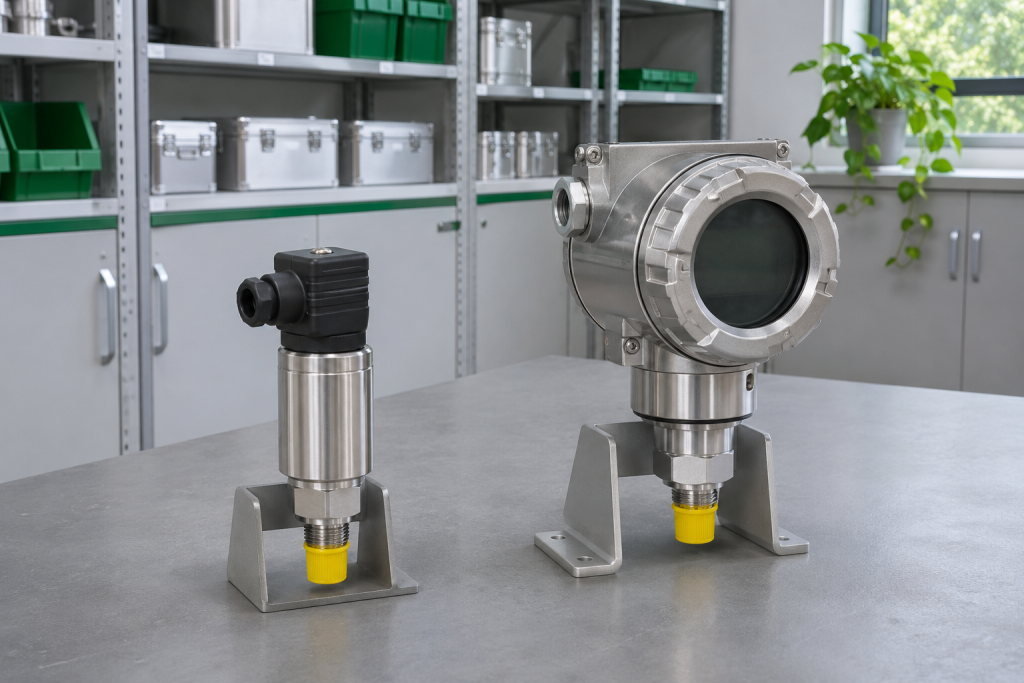
A request for a pressure-transmitter spare can look complete: the range is listed, the thread matches and the output is correct. Yet the replacement can still describe a different physical condition if its pressure reference is wrong. A number without its reference is an incomplete purchasing requirement, even when the connector and display look familiar.
For pressure transmitter spares, capture whether the approved measurement is gauge, absolute or another explicitly defined type before comparing candidates. This is an identification and procurement review, not a procedure for venting a process, adjusting a transmitter or changing a control loop.
Put the reference beside the range
WIKA’s explanation of pressure references defines gauge pressure relative to the prevailing atmospheric pressure and absolute pressure relative to an ideal vacuum. These are different reference points, not alternative names for the same instrument range. The distinction belongs in the equipment record and the quotation.
Write the pressure type alongside the engineering unit, lower and upper range values, and complete model code. Do not rely on an isolated number copied from a screen or an old spreadsheet column. If the reference is unclear, mark it as unresolved and obtain the approved instrument specification, manufacturer documentation and plant configuration record.
The existing sensor identity and interface checklist helps organize nameplate and connection evidence. Add the pressure reference explicitly; a general sensor description cannot settle it.
Separate unit conversion from reference conversion
Changing between pressure units does not establish a change between gauge and absolute pressure. Emerson’s gauge-versus-absolute pressure guide expresses the relationship using atmospheric pressure as an additional term. The reference must therefore be known as well as the unit before two readings can be meaningfully compared.
Do not resolve a spare mismatch by adding a convenient fixed offset to the PLC or display. That would be a change to the measurement chain, not evidence that the supplied hardware matches the original requirement. Any proposed conversion or compensation belongs in a documented engineering review, including the source of the reference information and the effects on dependent functions.
For procurement, keep the request simple and explicit: exact replacement against the approved pressure type, or an alternative awaiting engineering acceptance. The latter should not quietly become the former because a quotation uses the same unit.
Follow the measurement through the system
The transmitter is only one part of the pressure record. Confirm what the control system expects at the assigned input, what the operator display describes, and which calculations or alarms use the value. Keep the approved scaling and configuration evidence with the instrument identity rather than relying on a remembered screen label.
Ask the responsible engineer whether any dependency assumes a particular pressure reference. Record the answer before evaluating a substitute. A signal that appears plausible does not prove the correct physical interpretation, and a matching electrical output does not establish measurement equivalence.
Do not infer the reference from the shape of a housing, a similar family name or the presence of a digital display. Where a device has configurable functions, identify the exact supported capabilities and approved configuration from its own documentation. This guide does not claim that software settings can turn every pressure sensor into another measurement type.
Keep the remaining compatibility checks separate
Confirming gauge versus absolute pressure does not complete the replacement review. Record the process connection, wetted materials, pressure and temperature requirements, electrical supply, output or protocol, mounting arrangement and applicable approvals. Keep the exact installed order code separate from a shorter family designation.
For a pressure transmitter replacement, distinguish the manufacturer’s available measuring capability from the installed configured range and the site’s required operating conditions. Do not treat a supplier’s broad family description as evidence that the offered variant covers every option. Obtain the documentation for the actual candidate and retain unresolved differences.
Use the industrial sensor sourcing category to organize an enquiry once the measurement requirement is defined. No particular catalog model is endorsed here: a generic instrument class cannot establish the correct reference, full order identity or suitability for a specific installation.
Define acceptance evidence before ordering
A useful purchase record identifies the required pressure type and range, the offered full model, the supporting manufacturer document and the person responsible for resolving differences. Include a clear photograph of the supplied nameplate and the configuration information the site requires. Keep quotation assumptions visible until they are accepted.
If calibration or functional evidence is requested, require its scope to identify the supplied unit, the measurement reference, the conditions checked and any limitations. A certificate heading or an unqualified statement that the item was tested does not prove compatibility with the plant’s approved measurement chain.
Installation, isolation, depressurization and commissioning remain under qualified site procedures and the actual equipment instructions. Do not open a pressure connection or alter a reference arrangement to identify an unknown spare. Where records disagree, hold the sourcing decision for clarification rather than using a live process as a test.
FAQ
Does the same pressure range mean two transmitters are interchangeable?
No. Confirm the reference and complete variant first, then review mechanical, material, electrical, environmental and configuration requirements against the installation.
Can changing the displayed unit resolve a gauge-versus-absolute mismatch?
No. A unit change and a reference change are different questions. Any proposed conversion needs an approved engineering basis, not an assumed offset.
Does a matching output prove that the measured pressure type is correct?
No. Electrical compatibility is one requirement. Preserve separate evidence of the pressure reference, configured range and intended interpretation by the control system.
What should happen if the nameplate and plant record disagree?
Record the discrepancy, preserve photographs and obtain the applicable manufacturer and plant documents. Do not approve a substitute or modify a live loop to hide the uncertainty.
Clarify the spare requirement
Send the complete model, nameplate photos, pressure reference, range, discontinued-part replacement need and delivery requirement to [email protected] or WhatsApp/Phone +86 18259474341. Identify any specification or configuration question still awaiting the responsible engineer’s confirmation.
Route this topic into a sourcing request
Connect the article topic to a model number, category, brand, quantity, and destination before opening the RFQ.
Related Insights
Continue with sourcing and model matching guides
 Nov 28, 2026
Series 90-30 Spares: Check the RX3i Rack Boundary
Separate exact Series 90-30 spares from the verified RX3i rack, processor and retained I/O needed for a planned migration.
Read guide Nov 27, 2026
HMI Screen Spares: Identify the Failed Layer
Separate surface damage, touch input and the supported display assembly before specifying an HMI hardware spare.
Read guide Nov 26, 2026
Motor Brake Rectifier Spares: Match the Coil
Check the fitted brake coil and approved control function before treating a motor brake rectifier as an exact spare.
Read guide