
Fuji IGBT Power Module Spares: Verify Before the Swap
When an inverter or industrial drive trips, the failed IGBT module is often treated as a simple order-line problem: read the label, find the same family, and replace it. That approach can turn a contained power-stage failure into a second failure during commissioning. An IGBT module is part of an electrical, thermal, mechanical, and protection […]
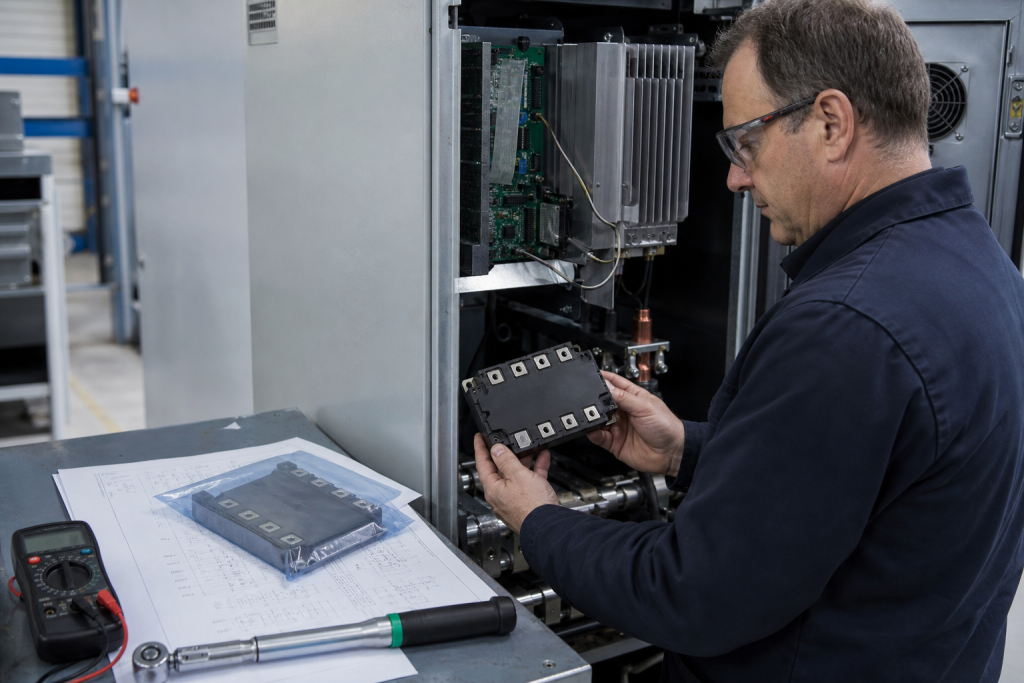
When an inverter or industrial drive trips, the failed IGBT module is often treated as a simple order-line problem: read the label, find the same family, and replace it. That approach can turn a contained power-stage failure into a second failure during commissioning. An IGBT module is part of an electrical, thermal, mechanical, and protection system. A close-looking package is not automatically a safe substitute.
Fuji Electric’s application material makes the same practical point from another angle. Module life depends on operating temperature changes, cooling, switching conditions, and the way the power stage is designed. For maintenance teams, the useful question is therefore not only “Can we find a Fuji module?” It is “Can we prove that this module belongs in this converter, and can we recover the evidence if the first replacement does not solve the outage?”
Start with the complete nameplate
Record the exact part number, suffix, lot or date code, package designation, and every visible marking before removing the failed device. Photograph the module, its terminal layout, the surrounding gate-drive board, and the heat-sink interface. Do not rely on a shortened warehouse description such as “75 amp Fuji IGBT.” Similar current or voltage labels can hide different internal topology, pin assignments, temperature sensing, isolation, or protection requirements.
The published Fuji Electric brand catalog provides broader sourcing context. For a model-specific reference, see the published Fuji Electric 6MBP75JA120 IGBT power module page. Treat the page as a model-specific starting point, then verify the installed drive documentation and the manufacturer data sheet before approval.
Four checks before ordering a replacement
1. Electrical and topology match
Compare voltage class, current rating, short-circuit capability, switching limits, diode arrangement, terminal assignment, and internal circuit topology. A six-pack, half-bridge, chopper, and braking module may share a similar housing while serving completely different positions in the circuit. Check the DC bus, output phase, brake, and neutral connections against the schematic. A higher headline rating does not repair a topology mismatch.
2. Gate drive and protection match
Verify gate threshold behavior, recommended gate resistance, isolation requirements, desaturation or over-current protection, thermistor connections, and the drive board’s fault logic. The IGBT module and gate driver form one switching system. A replacement that turns on or off differently can create excessive switching loss, false protection trips, or destructive overshoot even when the static voltage and current numbers appear acceptable.
3. Mechanical and thermal match
Check outline dimensions, terminal height, mounting-hole pattern, busbar clearance, isolation distance, heat-sink flatness, and the approved thermal interface material. Clean the heat sink and inspect it for distortion before installation. Record the torque method used for the module and busbar. Uneven pressure or a poor thermal interface can raise case temperature and shorten the life of the replacement. Do not treat thermal compound as a cosmetic detail.
4. Application and documentation match
Capture the drive model, firmware or control-board revision, motor data, load profile, switching frequency, ambient conditions, cooling method, and the reason for the original failure. Preserve the schematic, service manual, inspection photos, and test results in the maintenance record. If the original part number is obsolete, a documented cross-reference is more valuable than an unverified claim that a newer family is “equivalent.”
Use lifetime evidence correctly
Fuji Electric explains that IGBT module life is strongly affected by temperature gaps involving junction temperature and case temperature. Its application manual also describes power-cycling calculations and notes that multiple temperature-rise peaks in one operating cycle affect the resulting life estimate. This does not produce a universal calendar-life number for every drive. It gives engineers a way to investigate why modules fail early.
Before buying several spares, review the operating pattern. Look for high ambient temperature, blocked airflow, fan degradation, repeated acceleration and braking, overloads, high switching frequency, loose bus connections, and thermal cycling that is more severe than the original design assumption. If the failed module is replaced without correcting the stressor, the new module may become another short-lived spare.
Receiving inspection is part of the replacement plan
On receipt, match the full marking and package against the approved record. Inspect terminals, mold compound, mounting surfaces, connector interfaces, and the package for cracks, impact marks, corrosion, or rework signs. Keep the module in its original protective packaging, dry and clean, with its identity and inspection status visible. Store it with the correct handling controls for power semiconductors and do not mix unverified substitutes into a critical-spares bin.
For a plant spare, record the source, date received, photographs, inspection result, and the equipment asset to which the part is assigned. That evidence protects the outage team from discovering during an emergency that a visually similar module was never approved for the installed topology.
When a spare should become a redesign decision
A like-for-like spare is reasonable when the installed design is understood, the module is still supportable, the failure cause is controlled, and the replacement can be tested under an approved procedure. A redesign or drive replacement deserves review when the part is repeatedly unavailable, the gate drive is unsupported, the cooling system is degraded, the failure mode is recurring, or the installed converter has no defensible documentation.
Do not use one emergency replacement as proof that the entire power stage is modernized. Keep the decision separate: first restore the asset with a verified component if that is technically and procedurally acceptable, then evaluate whether the drive, control board, cooling, and protection architecture should be refreshed.
FAQ
Is a higher-current IGBT module always a safe replacement?
No. Current rating is only one part of the match. Topology, voltage class, gate-drive behavior, diode configuration, terminals, protection, and thermal characteristics must also agree with the installed design.
Can the part number alone prove compatibility?
It proves the identity of the candidate, not the complete application. Confirm the drive position, schematic, gate-driver board, cooling arrangement, and approved manufacturer data before installation.
Does a new module remove the need to investigate the failure?
No. Over-temperature, poor cooling, switching stress, loose connections, and protection faults can destroy the next module. Record and test the likely cause before returning the drive to service.
How should a spare be stored?
Keep it in protective packaging in a clean, dry, controlled store, with the full identity, source, inspection record, and assigned asset preserved. Follow the handling requirements for the specific power semiconductor.
When should procurement stop treating the issue as a normal spare?
Escalate when availability is unstable, documentation is incomplete, the control or gate-drive platform is unsupported, failures repeat, or the cooling and protection design no longer provides a reliable maintenance path.
Make the quote request useful
When requesting a Fuji IGBT power module spare, send the complete part number, clear nameplate photographs, drive model, quantity, delivery country, failure symptoms, and any available schematic or cabinet photo. For an exact model review, contact [email protected] or WhatsApp/Phone +86 18259474341.
Reference material: Fuji Electric IGBT application manuals; Fuji Electric IGBT lifetime FAQ; Fuji Electric revised and discontinued product information. Accessed 2026-09-02.
Route this topic into a sourcing request
Connect the article topic to a model number, category, brand, quantity, and destination before opening the RFQ.
Related Insights
Continue with sourcing and model matching guides
 Sep 8, 2026
SANYO DENKI QS1E Spares: Save Parameters First
When a SANMOTION Q axis stops, the purchasing request often becomes a model number: “Please quote QS1E01AA0H4A3P1T.” That is a useful starting point, but…
Read guide Sep 6, 2026
Yaskawa SGDH-05DE-OY Spares: Check the Servo Chain
A servo drive fault often produces a deceptively simple purchasing request: “Replace the SGDH-05DE-OY.” In a running machine, however, the amplifier is only one…
Read guide Sep 5, 2026
GE IS220PCLAH1A Spares: Check Mark VIe Fit
When a Mark VIe cabinet develops an intermittent control fault, the urgent request often becomes a single line: “Please quote IS220PCLAH1A.” That is understandable…
Read guide