
Yaskawa SGDH-05DE-OY Spares: Check the Servo Chain
A servo drive fault often produces a deceptively simple purchasing request: “Replace the SGDH-05DE-OY.” In a running machine, however, the amplifier is only one part of the motion chain. The motor, encoder or feedback device, incoming power, control command, mechanical load, cabling, and stored parameters all influence whether a replacement will restore motion or create […]
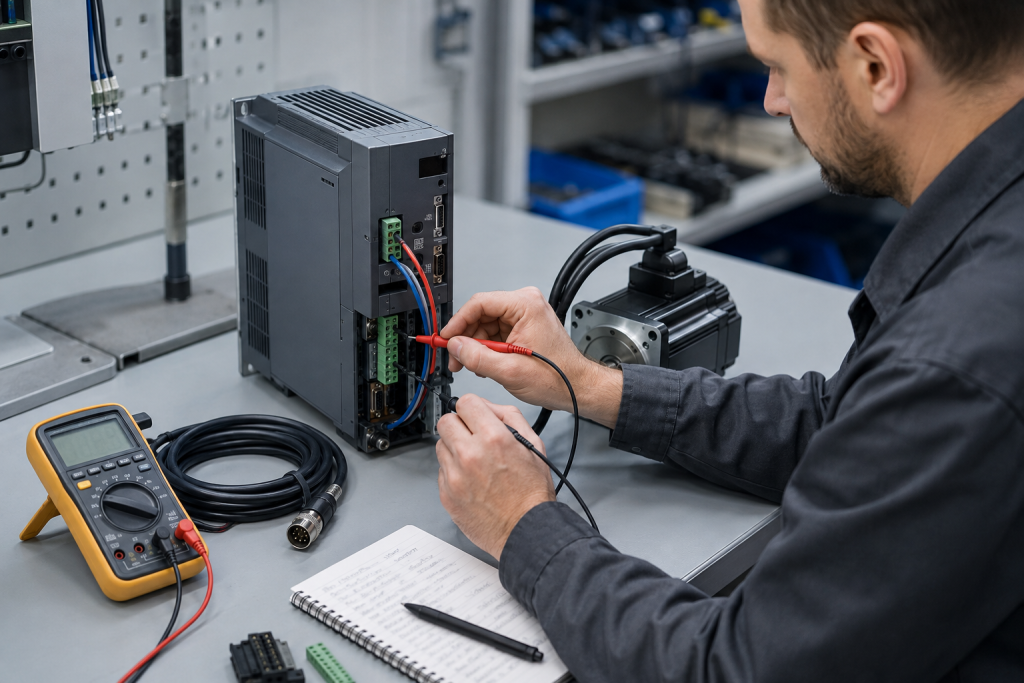
A servo drive fault often produces a deceptively simple purchasing request: “Replace the SGDH-05DE-OY.” In a running machine, however, the amplifier is only one part of the motion chain. The motor, encoder or feedback device, incoming power, control command, mechanical load, cabling, and stored parameters all influence whether a replacement will restore motion or create a second outage.
For maintenance and MRO teams, a Yaskawa SGDH-05DE-OY spare should therefore be handled as a controlled servo-system recovery task. The correct question is not only whether the same model can be found. It is whether the offered unit matches the installed electrical and feedback context, preserves the required parameters, and can be commissioned without guessing at the machine interface.
Start with the installed servo chain
Before removing the suspected drive, record the complete marking, revision, serial or lot information, cabinet position, incoming voltage, motor model, encoder or feedback type, command interface, brake arrangement, and alarm history. Photograph the drive label, connectors, terminal wiring, adjacent components, motor nameplate, and any display or keypad fault code.
Also identify the machine axis, gearbox or coupling, mechanical load, cable length, shielding and grounding practice, and the last known good parameter backup. A model number without the axis context can produce a technically similar quote that still fails during tuning, homing, or safety interlock checks.
The published Yaskawa SGDH-05DE-OY servo drive page is a model-level sourcing reference. The related Yaskawa SGMRV-05ANA-YR21 servo motor page can help connect the drive request to the motor side of the installed axis. Neither page replaces the machine drawing, parameter archive, or commissioning record.
Why a same-model swap can still fail
A servo system is a closed control loop. The drive receives a command, applies power to the motor, reads feedback, and controls position, speed, or torque against the machine load. A fault that appears inside the amplifier may also be related to feedback wiring, encoder noise, motor insulation, grounding, brake timing, overload, mechanical binding, or a parameter that no longer matches the axis.
Before approving the spare, separate the evidence into four checks:
- Identity: full model, revision, rating, connectors, and physical configuration.
- Electrical fit: supply, motor capacity, control voltage, grounding, brake, and protection.
- Feedback and command fit: encoder type, feedback cable, pulse or network command, and axis settings.
- Recovery evidence: parameter backup, alarm history, tuning record, and controlled test procedure.
This structure prevents the common mistake of treating “powers on” as proof of compatibility. The replacement must be checked against the complete axis and the machine’s intended operating sequence.
Protect the parameter record before the outage
Save the current drive parameters, motor data, gain and tuning values, origin or homing settings, limits, alarm history, and any controller-side axis configuration. Store the backup with the asset ID, axis number, drive model, motor model, feedback type, software or setup-tool version, and the date of capture.
Do not rely on a photograph of the display as the only backup. A photo may preserve an alarm code, but it does not preserve the complete configuration needed to restore the axis. If the machine has no verified parameter archive, make that gap visible in the RFQ and outage plan before accepting a replacement.
Use the Sigma-II documentation as a compatibility checklist
Yaskawa’s official Sigma-II documentation describes the servo system as a feedback-controlled arrangement involving the servo amplifier, servo motor, detector, and controlled machine. That system view is more useful than a catalog-only comparison because it directs the engineer to check the feedback path and load, not only the drive label.
Use the manual to confirm terminal functions, wiring requirements, alarm meaning, grounding, motor and feedback connections, and the commissioning sequence applicable to the installed equipment. Do not assume that a later setup tool, different cable, or different motor family will preserve the same behavior without a documented compatibility check.
Build an RFQ that can be tested
An effective SGDH-05DE-OY RFQ should include the complete model marking, revision, quantity, destination country, required delivery window, machine and axis identity, motor model, feedback type, incoming supply, failure symptoms, and parameter-backup status. Attach clear nameplate photographs and cabinet context photographs.
Ask the supplier to state whether the offered unit is new, repaired, refurbished, or used. Request the identification basis, inspection scope, functional test evidence, warranty terms, packaging condition, and any configuration responsibility. If the supplier cannot confirm the revision or test method, classify the unit as an unverified recovery option rather than a confirmed replacement.
Control the replacement and commissioning
On receipt, compare the full marking, connectors, mounting, packaging, and visible condition with the approved record. Inspect for corrosion, impact, contamination, bent pins, cracked housings, or evidence of rework. Photograph the received item before installation and keep its traceability tied to the machine axis.
During replacement, follow the approved isolation and discharge procedure. Check wiring and shield termination before energizing. Restore only the intended parameter set, then verify drive alarms, feedback direction, motor rotation, brake release, limits, homing, controller communication, and the machine’s controlled test sequence. Record the final parameter set and commissioning results.
When to move from spare to modernization
Escalate to a broader lifecycle or modernization review when parameter archives are missing, the same fault repeats, the motor or feedback device is no longer supportable, the drive has poor repair evidence, or the machine depends on a setup environment that cannot be recovered. A verified same-model spare can reduce immediate downtime, but it does not automatically create a reliable long-term support path.
Compare the cost and risk of controlled spare coverage, repair and refurbishment, a drive-and-motor replacement, or a wider axis retrofit. Keep the immediate recovery decision separate from the capital decision, but use the same evidence for both.
FAQ
Is every SGDH-05DE-OY listing interchangeable?
No. Confirm the complete marking, revision, electrical rating, feedback arrangement, command interface, parameter set, and machine-axis context before approval.
Should the motor model be included in the drive RFQ?
Yes. The motor, feedback device, brake, and load affect commissioning. A drive-only request can hide a mismatch that appears after energizing.
Can I replace the drive without the original parameters?
It may be possible, but it is a higher-risk recovery. Preserve the existing record where possible and plan a controlled re-commissioning process if the archive is incomplete.
Is a refurbished servo drive acceptable for an outage?
It can be considered when identity, revision, inspection scope, test evidence, warranty, and traceability are documented. Treat it as controlled recovery stock, not as proof of unlimited future availability.
What should accompany a quote request?
Send the full drive marking, motor and feedback details, axis identity, cabinet photographs, failure symptoms, parameter status, quantity, destination, and required delivery window.
Make the request actionable
For a Yaskawa SGDH-05DE-OY spare review, send the complete drive and motor markings, feedback details, cabinet and label photographs, parameter-backup status, quantity, destination country, and urgency. Contact [email protected] or WhatsApp/Phone +86 18259474341 for a model, evidence, and replacement review.
Reference material: Yaskawa SGDH Sigma-II documentation index; Yaskawa Sigma-II user manual. Accessed 2026-09-06.
Route this topic into a sourcing request
Connect the article topic to a model number, category, brand, quantity, and destination before opening the RFQ.
Related Insights
Continue with sourcing and model matching guides
 Sep 8, 2026
SANYO DENKI QS1E Spares: Save Parameters First
When a SANMOTION Q axis stops, the purchasing request often becomes a model number: “Please quote QS1E01AA0H4A3P1T.” That is a useful starting point, but…
Read guide Sep 5, 2026
GE IS220PCLAH1A Spares: Check Mark VIe Fit
When a Mark VIe cabinet develops an intermittent control fault, the urgent request often becomes a single line: “Please quote IS220PCLAH1A.” That is understandable…
Read guide Sep 4, 2026
B&R X20BC8084 Spares: Check Lifecycle Before Last-Time Buy
A failed X20 bus controller rarely arrives as a clean, isolated purchasing problem. The line may stop with one module fault, but the recovery…
Read guide