
Mining and Metals Automation Spares: A Remote-Site Planning Guide
Plan mining and metals automation spares around dust, heat, remote logistics, long shutdowns, exact-model risk, testing, and recovery windows.
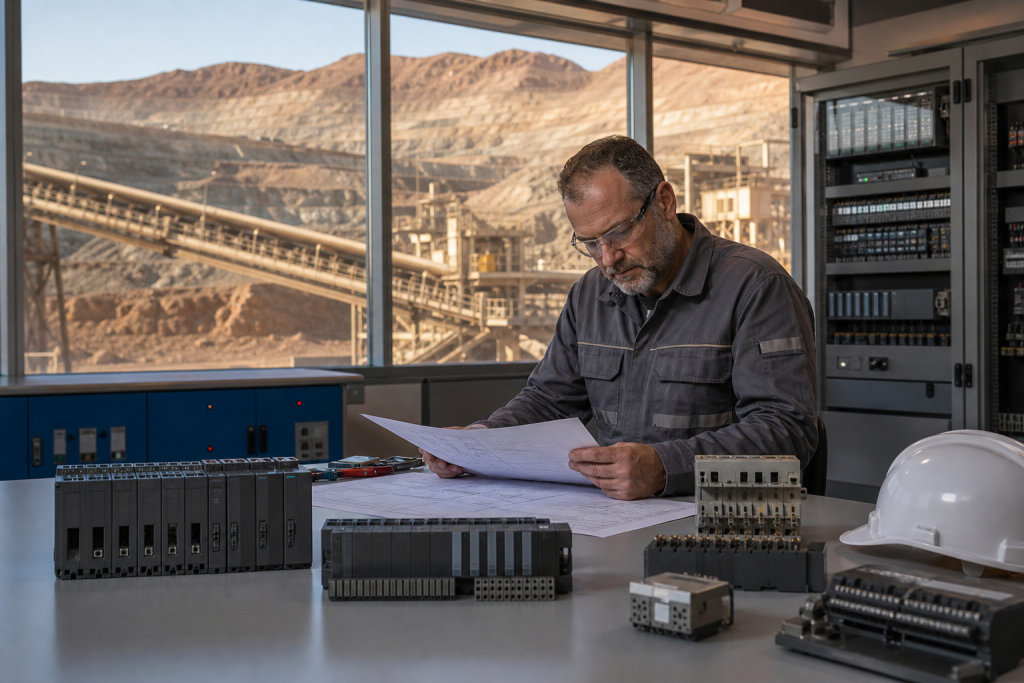
Mining and metals plants often discover the true cost of an automation spare when the equipment is far from the central warehouse, the next shipment depends on one transport route, or a control cabinet has been operating for years in dust, heat, vibration, and wide temperature changes. A part that is easy to replace in a city factory may require a completely different recovery plan at a mine, concentrator, smelter, or remote pumping station.
The right approach is not to stock every module. It is to connect asset criticality, environmental exposure, logistics, exact-model evidence, and testing capability. That creates a spare plan that supports production without turning the warehouse into an unmanaged collection of expensive parts.
Map the process consequences first
Begin with the process role rather than the part family. Identify crushers, conveyors, mills, flotation, thickening, pumping, material handling, furnace, casting, rolling, and utility systems that depend on automation. Record the safe state, restart sequence, maximum acceptable downtime, and whether a manual or degraded operating mode is approved.
A small communication or power module can have a large consequence if it stops a bottleneck conveyor, dewatering train, ventilation system, or furnace auxiliary. Classify the spare by the production consequence of failure, not by purchase price or physical size.
Account for the real environment
Review the environment where the installed equipment operates. Dust ingress, heat, vibration, moisture, corrosive atmosphere, unstable power, cabinet cooling, and maintenance access can affect both failure likelihood and replacement suitability. Record cabinet location, enclosure protection, cooling arrangement, installed filters, and any known environmental alarms.
The storage environment also matters. A spare stored in a hot container, damp warehouse, or unprotected maintenance vehicle may not have the same readiness as one kept in controlled conditions. Separate “received,” “tested ready,” “repair candidate,” and “hold” status so the inventory does not overstate coverage.
Plan around remote logistics
Remote-site lead time includes more than supplier availability. Add model confirmation, inspection, packing, export documents, carrier handoff, road or rail transfer, site receiving, quarantine, bench testing, installation, and commissioning. Weather, border procedures, site access, shift schedules, and limited specialist availability can extend the recovery path.
For each Tier 1 spare, record the last safe order date before a planned shutdown and the latest date when a fallback decision is required. A fallback may be a tested spare at another site, a repair route, an approved substitute, or a temporary operating procedure. Define the owner of that fallback before the emergency.
Verify exact-model and revision evidence
Mining plants frequently combine new expansions with older control systems. Never assume that a family name proves compatibility. Match the installed label, exact model, hardware revision, firmware, rack or chassis, wiring, I/O role, network protocol, and engineering tool environment.
For example, a GE IC695PSD140CA power supply module spare should be reviewed against the installed rack, power architecture, load, redundancy role, cabinet conditions, revision evidence, and approved test procedure. Product identification supports sourcing, but site compatibility and acceptance remain engineering decisions.
Build a site-to-site coverage model
Central warehouses and remote sites should not use the same coverage rule. A central location may hold common modules and repair candidates, while a remote plant may need a tested, immediately deployable unit for components with long transport or difficult commissioning.
Create a matrix with asset, installed model, site, process role, criticality, environmental exposure, realistic recovery time, stock location, test status, supplier path, and fallback. Review whether one spare can serve several identical assets or whether firmware, revision, application, and cabinet differences make that assumption unsafe.
Make testing practical for the site
A spare is not fully ready if the site has no safe way to test or configure it. Document the bench fixture, power source, engineering software, project backup, licenses, communication partners, and acceptance authority. For refurbished or surplus parts, request label photographs, inspection notes, test scope, warranty, packaging evidence, and known limitations.
Test what matters to the recovery path. Depending on the equipment, that may include power-up, diagnostics, communication ports, I/O behavior, firmware identification, project loading, alarm response, restart, and rollback. For safety-related or regulated applications, follow the site’s approved validation process.
Write stronger RFQs for difficult sites
A remote-site RFQ should state the exact model, revision, condition, quantity, destination, required arrival date, packaging, warranty, test evidence, documents, and site acceptance requirements. Ask suppliers to distinguish warehouse release from arrival at the plant. State whether the unit will be installed directly, bench-tested first, or held as a repair candidate.
Include photographs of the installed label and connectors when possible. A clear image can prevent a wrong suffix, connector, voltage, or revision from becoming a long-distance return. It also lets a supplier identify questions before quoting rather than after a shipment has reached a remote site.
The industrial power supplies collection can help group related sourcing requirements, but final selection must remain tied to the installed application and documented environmental and electrical checks.
Review the plan after every failure
After a failure or planned intervention, update the spare record with actual symptoms, failed component, replacement time, test result, environmental observations, and any logistics delay. Do not turn one event into a universal failure rate. Use it to refine the specific asset, site, process role, and recovery assumptions.
Also review whether the plant has become more dependent on a single line, whether an expansion changed the consequence of failure, whether an OEM changed lifecycle status, or whether a remote location now has a different transport risk. Spare planning should evolve with the operation.
FAQ
Should remote mines hold more automation spares than city plants?
Not automatically. They should hold the parts whose realistic recovery path is longer than the site’s outage tolerance, considering logistics, testing, access, and specialist availability.
What environmental details belong in a spare plan?
Record dust, heat, vibration, moisture, corrosion, cabinet cooling, enclosure conditions, power quality concerns, storage conditions, and maintenance access.
Can one spare serve multiple sites?
Only when model, revision, firmware, application, environmental and acceptance requirements are genuinely compatible. Document the boundaries instead of assuming interchangeability.
What should a remote-site RFQ request?
Request exact identity, condition, test scope, label photographs, warranty, packaging, documents, delivery milestone, destination, and site acceptance requirements.
Turn remote logistics into a controlled recovery plan
SmartNexMSK can help review installed-model evidence, environmental risk, site-to-site coverage, test requirements, remote delivery timing, and replacement options. Send model numbers, label photographs, quantity, destination, and the required maintenance window to [email protected] or WhatsApp/Phone +86 18259474341.
Route this topic into a sourcing request
Connect the article topic to a model number, category, brand, quantity, and destination before opening the RFQ.
Related Insights
Continue with sourcing and model matching guides
 Sep 8, 2026
SANYO DENKI QS1E Spares: Save Parameters First
When a SANMOTION Q axis stops, the purchasing request often becomes a model number: “Please quote QS1E01AA0H4A3P1T.” That is a useful starting point, but…
Read guide Sep 6, 2026
Yaskawa SGDH-05DE-OY Spares: Check the Servo Chain
A servo drive fault often produces a deceptively simple purchasing request: “Replace the SGDH-05DE-OY.” In a running machine, however, the amplifier is only one…
Read guide Sep 5, 2026
GE IS220PCLAH1A Spares: Check Mark VIe Fit
When a Mark VIe cabinet develops an intermittent control fault, the urgent request often becomes a single line: “Please quote IS220PCLAH1A.” That is understandable…
Read guide