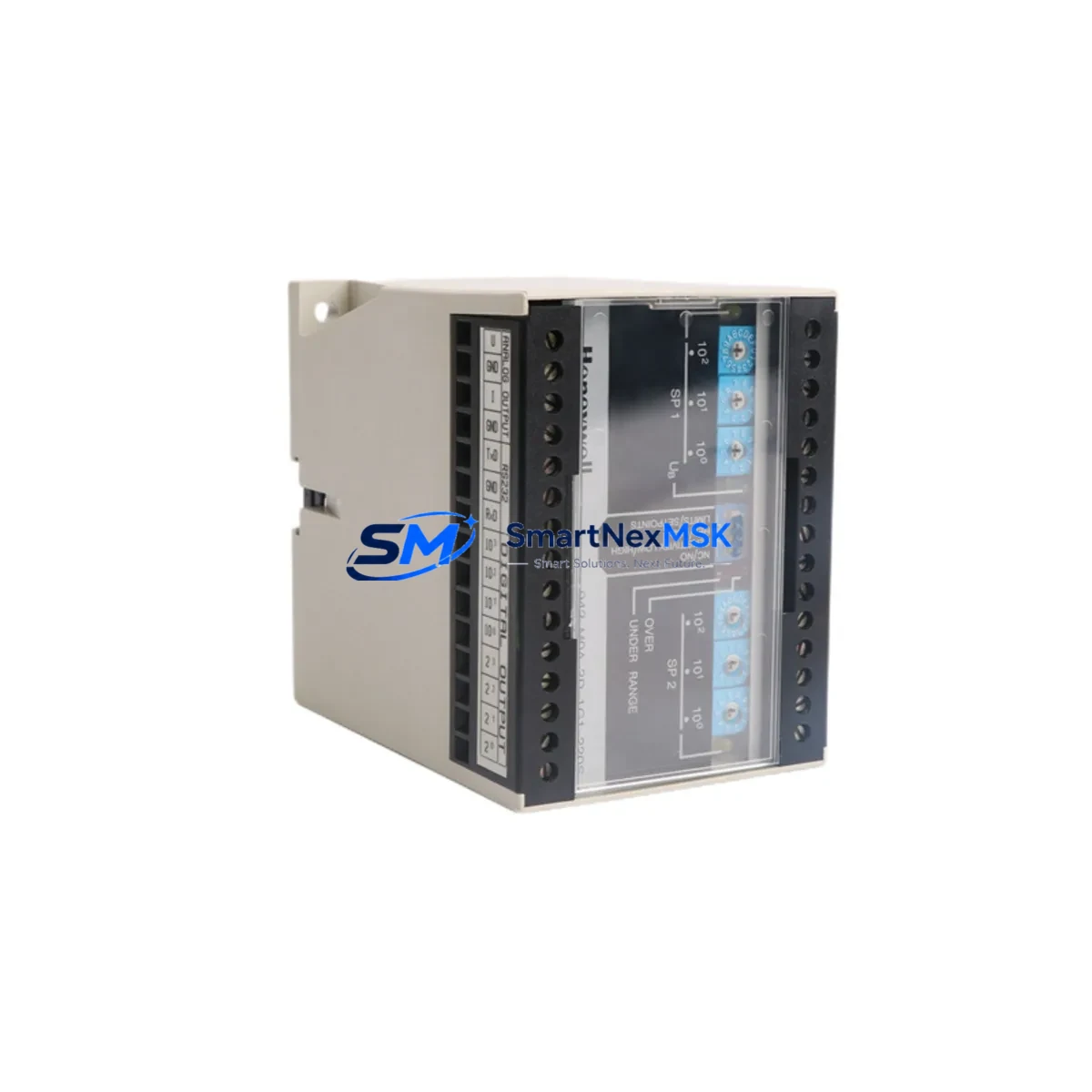
Honeywell 942-M0A-2D-1G1-220S Retrofit-Ready Inductive Proximity Sensor for 942 Series Control Systems
The Honeywell 942-M0A-2D-1G1-220S is an M30-barrel inductive proximity sensor engineered for seamless integration into legacy and current-generation 942 Series automation architectures. Operating at 220V AC with a normally-open (NO) output configuration, this sensor is purpose-built for industrial environments where reliable, non-contact object detection is critical to maintaining continuous production. Whether you are replacing a failed unit on an aging control line, upgrading a discontinued sensor in a retrofit project, or expanding I/O capacity in an existing control cabinet, the 942-M0A-2D-1G1-220S delivers the electrical and mechanical compatibility required for a smooth, low-downtime transition.
SMARTNEXMSK maintains verified stock of the 942-M0A-2D-1G1-220S and ships with full pre-shipment functional testing and a 12-month warranty, giving procurement and maintenance teams the confidence to plan scheduled and emergency replacements without extended lead times.
Upgrade Compatibility Table
| Parameter | 942-M0A-2D-1G1-220S Specification | Retrofit / Replacement Notes |
|---|---|---|
| Housing Diameter | M30 Barrel | Direct fit for M30 mounting holes; no bracket modification required |
| Supply Voltage | 220V AC | Verify panel transformer output before wiring; confirm terminal block rating ≥ 250V AC |
| Output Type | Normally Open (NO) | Confirm PLC input card logic polarity; update ladder rung if replacing an NC-type sensor |
| Series Compatibility | Honeywell 942 Series | Compatible with 942 Series sensor mounting rails and terminal blocks |
| Communication / Interface | Discrete AC output (2-wire) | No protocol migration required; connects directly to AC discrete input modules |
| Installation | Standard M30 thread, flush/non-flush configurable | Check sensing distance setting after installation; re-teach if target material differs |
| Commissioning Focus | Sensing gap, output verification, wiring polarity | Use multimeter to confirm output switching before connecting to PLC input card |
| Warranty | 12-Month Warranty | Covered from date of shipment; includes functional failure under normal operating conditions |
Retrofit Planning for Existing Automation Systems
Replacing the 942-M0A-2D-1G1-220S in an operational control system requires a structured approach that accounts for both the sensor itself and the surrounding automation infrastructure. In most 942 Series installations, the sensor feeds a discrete AC input module mounted on a shared backplane or DIN-rail rack. Before removal, engineers should document the existing terminal wiring using the original panel drawing or a field-traced schematic, noting the terminal block positions, cable routing, and any ferrite cores or surge suppressors installed on the sensor cable.
Power capacity is a primary verification point. The 220V AC supply rail feeding the sensor circuit must be confirmed against the transformer or power distribution block rating. In older control cabinets, the same rail may also supply a Honeywell 942-series relay output module or an auxiliary 24V DC power supply unit used for HMI panels and communication gateways. Overloading this rail during a retrofit can cause nuisance tripping or damage to adjacent modules.
Terminal wiring for the 942-M0A-2D-1G1-220S follows a standard 2-wire AC connection. Technicians should confirm that the terminal block accepts the existing cable cross-section and that the screw torque specification is met to prevent intermittent contact faults under vibration. If the original installation used a 3-wire DC sensor that is being replaced with this 2-wire AC unit as part of a voltage migration, the wiring scheme must be revised and the corresponding PLC input card — typically a Honeywell or third-party AC discrete input module — must be confirmed as compatible with 220V AC signals.
For systems where the 942-M0A-2D-1G1-220S interfaces with a programmable logic controller, the program logic should be reviewed before the sensor swap. If the original sensor was configured as normally closed (NC) and the replacement is normally open (NO), the associated input rung in the ladder diagram must be inverted to maintain correct machine behavior. This is a common source of commissioning errors during sensor retrofits and should be verified in simulation mode before live restart. Controllers in the same control cabinet — such as a Honeywell HC900 hybrid controller, a Siemens S7-300 CPU, or an Allen-Bradley MicroLogix unit — may require a forced I/O test to confirm the new sensor signal is correctly mapped.
HMI screens that display sensor status should also be reviewed. If the HMI tag is linked to the input address associated with this sensor, the display logic may need to be updated to reflect the new output polarity. Communication links between the PLC and SCADA or HMI — whether via Modbus RTU, Profibus DP, or Ethernet/IP — do not require reconfiguration for a like-for-like sensor replacement, but should be monitored during the first production cycle after restart.
I/O expansion scenarios are also common in 942 Series retrofit projects. When a plant adds new detection points alongside the 942-M0A-2D-1G1-220S replacement, additional AC discrete input modules, terminal blocks, and DIN-rail space must be planned. Cable trays, grounding bars, and EMC shielding should be assessed to ensure the expanded I/O does not introduce noise into adjacent analog input channels or encoder feedback lines. A Honeywell 942-series sensor mounting bracket or equivalent DIN-rail adapter may be required if the new sensor is installed in a position previously occupied by a different form-factor device.
Downtime Control During System Migration
Minimizing production downtime during a sensor replacement or control system upgrade requires preparation that begins well before the maintenance window. For the 942-M0A-2D-1G1-220S, the recommended approach is to pre-stage the replacement unit with all required accessories — terminal ferrules, cable glands, and mounting hardware — so that the physical swap can be completed within a single planned shutdown window, typically 30 to 60 minutes for a single sensor replacement.
Before the maintenance window opens, the PLC program should be backed up to a laptop or programming terminal using the appropriate software — such as Honeywell Control Builder, Siemens STEP 7, or Rockwell Studio 5000 — depending on the controller platform in use. This backup preserves the original I/O mapping, force table states, and any sensor-specific calibration parameters stored in the program data blocks. If the sensor feeds a safety-rated input channel, the safety program must be separately archived and the safety system must be properly bypassed and documented according to the plant’s lockout/tagout (LOTO) procedure.
During the swap, the 220V AC supply to the sensor circuit should be isolated at the circuit breaker or fused disconnect, not at the terminal block, to prevent arc flash risk. After the new 942-M0A-2D-1G1-220S is installed and wired, a point-to-point continuity check should be performed before power is restored. Once power is applied, the sensor output should be verified with a multimeter or the PLC’s online I/O diagnostic screen before the machine is returned to automatic mode. This staged verification process protects the original program logic and ensures that the control system resumes normal operation without requiring a full restart or re-initialization of connected devices such as variable frequency drives (VFDs), servo amplifiers, or remote I/O adapters.
For multi-sensor retrofit projects where several 942-M0A-2D-1G1-220S units are being replaced across a production line simultaneously, a phased replacement schedule — replacing sensors zone by zone rather than all at once — allows the plant to maintain partial production capacity and reduces the risk of a system-wide fault during commissioning.
Retrofit Support FAQ
Q1: Is the 942-M0A-2D-1G1-220S a direct drop-in replacement for other 942 Series sensors?
The 942-M0A-2D-1G1-220S shares the M30 housing and 942 Series mounting standard with other models in the 942 family. However, output type (NO vs. NC), supply voltage, and sensing distance must be confirmed against the original sensor’s datasheet before installation. If the original unit was a DC-powered model, the input card and wiring scheme must be updated to accommodate the 220V AC output of this unit.
Q2: What commissioning steps are required after installation?
After physical installation and wiring, verify the sensing gap against the target material and distance specification. Use the PLC’s online I/O monitor or a handheld multimeter to confirm the output switches correctly when a metal target enters the sensing field. If the sensor feeds a safety input, a full safety function test per IEC 62061 or ISO 13849 must be completed and documented before the machine is returned to service.
Q3: Can this sensor be used in a system that is migrating from DC discrete I/O to AC discrete I/O?
Yes. The 942-M0A-2D-1G1-220S is designed for AC discrete input architectures. When migrating from a DC I/O platform, the corresponding PLC input module must be replaced with an AC discrete input card rated for 220V AC signals. Terminal wiring, cable insulation ratings, and surge protection devices should also be reviewed and upgraded as part of the migration plan.
Q4: What does the 12-month warranty cover, and how is it processed?
The 12-month warranty covers functional failure of the 942-M0A-2D-1G1-220S under normal operating conditions from the date of shipment. It does not cover damage caused by incorrect wiring, overvoltage, mechanical impact, or installation outside the sensor’s rated environmental specifications. To initiate a warranty claim, contact SMARTNEXMSK with the order reference, a description of the failure, and photographic evidence of the installation. Replacement units are dispatched after fault verification, with priority processing for customers with active production impact.
© 2026 SMARTNEXMSK. All rights reserved.
Original Source: https://smartnexmsk.com
Contact: [email protected] | +86 18259474341