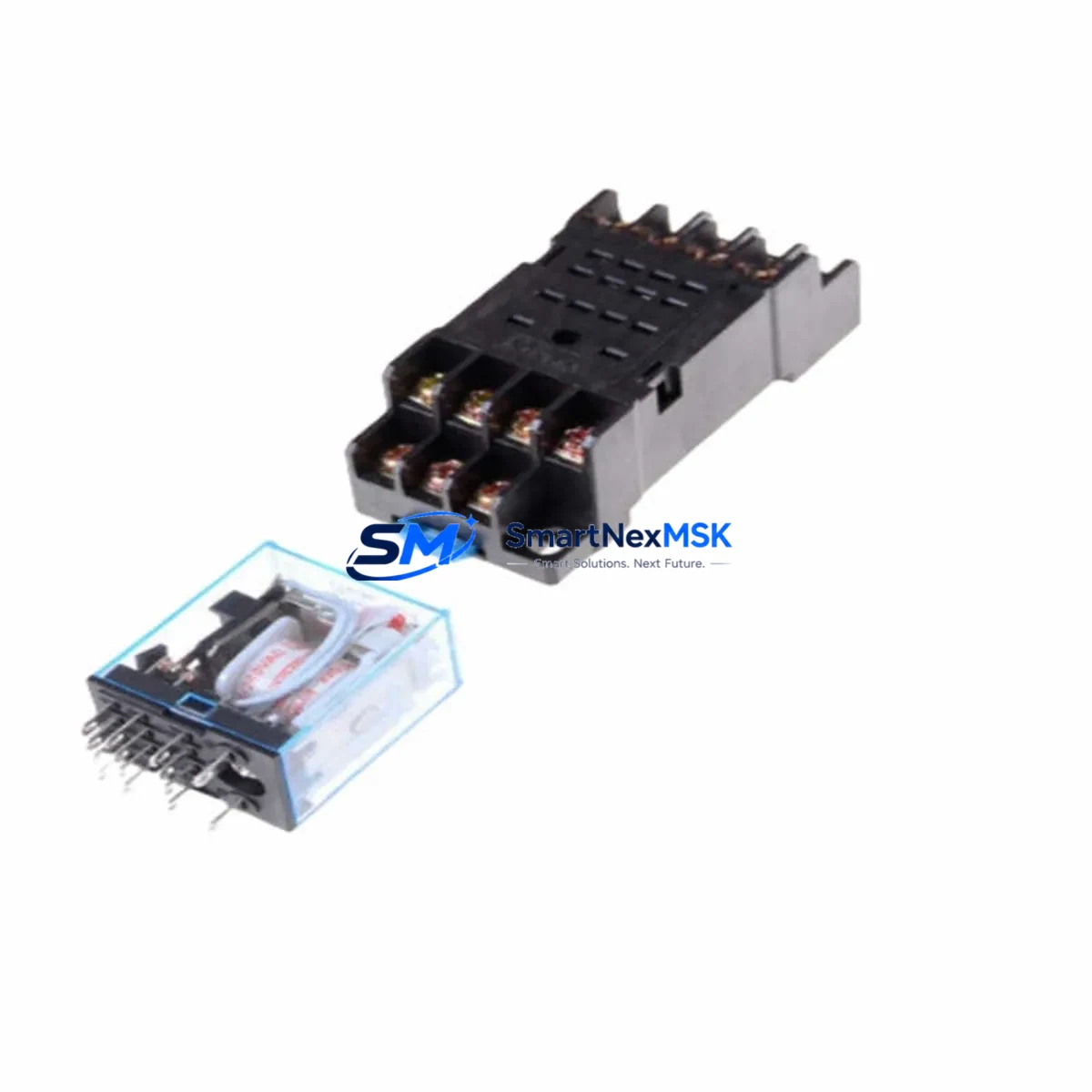
OMRON MY4NJ Maintenance-Ready Spare MY Series Automation
The OMRON MY4NJ is a 4PDT (4-pole double-throw) general-purpose power relay rated for 14-pin socket mounting, widely deployed across MY Series industrial control panels, machine tool circuits, and process automation systems. For maintenance engineers managing aging control cabinets or executing planned shutdowns, having a verified MY4NJ spare on the shelf is a direct line of defense against unplanned downtime. This listing supplies an original OMRON MY4NJ — not a substitute, not a compatible clone — sourced, inspected, and dispatched with a 12-month warranty from smartnexmsk.com.
Whether you are responding to a relay chatter fault, executing a scheduled PM cycle, or building out a critical-spares inventory for a legacy OMRON PLC-controlled line, the MY4NJ is a high-frequency replacement item that should never be absent from your stockroom. Its 14-pin footprint is compatible with OMRON PYF14A and PYF14A-E sockets, making field swap-out a sub-five-minute operation when the socket is already wired in place.
Spare Maintenance Table
| Parameter | Specification |
|---|---|
| Model / SKU | MY4NJ |
| Brand | OMRON |
| Series | MY Series |
| Contact Configuration | 4PDT (4-pole double-throw) |
| Pin Configuration | 14-pin (octal-style socket mount) |
| Compatible Socket | OMRON PYF14A / PYF14A-E |
| Coil Voltage Options | AC 100–120V / AC 200–240V / DC 12V / DC 24V (suffix-dependent) |
| Contact Rating | 5A @ 250VAC / 5A @ 30VDC |
| Insulation Resistance | ≥1,000 MΩ (500VDC) |
| Dielectric Strength | 2,000 VAC (coil to contact) |
| Mechanical Life | ≥20,000,000 operations |
| Electrical Life | ≥100,000 operations (rated load) |
| Operating Temperature | -55°C to +70°C |
| Ambient Humidity | 5% to 85% RH (non-condensing) |
| Mounting | Socket mount (DIN rail or panel via socket) |
| Origin | Japan |
| Warranty | 12 Months |
| Condition | Original, New-in-Box |
| Shipping | Tested before dispatch; ESD-safe packaging |
Maintenance Planning for Continuous Operation
The MY4NJ does not operate in isolation. In any well-maintained control cabinet, a relay failure is a signal to inspect the entire relay group and its associated circuit components. When replacing a MY4NJ, a disciplined maintenance engineer will simultaneously verify the condition of the PYF14A relay socket for contact wear and terminal corrosion. Burned or pitted socket contacts are a leading cause of repeat relay failures and must be replaced alongside the relay body.
Upstream of the relay, check the OMRON S8VS or S8VK series 24VDC power supply module supplying the coil circuit. Voltage sag or ripple from a degraded PSU can cause relay chatter, premature contact wear, and false trip events. A power supply that is more than five years old in a high-cycle application should be flagged for proactive replacement.
On the output side, inspect the terminal blocks — particularly OMRON XW5T or equivalent DIN-rail terminal strips — for loose screws, discoloration, or signs of arcing. High-resistance connections at the terminal level generate heat that accelerates insulation breakdown across the entire wiring harness.
If the MY4NJ is wired into a PLC output circuit, verify the health of the associated OMRON CJ1W-OC211 or CJ1W-OD211 output module. A shorted relay coil can back-feed transients into the PLC output card, causing latent damage that only manifests weeks later. Use a clamp meter to confirm coil current draw is within spec before declaring the repair complete.
For systems using OMRON G2R or G3RV solid-state relay variants in adjacent circuits, cross-check their load ratings — mixed relay types in the same panel are common in retrofit installations and can create unexpected load-sharing issues during fault conditions.
Where the MY4NJ controls a motor starter or solenoid valve circuit, inspect the surge suppressor or RC snubber across the inductive load. A failed suppressor dramatically shortens relay contact life and is a $2 component that is frequently overlooked during PM cycles.
Finally, if the control system includes an OMRON NS-series HMI or CX-Programmer-managed CP1H/CJ2M PLC, pull the I/O diagnostic log before closing the work order. Relay output faults are often preceded by intermittent I/O alarms that were acknowledged but not investigated — a pattern that indicates a systemic wiring or load issue rather than a one-off component failure.
Site Replacement Workflow
Step 1 — Isolation: De-energize the control circuit at the upstream MCB or fuse. Verify zero voltage at the relay socket terminals using a calibrated multimeter. Do not rely on PLC output status alone.
Step 2 — Documentation: Photograph the existing relay label and wiring before removal. Confirm the coil voltage suffix on the MY4NJ body matches the replacement unit. A MY4NJ-AC240V installed in a DC24V circuit will not operate and may damage the coil driver.
Step 3 — Socket inspection: With the relay removed, inspect the PYF14A socket contacts using a dental pick or contact cleaner. Replace the socket if contacts show pitting deeper than 0.3mm or if the relay body does not seat firmly.
Step 4 — Installation: Insert the MY4NJ into the socket until the locking tab clicks. Do not force. Verify the relay is fully seated — a partially inserted relay will cause intermittent contact resistance faults that are difficult to diagnose remotely.
Step 5 — Functional test: Re-energize the circuit and command the output from the PLC or test switch. Confirm all four poles switch cleanly. Measure coil current draw and compare against the datasheet nominal value. Log the replacement in the equipment maintenance record with date, technician ID, and new relay serial number.
Step 6 — System validation: Run the machine through at least one full production cycle before returning to unattended operation. Monitor the HMI alarm log for the first 30 minutes of resumed operation.
Spare Parts Support FAQ
Q: Is this MY4NJ an original OMRON component or a compatible substitute?
A: This is an original OMRON MY4NJ sourced directly from authorized supply channels. Each unit is inspected and verified before dispatch. We do not supply counterfeit, refurbished, or third-party compatible relays under the OMRON part number.
Q: How do I confirm the correct coil voltage suffix before ordering?
A: The coil voltage is encoded in the full part number suffix (e.g., MY4NJ AC100/110, MY4NJ DC24). Check the label on the relay body being replaced or refer to the panel wiring diagram. If you are unsure, contact us at [email protected] with your panel drawing or existing relay photo and we will confirm the correct variant before shipment.
Q: What is your lead time and how is the relay tested before shipping?
A: In-stock units ship within 1–2 business days. Each MY4NJ undergoes coil resistance measurement and contact continuity verification prior to packaging. Units are shipped in ESD-safe anti-static bags with original OMRON labeling intact. Expedited shipping is available for emergency breakdown situations.
Q: What does the 12-month warranty cover?
A: The 12-month warranty covers manufacturing defects, coil failure under rated voltage, and contact failure under rated load conditions. It does not cover damage caused by installation in incorrect voltage circuits, mechanical impact, or operation outside the published environmental ratings. Warranty claims are processed within 5 business days of receiving the returned unit.
© 2026 SMARTNEXMSK. All rights reserved.
Original Source: https://smartnexmsk.com
Contact: [email protected] | +86 18259474341