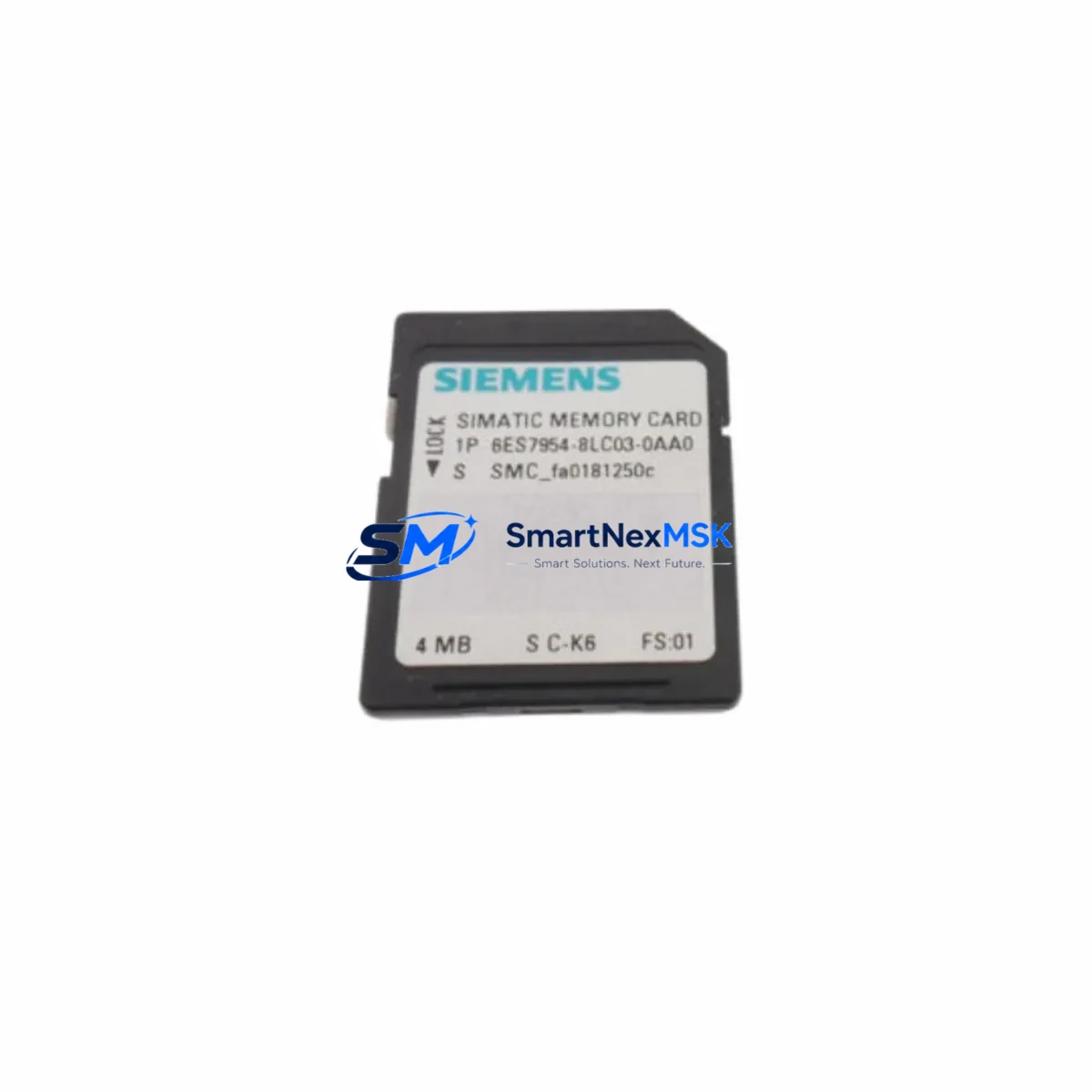
Siemens 6ES7954-8LC03-0AA0 Retrofit-Ready Memory Card for S7-1200/S7-1500 Control Systems
The Siemens 6ES7954-8LC03-0AA0 is a 2 MB SIMATIC Memory Card engineered for seamless integration into SIMATIC S7-1500 and SIMATIC S7-1200 programmable logic controllers. As legacy automation infrastructure ages and original memory cards reach end-of-life, this module serves as the authoritative retrofit-ready replacement — enabling engineers to restore, upgrade, or migrate control system programs without rewriting application logic or reconfiguring hardware architectures from scratch.
Whether you are recovering a failed production line, upgrading a control cabinet from an older S7-300 platform, or migrating program data from a decommissioned CPU 315-2 PN/DP to a modern CPU 1516-3 PN/DP, the 6ES7954-8LC03-0AA0 provides the non-volatile storage foundation required for reliable program retention, firmware updates, and data logging across the SIMATIC S7-1500 family.
Upgrade Compatibility Table
| Parameter | Details |
|---|---|
| SKU / Part Number | 6ES7954-8LC03-0AA0 |
| Storage Capacity | 2 MB |
| Compatible Controllers | SIMATIC S7-1500 (all CPU variants), SIMATIC S7-1200 (CPU 1211C–1217C) |
| Form Factor | SIMATIC Memory Card (SD-based, proprietary Siemens format) |
| Interface / Slot | Front-panel card slot on S7-1500 / S7-1200 CPUs |
| Replaces / Upgrades | 6ES7954-8LC02-0AA0 (V2), 6ES7954-8LB00-0AA0 (512 KB), earlier 2 MB variants |
| Communication Compatibility | PROFINET, PROFIBUS (via CM modules), Industrial Ethernet |
| Installation Requirement | CPU must be in STOP mode; card inserted into front slot before power-on |
| Programming Software | TIA Portal V13 SP1 and above (V16/V17/V18/V19 recommended) |
| Firmware Update Support | Yes — card used as firmware carrier for CPU and I/O module updates |
| Debugging / Commissioning | Verify card recognition in TIA Portal online device view; check CPU diagnostic buffer |
| Warranty | 12 Months — covers manufacturing defects and functional failures under normal use |
Retrofit Planning for Existing Automation Systems
Successful retrofit projects involving the 6ES7954-8LC03-0AA0 require systematic pre-migration planning. Engineers replacing memory cards in operational S7-1500 systems should begin by archiving the existing program from TIA Portal using the “Upload from device” function, ensuring the full project — including hardware configuration, network topology, and HMI screen bindings — is saved before the card is removed.
In control cabinet upgrades where a CPU 1515-2 PN or CPU 1517-3 PN/DP is being introduced to replace an older CPU 315F-2 PN/DP, the memory card must be formatted using TIA Portal before first use. The card carries not only the user program but also the CPU’s IP address assignment, device name (PROFINET device name), and startup parameters — making it a critical configuration carrier during system handover.
For projects involving ET 200SP distributed I/O expansion or integration of CM 1542-5 PROFIBUS communication modules, engineers must verify that the memory card capacity is sufficient to store the expanded hardware configuration alongside the user program. The 2 MB capacity of the 6ES7954-8LC03-0AA0 comfortably accommodates mid-scale S7-1500 projects with up to several hundred I/O points and multiple communication interfaces.
When migrating from S7-300 platforms, the SIMATIC S7-1500 CPU 1511-1 PN paired with this memory card provides a cost-effective entry point. Engineers should map legacy S7-300 data blocks and organization blocks to their S7-1500 equivalents in TIA Portal, paying particular attention to OB1 cycle time settings, interrupt OBs, and any STEP 7 Classic-specific instructions that require substitution with equivalent TIA Portal instructions.
Control systems incorporating SIMATIC HMI TP700 Comfort or KTP900 Basic panels connected via PROFINET must have their HMI screen tag connections re-validated after CPU replacement. Tag addresses referencing DB blocks or I/O addresses may shift during migration, and the HMI project should be re-downloaded to the panel after the CPU program is confirmed stable. The SM 521 digital input module and SM 522 digital output module wiring should be verified against the updated hardware configuration to prevent I/O address mismatches.
For systems using CP 1543-1 Industrial Ethernet communication processors for OPC UA or S7 communication with SCADA systems, the communication module configuration is stored on the memory card and must be re-established after card replacement. Verify firewall rules, connection parameters, and OPC UA server certificates are correctly restored before returning the system to production.
All retrofit work should include a pre-shipment functional test: insert the 6ES7954-8LC03-0AA0 into a test CPU, download the archived project, verify the CPU transitions to RUN mode without errors, and confirm all I/O modules are recognized in the diagnostic buffer. This step eliminates card-related failures before the module reaches the customer site.
Downtime Control During System Migration
Minimizing production downtime during a memory card replacement or CPU migration is a primary concern for maintenance engineers. The 6ES7954-8LC03-0AA0 supports a structured hot-swap preparation workflow: with the CPU in STOP mode, the existing card is removed, the replacement card (pre-loaded with the verified program via TIA Portal) is inserted, and the CPU is powered on. If the program was pre-loaded onto the card offline, the CPU will boot directly into RUN mode without requiring a TIA Portal connection on-site — reducing commissioning time to under five minutes in straightforward replacements.
For more complex migrations involving multiple IM 155-5 PN ST interface modules in distributed ET 200SP racks, engineers should prepare a commissioning checklist covering: power supply voltage verification (24 VDC for S7-1500 CPUs via PM 70W 120/230VAC power supply modules), PROFINET device name assignment, I/O module parameterization, and safety function validation for F-CPU applications. Using the memory card as a program carrier eliminates the need for a laptop connection during final commissioning, preserving the original program logic and reducing the risk of human error during re-entry.
Maintaining a spare 6ES7954-8LC03-0AA0 pre-loaded with the current production program in your spare parts inventory is the single most effective strategy for reducing unplanned downtime. Combined with a documented backup procedure in TIA Portal and a labeled, version-controlled card storage protocol, this approach ensures that any field engineer can restore a failed S7-1500 CPU to full operation within minutes — without specialist support.
Retrofit Support FAQ
Q1: Is the 6ES7954-8LC03-0AA0 a direct replacement for the 6ES7954-8LC02-0AA0?
Yes. The 6ES7954-8LC03-0AA0 (Version 3) is the current production successor to the 6ES7954-8LC02-0AA0 (Version 2). Both are 2 MB SIMATIC Memory Cards with identical physical form factors and functional compatibility across all SIMATIC S7-1500 and S7-1200 CPU variants. No hardware or software modification is required for substitution.
Q2: Can I use this card to transfer a program between two S7-1500 CPUs of different model variants?
Yes, with conditions. The program stored on the card must be compatible with the target CPU’s firmware version and hardware configuration. If the target CPU is a different model (e.g., migrating from CPU 1511 to CPU 1515), the hardware configuration in TIA Portal must be updated to match the new CPU before downloading to the card. PROFINET device names and IP settings stored on the card will also need to be reassigned to the new CPU.
Q3: What wiring or terminal changes are required when replacing only the memory card?
None. The 6ES7954-8LC03-0AA0 is a plug-in card that interfaces exclusively with the CPU’s front-panel card slot. No terminal block rewiring, backplane connector changes, or I/O module modifications are required. All field wiring connected to SM 521/SM 522 I/O modules or ET 200SP distributed racks remains unchanged.
Q4: What does the 12-month warranty cover, and how is it claimed?
The 12-month warranty covers manufacturing defects and functional failures under normal operating conditions, including card read/write failures, unrecognized card errors, and data corruption not caused by improper handling or electrical overstress. To claim warranty service, contact our sales team with your order reference and a description of the fault. We will arrange replacement or repair with priority handling to minimize your system downtime.
© 2026 SMARTNEXMSK. All rights reserved.
Original Source: https://smartnexmsk.com
Contact: [email protected] | +86 18259474341