
QUINT Power Supply Spares: Boost Is Not Redundancy
Separate nominal output, conditional boost, redundant power paths and UPS duties before approving a QUINT power supply spare.
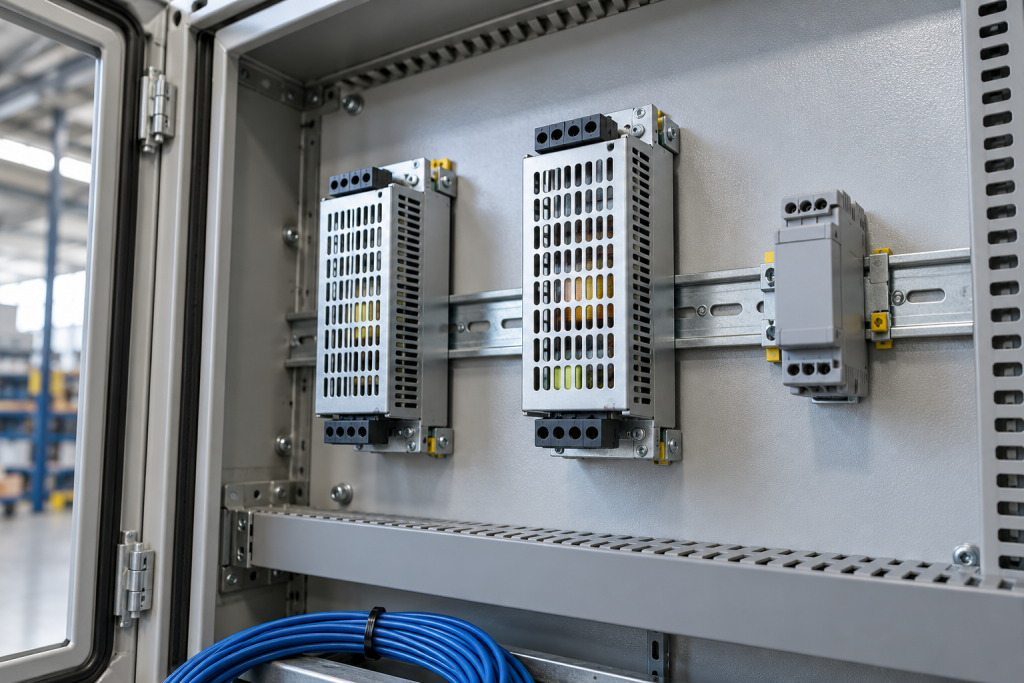
A 24 V control cabinet can appear healthy while its power reserve has already disappeared. Both supplies are running, the controller is online, and the replacement request says only “QUINT, 24 V, 10 A.” Yet the cabinet may depend on temporary overload capability, a decoupling module, or stored energy that the proposed spare does not reproduce.
When specifying QUINT power supply spares, separate four duties: continuous load supply, short-duration boost, fault-tolerant supply paths and mains-failure buffering. They address different disturbances. Treating them as interchangeable can turn a plausible model match into an incomplete recovery plan.
Keep the order number with the application
Start with the complete Phoenix Contact model and article number, not the QUINT family name alone. Record input arrangement, output setting, installed accessories, terminal connections and monitoring signals. Photograph the nameplate and the surrounding power architecture before deciding what the spare must replace.
Separate the power supply from the redundancy module and UPS in the asset list. A cabinet may contain all three, but they are not three versions of the same component. The request should identify whether the fault concerns conversion, decoupling, stored energy or a downstream load.
Read boost as a conditional operating capability
For a specific example, Phoenix Contact lists QUINT4-PS/1AC/24DC/10, article 2904601, with a nominal output of 24 V DC and 10 A. Its published FAQ describes static boost of 12.5 A at ambient temperatures up to 40 degrees C, and dynamic boost up to 20 A for a maximum of five seconds at temperatures up to 60 degrees C.
Those figures belong to that exact product and its stated conditions. They do not make every QUINT supply a continuous 20 A source. Nor should startup capability be substituted for the steady-state load budget or transferred to another generation using the family name.
Record the sustained demand separately from startup peaks, including their duration and repetition. Have the engineering reviewer compare these requirements with the complete manufacturer curves and installation conditions. Keep SFB protection behavior separate from load-starting boost; neither term removes the need to review downstream protection.
Separate increased capacity from redundancy
Two supplies can contribute enough combined current while still leaving no adequate surviving path after one is lost. As an illustrative nominal-rating check, two 10 A supplies serving a 14 A load do not establish 1+1 continuous redundancy: one remaining 10 A supply cannot cover that demand on its nominal rating. This is a sizing example, not a reported installation.
The distinction also appears in Phoenix Contact’s QUINT-DIODE/12-24DC/2X20/1X40 data. Article 2320157 lists 40 A for increased-power operation but 20 A for redundancy, with temperature derating specified separately. The larger number must not be read as redundant load capacity.
Review the complete surviving path, including input sources, branch protection, decoupling, conductors and the load connection. Two supplies fed by one failed upstream source do not, by themselves, protect against that source failure. Define the failure being covered before assigning the word “redundant” to the spare strategy.
Do not substitute DIODE and ORING by name
Phoenix Contact’s DIODE versus ORING explanation distinguishes diode decoupling from the Auto Current Balancing technology described for QUINT ORING. Decoupling and balanced utilization are different functions. An apparently similar redundancy accessory may not preserve the monitoring or balancing behavior used in the cabinet.
Before accepting a change, identify the exact accessory, channel ratings, voltage-drop allowance, heat conditions and alarm connections. Check what the control system actually monitors. Do not assume that a healthy output-voltage indication proves both input paths remain available or that the two supplies share current as intended.
Keep UPS duty outside the boost claim
Boost provides additional output capability under specified conditions; it is not evidence of the stored energy needed for an arbitrary mains outage. Phoenix Contact’s DC UPS guidance describes combinations of power supply, UPS and energy-storage modules. The required buffer duration and supported loads belong in a separate review.
If the recovery requirement includes controlled shutdown or continued operation during input loss, specify that duration, load and acceptance basis. Identify the actual storage technology and associated maintenance requirements. Do not infer minutes of ride-through from a boost percentage or from a redundancy module’s current rating.
Turn the distinctions into a purchasing record
When reviewing industrial power supply spare options, attach the complete model, article number, cabinet drawing, continuous demand, startup requirement and required failure coverage. Separate exact replacement from an engineering alternative in the quotation request.
Define the inspection and test boundary before acceptance. The automation spare receiving-inspection checklist supports identity and condition checks, but receiving a correct-looking unit does not validate redundancy or buffering. Installation and failure-response testing require qualified personnel, approved isolation and a controlled site procedure; this guide is not a live replacement instruction.
Frequently asked questions
Does 20 A dynamic boost make a 10 A supply a continuous 20 A spare?
No. For article 2904601, the published dynamic capability is time- and temperature-limited. Use the exact device documentation and application review, not the peak figure alone.
Do two parallel supplies automatically provide redundancy?
No. Confirm that the surviving path can support the required load and that the architecture covers the specified failure. Combined capacity alone does not demonstrate either condition.
Are QUINT DIODE and QUINT ORING interchangeable?
Do not assume so. Verify decoupling, current balancing, monitoring, ratings and installation requirements for the exact references before approving a substitution.
Can a boost-capable supply replace a DC UPS?
Not on that basis. A UPS requirement concerns an agreed load and outage duration, with suitable energy storage and acceptance evidence. Boost alone does not establish that capability.
What is the minimum useful spare request?
Provide the full model and article number, label photos, input and output requirements, cabinet arrangement, accessory identities and whether capacity, redundancy or buffering must be preserved.
Clarify the replacement duty
Send the model, nameplate photographs, discontinued-part replacement need and delivery requirement to [email protected] or WhatsApp/Phone +86 18259474341. Include the installed redundancy or UPS arrangement so the sourcing discussion starts with the required duty, not just a voltage and current label.
Route this topic into a sourcing request
Connect the article topic to a model number, category, brand, quantity, and destination before opening the RFQ.
Related Insights
Continue with sourcing and model matching guides
 Nov 28, 2026
Series 90-30 Spares: Check the RX3i Rack Boundary
Separate exact Series 90-30 spares from the verified RX3i rack, processor and retained I/O needed for a planned migration.
Read guide Nov 27, 2026
HMI Screen Spares: Identify the Failed Layer
Separate surface damage, touch input and the supported display assembly before specifying an HMI hardware spare.
Read guide Nov 26, 2026
Motor Brake Rectifier Spares: Match the Coil
Check the fitted brake coil and approved control function before treating a motor brake rectifier as an exact spare.
Read guide