
Relay Spares: Check Contact Duty, Not Just Coil Voltage
Separate coil identity from contact switching duty, small-signal requirements and socket compatibility when qualifying a relay spare.
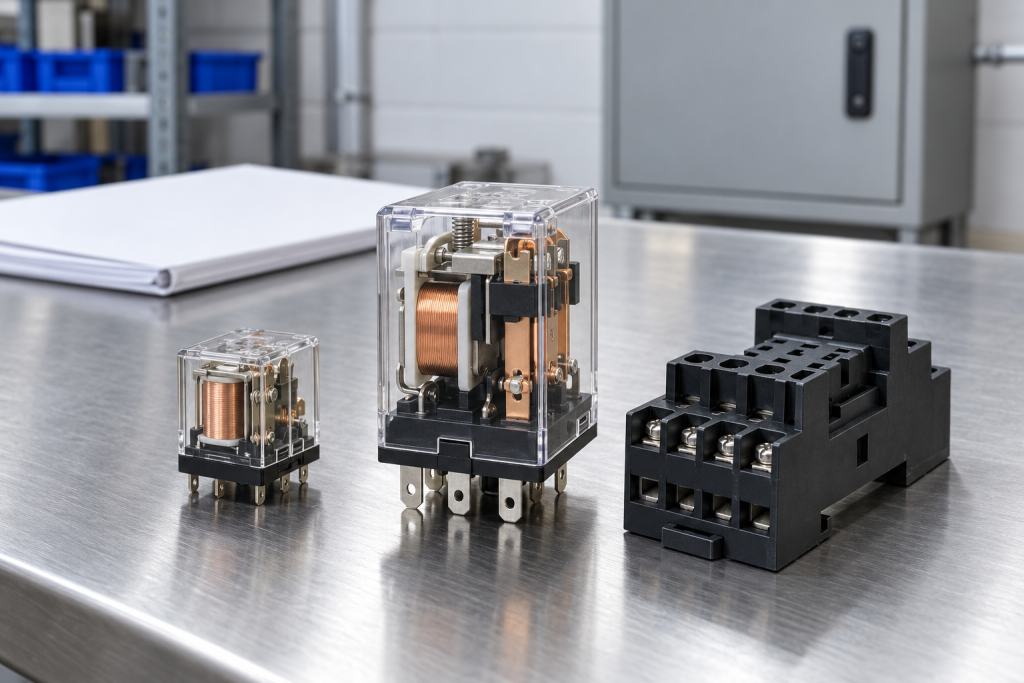
A relay spare can fit the socket, energize at the expected coil voltage and still be wrong for the circuit it switches. The buying mistake is treating a current figure on a listing as a complete contact-duty specification. That shortcut can leave a maintenance team with a replacement that looks correct but has not been qualified for the installed load.
For general-purpose relay spares, separate coil requirements, contact switching duty and the socket assembly. Keep each requirement attached to its evidence. This is a procurement and engineering-review framework, not an instruction to perform live tests or redesign a control circuit during an outage.
Give the coil and contacts separate records
Start the request with two distinct entries. The coil entry identifies the complete relay code, rated supply, AC frequency where applicable, and documented polarity or suppression features. The contact entry identifies what each used pole switches, at what voltage, and under which load conditions. Do not use the coil voltage as a description of the contact circuit.
OMRON’s general-purpose relay engineering guide explains that some indicator-equipped or diode-equipped DC relays have polarity. It also distinguishes AC and DC coil behavior. Preserve the exact variant rather than accepting a family name and a photograph as proof of the coil arrangement.
Use the general-purpose relay collection for sourcing context. It is not an interchange list. Reconcile a candidate’s full identification with the manufacturer’s documentation before treating it as an approved spare.
Read the complete contact-rating row
A contact requirement needs more than amperes. Retain the rated voltage, AC or DC, load type, relevant power factor or time constant, and the manufacturer’s conditions. Keep rated switching duty separate from carry-current limits and maximum switching limits. Do not combine independent maxima into an operating point the manufacturer has not rated.
OMRON’s LY4 contact-rating example shows why the qualifiers matter: its resistive and inductive load ratings differ. That table is an example for the identified family and conditions, not a universal derating formula for other relays. Obtain the actual candidate’s applicable rating rather than transferring the example’s numbers.
For each used pole, have engineering identify the actual load: a contactor coil, valve solenoid, indicator or another device. Keep the drawing reference and load identity in the request. An unanswered load field is an engineering question, not permission to select whichever relay has the largest headline current.
Do not overlook small signal loads
The opposite mistake is assuming that a higher power rating automatically improves every application. OMRON’s minimum-load contact guidance discusses contact resistance, surface films and application-dependent reliability. It treats minimum applicable load as a reference measure, not a guarantee that every contact construction suits every signal circuit.
Ask the responsible engineer to confirm the contact requirements for the receiving circuit when the relay carries a small signal. Record the manufacturer’s applicable guidance with the comparison. Do not create a new load or alter the input circuit merely to make an offered relay appear acceptable.
Keep suppression inside the qualification boundary
Suppression is not just an optional accessory in a purchasing description. Record the installed arrangement and whether the offered relay or socket includes a protection component. Identify the relevant drawing and manufacturer instructions before accepting a difference.
OMRON’s relay safety and application precautions explain that protection arrangements can affect release time, and require application conditions to be considered. Do not treat a different suppression arrangement as electrically and dynamically identical merely because the relay energizes.
The purchasing decision should distinguish an exact documented replacement from a proposal requiring circuit review. Do not add a diode, remove a suppressor, parallel contacts or change wiring as an informal workaround. Any proposed modification belongs with the circuit owner and the site’s controlled change process.
Qualify the socket and offered package
Record the socket identity separately, including the terminal arrangement, retention components and applicable documentation. A matching pin count does not establish the complete assembly’s suitability. OMRON’s relay and socket combination table identifies specific combinations and associated current information. Check the combination for the actual model rather than borrowing a nearby row.
The quotation should state whether it includes the relay only, socket, retaining clip or other agreed accessories. Require clear photographs of the offered labels and disclosure of any suffix difference. Keep unresolved identity questions open before shipment; do not let a generic catalog description silently replace the purchase requirement.
The receiving-inspection checklist supports physical acceptance. Add the circuit-specific contact review to that record so a neatly packaged unit is not automatically counted as qualified stock.
Close the application decision explicitly
Use a short comparison sheet: installed identity, offered identity, coil requirement, contact duty, socket combination, suppression arrangement, evidence references and unresolved differences. Assign an acceptance owner and identify the approved checks still required. Keep component observations separate from the machine’s return-to-service decision.
This article concerns ordinary general-purpose relays. It does not authorize substitution of safety relays, protection devices or safety-related functions. Qualified personnel must follow the equipment manufacturer’s procedures and site isolation, commissioning and change-control requirements. A click or indicator light is not complete application acceptance.
FAQ
Does the correct coil voltage prove a relay spare is suitable?
No. Contact duty, complete variant identity, socket and application requirements need separate review.
Can a resistive-load rating be applied to a solenoid automatically?
No. Use the manufacturer’s applicable load conditions and have engineering qualify the actual circuit.
Is a higher contact current rating always better?
No. Small-signal requirements and contact construction still matter; compare the intended duty.
Does matching the socket pin count establish compatibility?
No. Confirm the documented relay/socket combination, connections, ratings and retention arrangement.
Prepare the sourcing review
Send complete model numbers, nameplate photos, discontinued-part replacement needs and delivery requirements to [email protected] or WhatsApp/Phone +86 18259474341. Include the circuit’s known coil and contact requirements, and state whether an alternative may be reviewed.
Route this topic into a sourcing request
Connect the article topic to a model number, category, brand, quantity, and destination before opening the RFQ.
Related Insights
Continue with sourcing and model matching guides
 Nov 28, 2026
Series 90-30 Spares: Check the RX3i Rack Boundary
Separate exact Series 90-30 spares from the verified RX3i rack, processor and retained I/O needed for a planned migration.
Read guide Nov 27, 2026
HMI Screen Spares: Identify the Failed Layer
Separate surface damage, touch input and the supported display assembly before specifying an HMI hardware spare.
Read guide Nov 26, 2026
Motor Brake Rectifier Spares: Match the Coil
Check the fitted brake coil and approved control function before treating a motor brake rectifier as an exact spare.
Read guide