
S7-400 Phase-Out: Check the Exact Order Number
Separate the selected-component phase-out milestone from family positioning, then build an exact-order-number recovery and purchasing register.
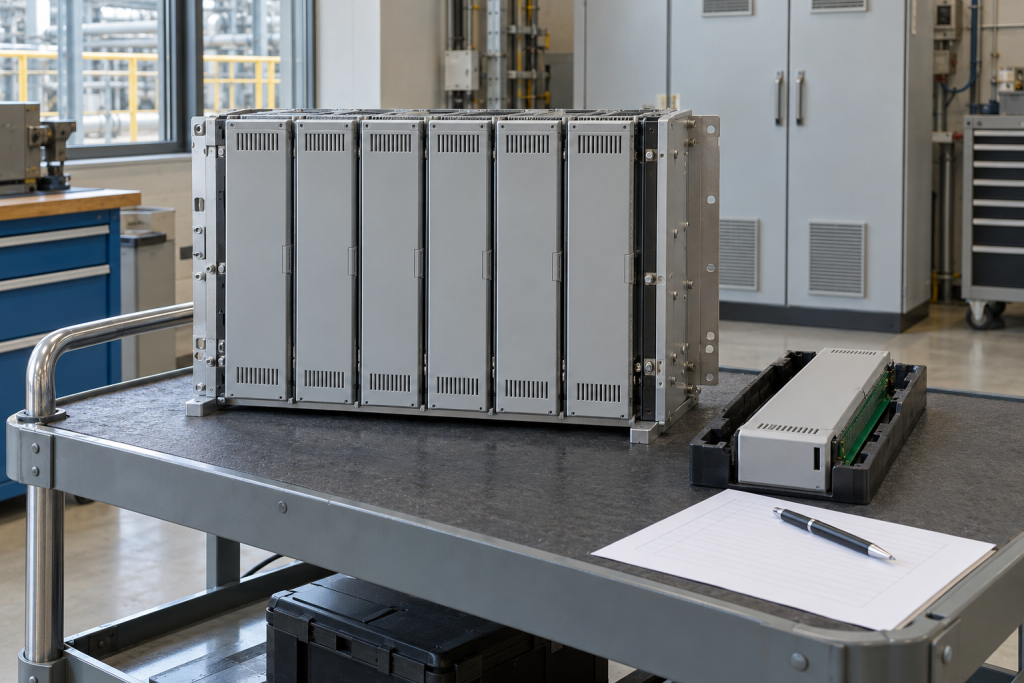
A long-term S7-400 roadmap does not settle the lifecycle status of every module in an installed rack. That distinction now matters for spare purchasing: Siemens identifies an October 2026 phase-out announcement for selected components, while continuing to position the wider controller platform for long-term use. A family-level statement and an order-number-level milestone answer different questions.
The maintenance decision is not simply whether S7-400 is old. It is whether the plant has a defensible recovery route for each installed order number. An incomplete stock list can hide a cancelled revision, an unapproved substitute or a module whose purchasing window needs attention before the next shutdown.
Start with the selected-component notice
The official SiePortal record for CPU 414-3, 6ES7414-3XM07-0AB0 lists its lifecycle as “Phase Out Announce.” Its related product-note summary, ID 110005434 dated October 1, 2026, states that selected SIMATIC S7-400 components reach milestone P.M400 on that date.
This is a selected-component announcement, not evidence that every S7-400 module has the same status or that all support has ended. This article uses the published product-record summary, not an assumed complete affected-parts list. Retrieve the applicable notice and confirm the exact article number before setting a final purchase or migration deadline.
Siemens’ S7-400 family page continues to describe long-term investment and the platform’s role alongside S7-410 in PCS 7. That wider positioning does not establish the supply condition, support entitlement or replacement suitability of an individual older unit.
Build an order-number register, not a family count
Record the complete Siemens article number from the installed label, including every suffix. Keep the cabinet, rack, slot, hardware revision, firmware and installed function beside it. Add a clear photograph and distinguish the installed module from the spare already held in stores. A description such as “CPU 414” is a useful starting point, not a release specification.
For each line, retain the official status checked, source URL, access date and applicable notice reference. Separate a dated lifecycle milestone from a supplier quotation’s validity date. If a record is unclear, mark it unresolved rather than copying a nearby model’s status into the inventory system.
Check more than the CPU. Include the actual power, communication and I/O modules needed to recover the affected function. This is a dependency review, not a claim that all those components are covered by one notice. Assign each its own evidence row.
Turn the status into a purchasing decision
A lifecycle label is an input to planning; it is not a stock reservation. Ask the sourcing team to identify the offered exact model, condition, documentation and delivery commitment. Treat an unverified marketplace availability message as a lead to investigate, not as proof that the plant’s recovery requirement is covered.
Choose a decision date based on the consequence of losing the function and the time needed to qualify a recovery route. Some assets may justify an exact bridge spare while modernization is engineered. Others may already have approved coverage and need only a scheduled review. Do not invent a universal last-buy deadline from a short notice summary.
Use the automation spare-parts criticality matrix to prioritize those decisions. Lifecycle urgency should be considered alongside failure consequence and usable recovery coverage, rather than replacing them.
Keep substitution separate from exact replacement
A proposed successor needs its own compatibility assessment. Compare the complete identities, required interfaces, engineering environment, project requirements and any installed application constraints. A newer CPU label or greater memory capacity does not, by itself, establish that the existing configuration can be restored unchanged.
Where redundant or safety-related functions are involved, keep the approved system documentation and responsible engineering authority in the decision. Do not generalize a standard CPU substitution to an H or F/FH application. This guide does not authorize a hot swap, firmware change or safety-system modification.
Record a proposed alternate as “pending engineering acceptance” until the required review and controlled test are complete. Keep the original spare requirement open while that work remains unresolved, so procurement does not mistake a quotation for an accepted recovery solution.
Close the evidence gap before counting coverage
For an exact spare, agree what identity, condition and functional evidence will support release. Keep the test configuration and its limitations with the unit record. A bench result should be interpreted only within the checks actually performed; it does not establish that a site’s full application has been recovered.
Organize sourcing through the SIMATIC S7-400 series collection or the broader PLC and controller category. Product descriptions still need reconciliation with official specifications. If specifications conflict, stop the recommendation and request clarification instead of using the listing as compatibility evidence.
Finish the review with an owner, next action and review date for each uncovered function. The useful output is a traceable decision register: exact spare accepted, alternate under qualification, modernization approved, or risk explicitly awaiting resolution. “S7-400 supported” is too broad to serve as that decision.
FAQ
Does the October 2026 notice mean all S7-400 products are cancelled?
No. The official summary refers to selected components and a phase-out announcement milestone. Verify the applicable order number and notice rather than extending that statement to the whole family.
Can the family roadmap replace an exact lifecycle lookup?
No. Family positioning does not establish the individual module’s current status, offered condition, supply commitment or suitability for an installed application.
Should an identified successor be treated as a drop-in spare?
No. It requires an application-specific assessment. Keep exact replacement and engineered substitution as separate procurement and acceptance decisions.
What should the plant send with an S7-400 spare enquiry?
Provide the complete article number, label photographs, installed role, revision details, quantity, condition requirement, lifecycle concern and required recovery date. Share sensitive project data only through an approved route.
Prepare the next decision
For an exact spare or discontinued replacement review, send model numbers, nameplate photographs, replacement requirements and delivery deadlines to [email protected] or WhatsApp/Phone +86 18259474341.
Route this topic into a sourcing request
Connect the article topic to a model number, category, brand, quantity, and destination before opening the RFQ.
Related Insights
Continue with sourcing and model matching guides
 Nov 28, 2026
Series 90-30 Spares: Check the RX3i Rack Boundary
Separate exact Series 90-30 spares from the verified RX3i rack, processor and retained I/O needed for a planned migration.
Read guide Nov 27, 2026
HMI Screen Spares: Identify the Failed Layer
Separate surface damage, touch input and the supported display assembly before specifying an HMI hardware spare.
Read guide Nov 26, 2026
Motor Brake Rectifier Spares: Match the Coil
Check the fitted brake coil and approved control function before treating a motor brake rectifier as an exact spare.
Read guide