
Semiconductor Fuse Spares: Check Protection Scope
Keep semiconductor fuse protection scope, application conditions and exact equipment references together before approving a spare or alternative.
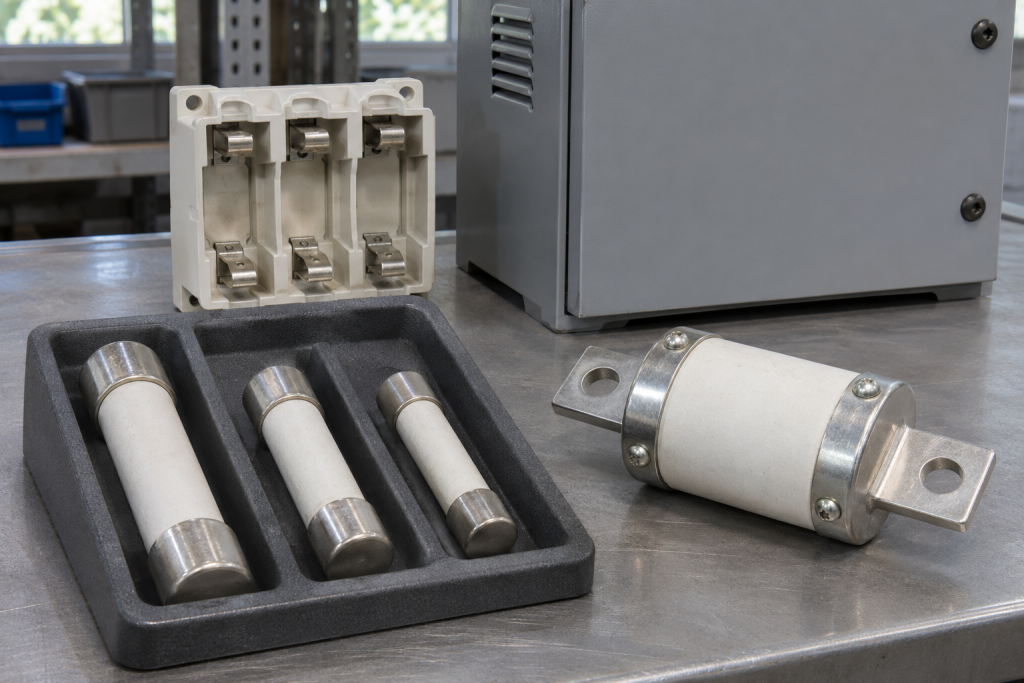
A semiconductor fuse replacement request often arrives as a current rating and a photograph. That can locate something with the right dimensions while leaving the protection requirement unresolved. For a drive or converter, a replacement that fits the holder is not automatically the fuse specified for the equipment.
Semiconductor fuse spares need an identifiable protection scope, complete order code and documented application. This guide concerns purchasing evidence for existing equipment. It is not a fuse-sizing calculation, a live fault test or permission to change an approved protection arrangement.
Identify the protected equipment first
Record the drive, converter or other assembly identity, its documented fuse position and the applicable equipment manual revision. Keep the installed fuse code with that record. A loose cartridge from a stores bin does not show which circuit it belongs to or why that variant was selected.
Ask whether the requirement is an exact documented spare or an alternative awaiting engineering review. If the original code cannot be established, keep that uncertainty visible. Do not let a supplier’s similar-looking photograph become the only basis for treating a replacement as approved.
Separate the protection class from the ampere value
Mersen’s IEC cylindrical fuse overview distinguishes its full-range gR offering from aR short-circuit protection. These descriptions concern protection scope, not simply different names for a fuse with the same current rating. Preserve the designation in the enquiry instead of copying only the amperes.
A change between classes requires review of the complete protection arrangement. Do not assume that a short-circuit protection description establishes overload coverage, or that a broader class label makes every candidate interchangeable. Obtain the exact manufacturer’s application evidence and the equipment owner’s acceptance before proposing a substitution.
For stores, record the category exactly as documented. Keep uncertain markings unresolved until the manufacturer document identifies them. A generic label such as fast fuse does not establish the required class, operating characteristics or equipment approval.
Keep voltage and interrupting conditions attached
Mersen’s power-electronics fuse brochure presents AC and DC ratings separately, with application-dependent qualifications. That is a reason to retain the actual columns and footnotes, not to transfer a convenient value between circuits.
Ask the responsible engineer to identify the required voltage basis and interrupting conditions from the approved design. Keep those requirements separate from the normal current rating. Neither an equal ampere value nor a higher-looking headline number is a complete comparison.
Do not infer a DC application rating from an AC marking. Where the exact candidate’s documentation does not cover the intended circuit, hold the alternative for clarification. This review intentionally provides no universal conversion factor or assumed fault-current limit.
Request the relevant operating characteristics
A quotation should point to the proposed code’s technical data, not merely to a broad family description. Ask for the characteristics the equipment documentation requires, including the applicable time-current and energy-limitation information. Keep the conditions associated with those data rather than comparing isolated numbers from unrelated sheets.
The competent engineer must decide whether an alternative satisfies the installed application’s coordination requirements. Procurement can collect the evidence and identify gaps; it should not invent a numerical pass criterion to release an urgent order. A cross-reference is a starting point for this review, not a substitute for its conclusion.
Keep the relationship to the equipment manual explicit. The automation spare receiving inspection checklist supports identity and condition checks when goods arrive. Receiving inspection alone cannot qualify a change to the original protection selection.
Check the complete physical assembly
Record the specified body size, termination or bolted-tag arrangement, mating holder and any indication accessory required by the equipment. Include clear photographs and the exact mounting reference available from controlled records. Similar external dimensions do not settle electrical performance or accessory compatibility.
Mersen lists cylindrical variants with different indication arrangements. Preserve the actual required variant instead of assuming that the same family name includes every accessory. Ask which items are included in the offered assembly and which remain separate.
Inspection access, isolation and replacement belong to qualified site procedures. Do not remove an installed fuse merely to obtain a better photograph, bypass a holder, or energize an uncertain assembly as a purchasing check. Obtain records through the equipment owner’s authorized process.
Keep failure investigation outside the buying shortcut
An operated fuse is not an explanation of the fault. Preserve the equipment event record and refer the cause, associated damage and return-to-service decision to the responsible personnel. Replacing the cartridge does not demonstrate that the drive or converter is healthy.
For an unavailable legacy code, retain the manufacturer’s exact replacement guidance and identify every difference requiring acceptance. Keep the proposed alternative segregated in the stock record until that decision is complete. Delivery urgency should be recorded, but it should not erase an unresolved protection requirement.
FAQ
Does matching the ampere rating qualify a semiconductor fuse spare?
No. The complete identity, protection scope, application ratings, operating characteristics and equipment requirements need separate evidence.
Can an AC rating be assumed to cover a DC circuit?
No. Use the manufacturer’s explicit rating and conditions for the exact candidate and intended application. Do not infer equivalence from appearance.
Does aR mean the same protection scope as gR?
No. Preserve the documented class and have any proposed change reviewed against the complete protection arrangement.
Does a new fuse make equipment ready to restart after a fault?
No. Fault investigation and the authorized return-to-service decision remain separate from sourcing and receiving a spare.
Prepare the fuse spare enquiry
Use the high-speed semiconductor fuse sourcing collection as an enquiry route, not an interchange approval. Send the complete model, nameplate photos, equipment identity, discontinued-part replacement need and delivery requirement to [email protected] or WhatsApp/Phone +86 18259474341. Identify any protection question still awaiting engineering acceptance.
Route this topic into a sourcing request
Connect the article topic to a model number, category, brand, quantity, and destination before opening the RFQ.
Related Insights
Continue with sourcing and model matching guides
 Nov 28, 2026
Series 90-30 Spares: Check the RX3i Rack Boundary
Separate exact Series 90-30 spares from the verified RX3i rack, processor and retained I/O needed for a planned migration.
Read guide Nov 27, 2026
HMI Screen Spares: Identify the Failed Layer
Separate surface damage, touch input and the supported display assembly before specifying an HMI hardware spare.
Read guide Nov 26, 2026
Motor Brake Rectifier Spares: Match the Coil
Check the fitted brake coil and approved control function before treating a motor brake rectifier as an exact spare.
Read guide