
Servo Drive Spares: Match the System Before the Outage
Match servo drive spares correctly with a practical checklist for motor data, encoder feedback, cables, parameters, testing, and recovery.

A servo drive spare is not a drop-in item just because the enclosure looks the same. The motor, encoder, feedback cable, brake, load, controller, firmware, and motion application all contribute to whether a replacement axis will start and perform correctly. A wrong match can create a long commissioning problem during the exact outage window when the team needs a fast recovery.
Rockwell Automation commissioning guidance shows why motor and encoder data matter during drive setup. The broader maintenance lesson is simple: keep the spare record at system level. A drive should be sourced and tested as part of an axis, not as an isolated black box.
Start with the complete axis
Identify the drive, motor, feedback device, power cable, feedback cable, brake circuit, controller, safety interface, gearbox, and load. Record the axis function, travel or speed requirement, torque demand, duty cycle, stopping behavior, and what happens if the axis is unavailable.
Rank the axis by consequence. A packaging axis with a short manual bypass is different from a positioning axis that blocks an entire line. A failed drive may also affect safety, guarding, homing, product quality, or machine synchronization. The consequence determines how much evidence and ready coverage the spare needs.
Capture the exact drive identity
Record the complete drive part number, power class, input voltage, output current, overload rating, firmware, control mode, network interface, safety option, mounting arrangement, and installed location. Photograph the nameplate, connectors, option cards, wiring, cooling path, and adjacent equipment.
Do not rely on a family name alone. Two drives in the same family may differ in current rating, voltage, feedback interface, network option, braking capability, or safety function. A visually similar replacement may require a new parameter set, different cable, or different commissioning procedure.
Match the motor and feedback
Capture the motor model, rated voltage, current, speed, torque, thermal sensor, brake, encoder type, encoder resolution, connector, and cable length. The drive must recognize and control the motor correctly. Feedback mismatch can produce startup faults, incorrect commutation, poor positioning, or an axis that moves in an unsafe direction.
Keep the encoder and motor evidence with the drive record. If a supplier proposes a substitute motor or feedback device, treat it as an engineering change until the responsible engineer confirms compatibility, tuning, mechanical fit, and acceptance requirements.
Protect parameters and motion data
Back up drive parameters, controller projects, axis configuration, cam or profile data, homing settings, limits, tuning values, fault history, and network settings. Record the software version used to create and restore the backup. Confirm that the backup can be opened or loaded in an approved environment.
Document the rollback path before installing the spare. The team should know how to isolate the axis, restore the previous drive, validate direction and limits, and return the machine to its approved state. A parameter file without a tested restore process is not full recovery coverage.
Check cables, brake, and power dependencies
Many drive failures are complicated by accessories. Confirm motor power cable construction, feedback cable type, shield termination, connector keying, brake voltage, braking resistor, line reactor, fuses, contactors, 24 V control power, and cabinet cooling. A replacement drive can be correct while an aged cable or missing brake component prevents a successful restart.
Include the power supply and protection devices in the spare review when they can prevent the axis from returning to service. The servo motors and drives collection can support related sourcing, while the power supplies collection can help cover control-power dependencies.
Test in a controlled sequence
Define acceptance before the outage. Begin with identity, physical fit, power, and wiring checks. Then restore parameters, verify motor and feedback recognition, confirm network communication, check limits and homing, test direction at low energy, validate brake release, and perform a controlled motion test under the approved procedure.
Do not use a live machine as the first test bench for a refurbished or unfamiliar drive. Request the supplier’s inspection and test scope, then decide which checks the site must repeat. Record the final result, outstanding limitations, and person responsible for approval.
Plan for lifecycle and substitution risk
Record the drive’s lifecycle status, firmware availability, repair route, known alternates, and required evidence. An active drive may still have a long lead time or a discontinued option card. An older drive may be serviceable through repair or tested stock while the site plans a modernization.
Do not let a migration plan eliminate interim coverage. Until the new motion system is commissioned and accepted, the existing axis still needs a recovery path. Set a decision date before the planned shutdown and define whether the answer is local stock, tested regional stock, repair, an approved substitute, or a modernization project.
Write a complete RFQ
Include the drive and motor model, revision, axis function, quantity, condition requirement, encoder and cable information, brake and resistor data, destination, delivery milestone, parameter or firmware needs, test evidence, warranty, packaging, and acceptance criteria.
For used or refurbished equipment, request label photographs, serial information when available, repair notes, test scope, warranty, known limitations, and the evidence that will accompany shipment. “Tested” should always be followed by “tested for what?”
FAQ
Can a higher-power drive replace a failed lower-power drive?
Not automatically. Current limits, motor data, firmware, control mode, tuning, safety functions, braking, wiring, and machine acceptance requirements still need review.
Is the motor model enough to identify the correct spare drive?
No. The axis also depends on feedback, cables, brake, controller, application configuration, power system, and the installed drive revision.
Does a parameter backup make a replacement ready?
No. The backup must be compatible with the drive and software environment, and the site must verify restore, direction, limits, homing, safety, and motion performance.
What should be requested for a refurbished servo drive?
Request clear identity photographs, revision and serial evidence when available, inspection and repair notes, test scope, warranty, packaging details, known limitations, and acceptance criteria.
Prepare the complete axis, not just the drive
SmartNexMSK can help review servo drive and motor identity, encoder and cable dependencies, parameter evidence, substitute risk, testing requirements, and sourcing options. Send model numbers, nameplate photographs, quantity, destination, and required recovery date to [email protected] or WhatsApp/Phone +86 18259474341.
Route this topic into a sourcing request
Connect the article topic to a model number, category, brand, quantity, and destination before opening the RFQ.
Related Insights
Continue with sourcing and model matching guides
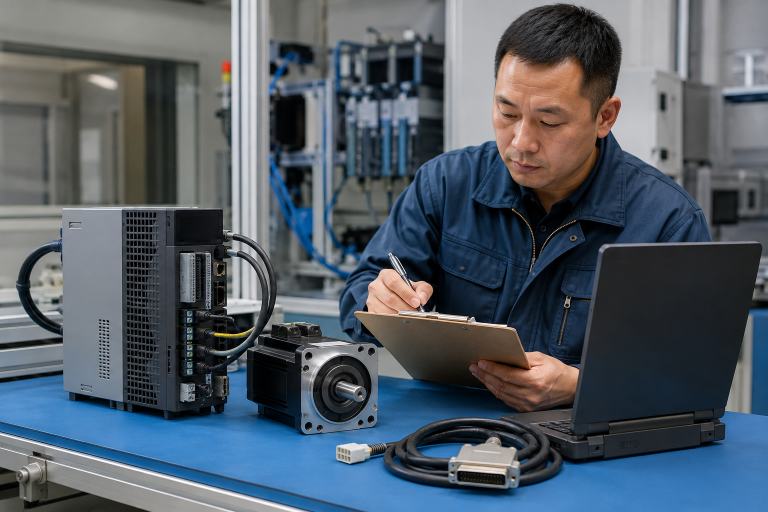 Sep 8, 2026
SANYO DENKI QS1E Spares: Save Parameters First
When a SANMOTION Q axis stops, the purchasing request often becomes a model number: “Please quote QS1E01AA0H4A3P1T.” That is a useful starting point, but…
Read guide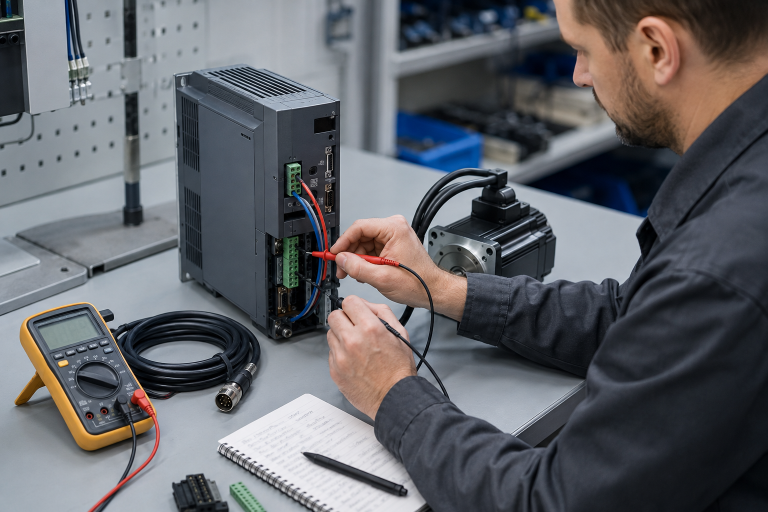 Sep 6, 2026
Yaskawa SGDH-05DE-OY Spares: Check the Servo Chain
A servo drive fault often produces a deceptively simple purchasing request: “Replace the SGDH-05DE-OY.” In a running machine, however, the amplifier is only one…
Read guide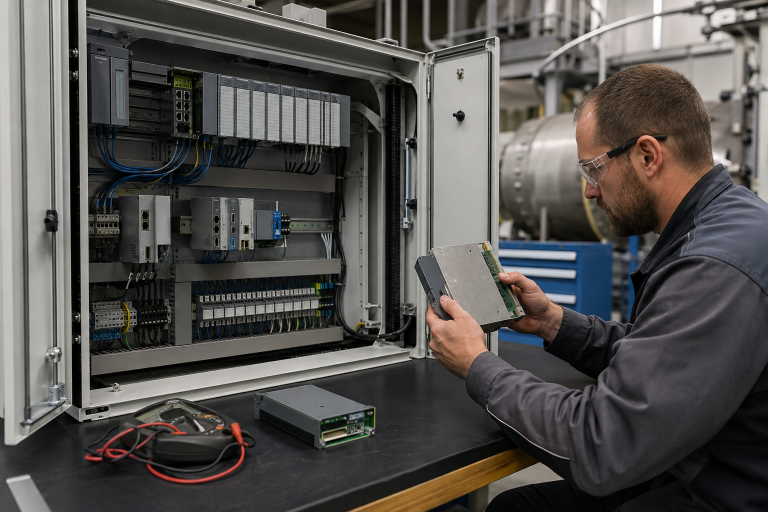 Sep 5, 2026
GE IS220PCLAH1A Spares: Check Mark VIe Fit
When a Mark VIe cabinet develops an intermittent control fault, the urgent request often becomes a single line: “Please quote IS220PCLAH1A.” That is understandable…
Read guide