
CNC Encoder Spares: Match the Feedback Interface
Check the complete CNC feedback route, not just the line count, before accepting an encoder spare or a proposed alternative.
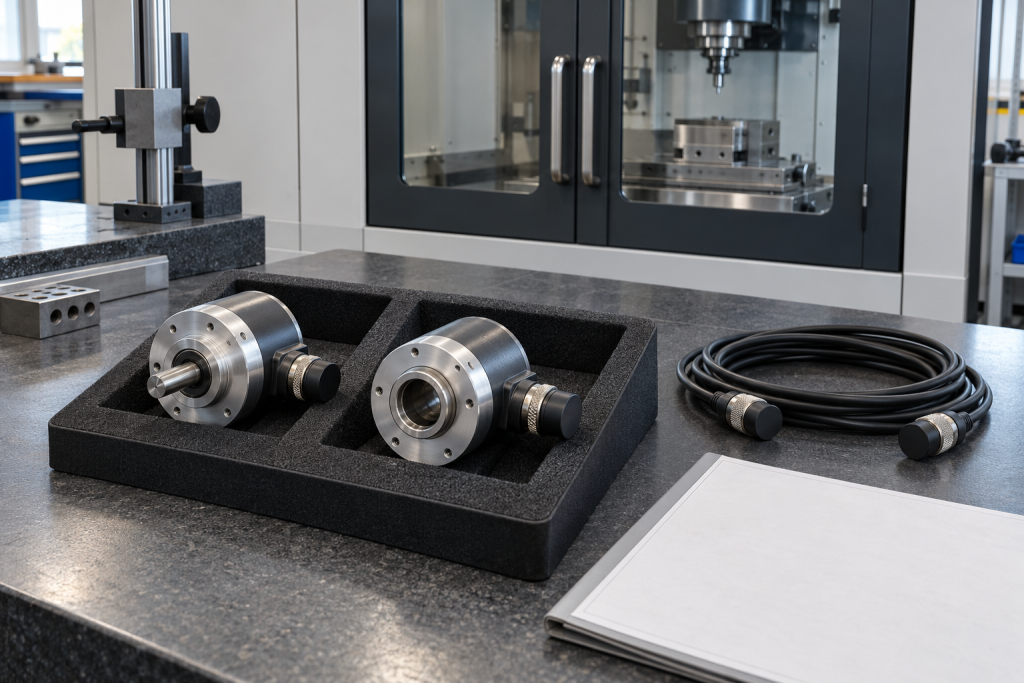
A CNC encoder spare can match the mounting space and advertised line count yet remain unsuitable for the machine’s feedback input. During an outage, that mismatch is easily mistaken for a commissioning fault. The purchasing problem starts earlier: a request that names the encoder but leaves its interface, receiving electronics and installed role undefined.
For a machining cell, define the spare against the complete feedback route. The objective is not to find a device with an impressive resolution figure. It is to preserve the approved relationship between measured movement and the control system, with any proposed change reviewed before the machine returns to service.
Identify the feedback route on this machine
Record the encoder, cable, any intermediate electronics and the receiving drive or controller input. Identify which axis or spindle uses the signal and what the machine builder’s documentation says that feedback does. Do not assume that a motor-mounted device and a separate position-measuring device serve the same function.
Photograph complete nameplates and connector arrangements without disturbing the installed system. Preserve the machine model, applicable drawing revision and input designation with the spare record. A cabinet photograph alone rarely establishes where a cable terminates or which interface the receiver expects.
The CNC machinery application page provides the sourcing context. A specific replacement still needs machine-level evidence; neither an application category nor a supplier’s compatibility headline establishes approval for an individual axis.
Separate line count from controller counts
HEIDENHAIN’s encoder FAQ explains where line count appears on an identification label and distinguishes resolution from measuring accuracy. Keep the manufacturer’s original terminology in the enquiry. A finer measuring step is not, by itself, proof of better accuracy or of compatibility with an existing control configuration.
Dynapar’s encoder FAQ distinguishes quadrature signals from multiplication performed by the controller. Consequently, a controller count figure must not be silently substituted for an encoder’s pulses-per-revolution specification. Record the encoder figure and the documented evaluation method as separate fields, rather than compressing both into an ambiguous “resolution” entry.
Dynapar also identifies encoder and controller frequency capability as constraints when choosing PPR. For an alternate, ask engineering to confirm the relevant limits against the machine’s approved operating range. This is an application review, not a reason for purchasing to choose a higher line count as an automatic upgrade.
Keep the full interface designation
Write down the electrical signal or serial interface, its full designation, supply requirement, connector and applicable pin-assignment document. Similar housings and mating connector shells do not establish that the signals are interchangeable. Treat missing electrical information as an open requirement, not a detail that can be settled by trying the device on the machine.
The HEIDENHAIN FAQ gives a useful example: EnDat02 and EnDat22 are ordering designations with different connection-relevant characteristics, including whether incremental signals are present. It directs readers to the technical documentation and its exceptions. An enquiry saying only “EnDat encoder” therefore leaves an important qualification gap.
This example is not a universal compatibility rule for every encoder carrying an EnDat description. Retain the complete ID and exact variant documentation, and ask the machine owner to confirm support at the receiving input. Do not infer substitution approval from a shared interface family name.
Include intermediate electronics in the comparison
A spare review can miss an installed conversion stage. HEIDENHAIN’s signal-converter overview distinguishes products by input and output interfaces and notes that signals can be interpolated. The converter’s role is part of the feedback route, not just an accessory description.
If the drawing includes such a device, record its exact identity and documented configuration alongside the encoder and receiver. Ask whether the proposed replacement assumes that the existing converter remains in use. A claim that an encoder “works with the controller” is incomplete if it quietly assumes different intermediate electronics.
Do not add an adapter, change interpolation or alter machine scaling to make an urgent spare appear compatible. Any such proposal belongs in the site’s engineering-change process, with its consequences assessed by the responsible machine specialist.
Define the offered unit before issuing the order
Keep exact replacement and engineered alternative as separate purchasing paths. Request the complete offered identification, clear label photographs, condition, included cable or connector items and the documentation used to support the match. Record unresolved differences and who must accept them. A supplier’s quotation should not silently become machine-builder approval.
The rotary encoder collection can support identification. It is not an approved interchange list. Compare any listing with the manufacturer’s exact variant record before recommending a unit; stop the recommendation when the stated interface or electrical requirements conflict.
Where the enquiry also includes the motor or drive, the servo drive and motor matching RFQ guide helps organize the companion identities. Keep the encoder-specific qualification attached rather than assuming that a matching drive family settles it.
Agree acceptance before the outage
Have the machine owner define the controlled checks needed after replacement, including the correct feedback relationship and any machine-builder requirements for reference or datum verification. Keep component-level evidence separate from acceptance of the machine’s positioning performance. Neither a powered encoder nor a plausible position display proves the whole machine is ready.
This guide does not authorize live feedback disconnection, parameter changes, axis movement, interlock bypasses or safety-function modifications. Use qualified personnel and the machine builder’s approved maintenance and commissioning procedures. Record the evidence and outstanding limitations before counting the spare as recovery-ready.
FAQ
Is matching the line count enough?
No. Confirm the interface, supply, connection, mechanical arrangement and receiving-system requirements as well.
Are encoder PPR and controller counts identical?
Not necessarily. Preserve the encoder specification and the controller’s documented evaluation method separately.
Can EnDat02 and EnDat22 be treated as the same order?
No. Check the full designation and exact device and receiver documentation before accepting a replacement.
Does an existing converter remove the need for interface checks?
No. Its input, output and documented configuration are additional parts of the comparison.
Prepare the encoder review
Send model numbers, nameplate photographs, discontinued-part replacement needs and delivery requirements to [email protected] or WhatsApp/Phone +86 18259474341. Include the machine, feedback role and known interface constraints, and state whether an alternative may be reviewed.
Route this topic into a sourcing request
Connect the article topic to a model number, category, brand, quantity, and destination before opening the RFQ.
Related Insights
Continue with sourcing and model matching guides
 Nov 28, 2026
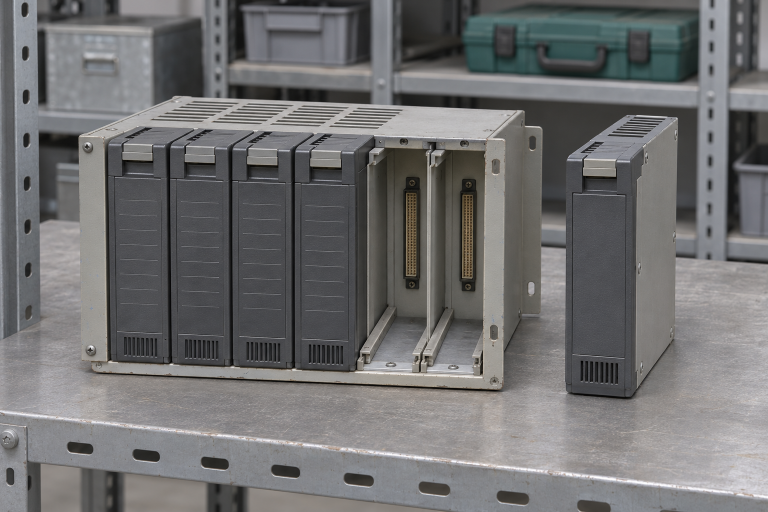
Series 90-30 Spares: Check the RX3i Rack Boundary
Separate exact Series 90-30 spares from the verified RX3i rack, processor and retained I/O needed for a planned migration.
Read guide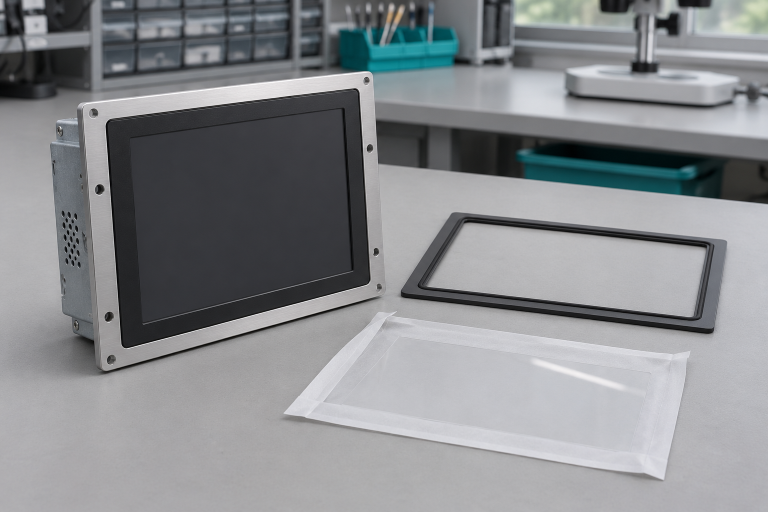 Nov 27, 2026
HMI Screen Spares: Identify the Failed Layer
Separate surface damage, touch input and the supported display assembly before specifying an HMI hardware spare.
Read guide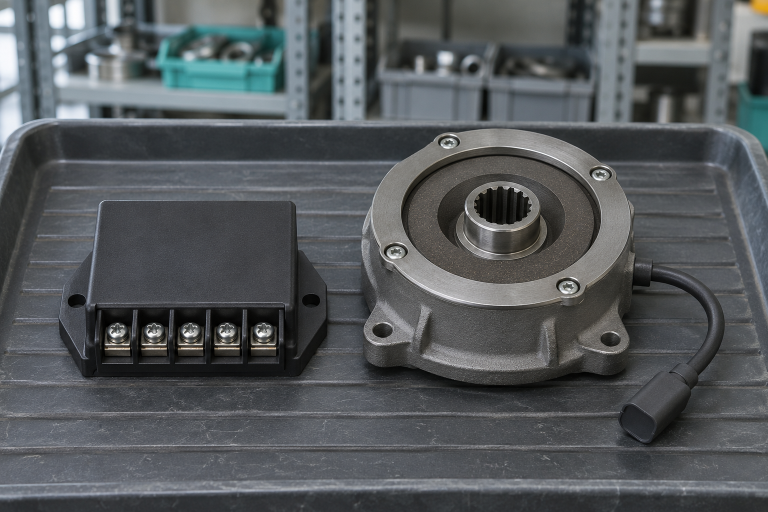 Nov 26, 2026
Motor Brake Rectifier Spares: Match the Coil
Check the fitted brake coil and approved control function before treating a motor brake rectifier as an exact spare.
Read guide