
CompactLogix L32E Spares: Read Lifecycle Correctly
Distinguish discontinued L32E hardware, listed firmware and functional replacement before defining a recovery spare or migration scope.
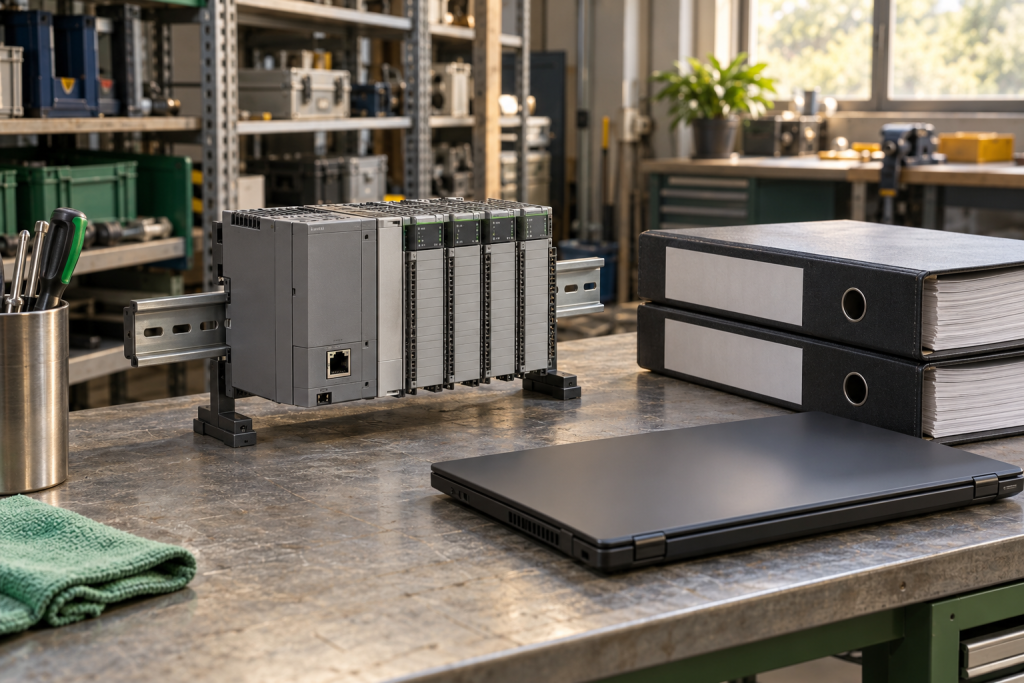
A purchasing request for a 1769-L32E can stall on a misleading question: if firmware is still listed online, is the controller really obsolete? For a maintenance team, that ambiguity matters. Hardware availability, software access and an executable recovery plan are separate decisions. A download page cannot answer all three.
CompactLogix L32E spares should therefore be evaluated against a dated manufacturer record and the installed application, not a seller’s broad description of support. The practical objective is to keep a defined machine recoverable while preparing a credible exit from a discontinued platform.
Start with the exact lifecycle record
Rockwell Automation’s 1769-L32E product record identifies the controller as Discontinued, with a discontinuation date of December 16, 2020. It also gives the replacement category as Functional Replacement. These are established lifecycle facts, not a new announcement in October 2026.
Record the catalog number, selected hardware series, source URL and retrieval date in the asset file. Do not transfer that status to every controller carrying a 1769 prefix. A family name is useful for organizing inventory, but it is not sufficiently precise evidence for a purchase decision.
Separate hardware status from service availability
Rockwell’s lifecycle definitions distinguish an announced end-of-life stage from discontinuation. The discontinued stage means new product is no longer manufactured or procured; repair or exchange may remain possible. That wording is conditional, not a commitment for a particular unit, location or deadline.
For procurement, request separate answers for physical availability, condition, repair eligibility and any return obligations. A supplier’s possession of an older unit does not change the manufacturer’s lifecycle status. Equally, the discontinued label alone does not establish whether a specific repair quotation can be obtained today.
Keep the accepted scope in writing. If the offer depends on a repairable core, identify who evaluates it, what happens when it is rejected, and whether the quoted schedule starts before or after receipt. An unresolved commercial condition is a recovery dependency, not just a purchasing detail.
A listed firmware file is not a support guarantee
The Product Compatibility and Download Center entry for 1769-L32E still lists firmware and EDS resources, including version 20.019 and selectable hardware series. A listing is useful evidence of a resource, but this article does not claim that a download was completed or that every version is available under every account entitlement.
Do not infer a software or firmware lifecycle category from the presence of that file. Rockwell publishes separate version-status definitions. Nor should version 20.019 be treated as an instruction to update a running machine. The correct revision must be established through the application’s compatibility review and approved change process.
Before accepting a spare, have the engineering owner identify the installed revision, project requirements, engineering workstation and permitted recovery route. Record any unresolved access or compatibility question as a hold point. The control-system backup and restore checklist provides the broader recovery framework; the L32E decision still needs its own evidence.
Buy a defined recovery capability
A useful spare specification describes the acceptance boundary, not merely the catalog number. For an L32E request, assemble the following before approving an offer:
- Readable nameplate photographs showing catalog number, hardware series and unit identity.
- The required firmware revision and who is responsible for establishing compatibility.
- Documented condition, included accessories and the agreed limits of inspection or testing.
- The installed system configuration and the recovery files controlled by the plant.
- Return terms, unresolved exceptions and the date by which the spare must be accepted.
When comparing PLC and controller spare options, keep like-for-like recovery and modernization on different lines of the request. Otherwise, a functional successor can look like a cheaper substitute while leaving engineering work outside the quotation.
For acceptance planning, define what the plant needs demonstrated and under what conditions. A power-on result is not evidence that the installed application, network relationships and machine sequence have been validated. Avoid an unsupported universal recovery-time promise; the remaining work depends on the particular installation.
Treat functional replacement as an engineering project
The manufacturer’s replacement category does not prove a drop-in exchange. Compare the proposed architecture against the existing project, I/O arrangement, communications, software environment, mounting and commissioning constraints. Resolve differences before deciding which outage can accommodate the work.
Maintain two explicit plans: a bounded recovery plan for the installed L32E system, and a reviewed modernization plan with responsibilities and acceptance criteria. Revisit the bridge strategy when a usable spare is consumed, a required resource becomes inaccessible, or planned plant modifications change the application. More hardware cannot compensate indefinitely for an unexecutable recovery route.
Frequently asked questions
Is the 1769-L32E discontinued?
Yes. The manufacturer record reviewed on October 19, 2026 identifies it as Discontinued and states December 16, 2020 as the discontinuation date. Recheck the exact catalog record before committing a purchase.
Does firmware availability mean full support continues?
No. A listed resource and a hardware lifecycle status describe different things. Confirm the relevant version status, access conditions and support scope separately rather than treating a download listing as a service commitment.
Can a functional replacement be installed without changes?
Do not assume so. The replacement category is not application-specific compatibility evidence. Engineering must resolve project, I/O, communication and installation differences and approve the commissioning plan.
Should a replacement spare receive the newest listed firmware?
Not automatically. Establish the approved revision for the installed application and validate any proposed change. A purchase order should identify who owns that decision instead of leaving it to an unspecified pre-shipment update.
Should procurement request a spare or a migration quotation?
Request separate scopes when both are needed. A spare supports a defined recovery route; migration changes the system. Compare total remaining work and acceptance responsibilities, not hardware prices alone.
Discuss the installed requirement
Send the complete model, nameplate photographs, discontinued-part replacement requirement and required delivery date to [email protected] or WhatsApp/Phone +86 18259474341. Include the installed firmware and whether the request concerns like-for-like recovery or a planned migration so the scope can be clarified before quotation.
Route this topic into a sourcing request
Connect the article topic to a model number, category, brand, quantity, and destination before opening the RFQ.
Related Insights
Continue with sourcing and model matching guides
 Nov 28, 2026
Series 90-30 Spares: Check the RX3i Rack Boundary
Separate exact Series 90-30 spares from the verified RX3i rack, processor and retained I/O needed for a planned migration.
Read guide Nov 27, 2026
HMI Screen Spares: Identify the Failed Layer
Separate surface damage, touch input and the supported display assembly before specifying an HMI hardware spare.
Read guide Nov 26, 2026
Motor Brake Rectifier Spares: Match the Coil
Check the fitted brake coil and approved control function before treating a motor brake rectifier as an exact spare.
Read guide