
DC UPS Spares: Read the Runtime Evidence
Keep supported loads, required buffer time, UPS and storage identities and manufacturer runtime evidence together before accepting a spare.
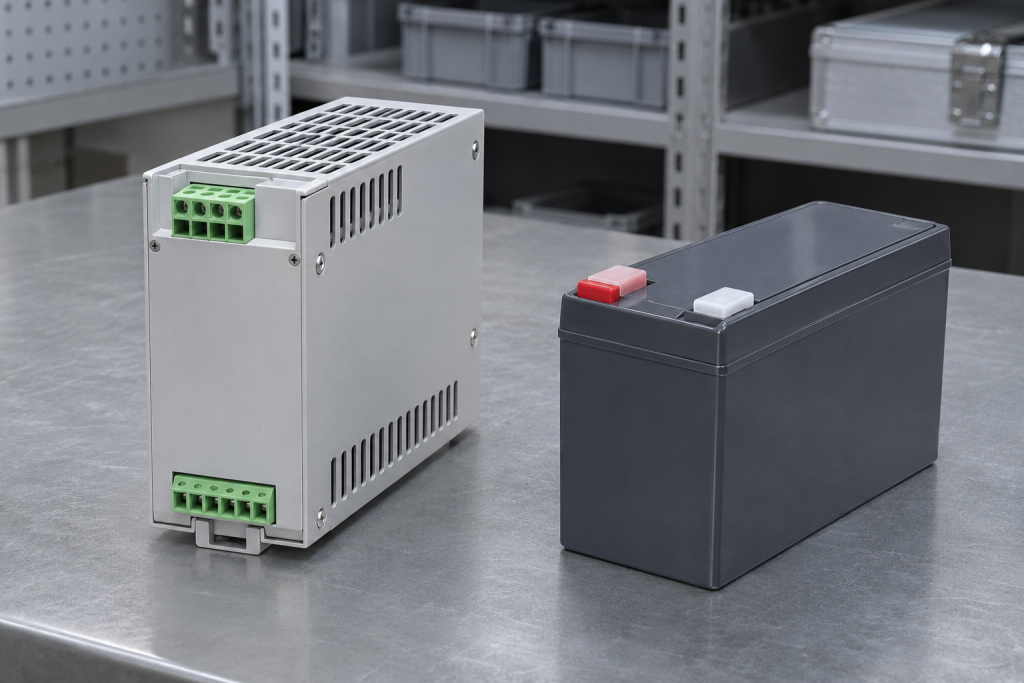
A DC UPS spare can match the output voltage and current on an enquiry while leaving the required operating time unresolved. The controller may need time for an orderly shutdown, while an added communication device has changed the supported load. A quotation for the same-sized box does not show that either requirement is covered.
For DC UPS spares, keep the supported load, required time and energy-storage identity in one evidence record. This guide concerns purchasing and documentary acceptance, not wiring, disconnecting batteries or interrupting a production supply. Electrical isolation, stored energy and application verification remain under the equipment owner’s approved procedures.
Define the load that needs the time
Ask the controls owner which devices belong to the approved buffered supply and what each must accomplish during an interruption. Distinguish maintaining a controller, preserving communication and completing a controlled shutdown. Do not assume that every device in the cabinet belongs on the same supported branch.
Record the approved load information and any documented changes since the original UPS selection. Include the relevant operating condition, rather than copying a controller’s nameplate alone. Procurement should request this information from the responsible engineer, not measure a live circuit or move loads between terminals.
State the required UPS buffer time and its purpose. A commercial description such as extended backup is not an acceptance criterion. Record who owns the time requirement and the document defining it. Continued electrical supply does not by itself establish a safe process response.
Keep the three component identities together
Phoenix Contact’s DC UPS overview describes modular combinations of a power supply, UPS module and energy storage, as well as integrated constructions. Establish which arrangement the installed system uses before comparing offers. A replacement electronics module and a complete supported-power assembly are different supplies.
Keep the full UPS reference, upstream supply identity and storage-module code together. List separately supplied accessories and the applicable document revisions. Where an assembly combines functions in one housing, preserve that boundary rather than treating every similar-looking module as a direct replacement.
The existing power-supply duty and redundancy guide explains the broader architectural distinction. This review adds the narrower runtime evidence: which documented combination supports which load for the required interval.
Read the runtime chart with its conditions
Phoenix Contact’s QUINT UPS technical reference presents buffer-time charts against load current for identified storage modules. Its charts also state ambient-temperature and start-of-use conditions. These are conditions of the published evidence, not a universal runtime promise for every stored spare.
Ask engineering to identify the applicable chart or selection reference for the complete proposed combination. Keep its load basis, storage identity and stated conditions beside the requested duration. Do not transfer a headline maximum from another battery module or read an electronics current rating as a number of minutes.
A supplier’s summary should identify the source of a runtime statement. Distinguish a manufacturer’s reference condition, a calculation reviewed for the application and a separately authorised test report. If the load or reference condition is missing, mark the duration unresolved rather than filling the gap with a convenient catalogue figure.
Keep storage technology and condition visible
A DC UPS battery module needs more identity than its nominal capacity. Phoenix Contact’s energy-storage overview distinguishes battery technologies and product-specific application conditions. The family description alone does not establish that another chemistry, connector or module is approved for the installed charger and UPS.
Request the exact storage-module reference and the applicable manufacturer requirements for handling, storage and charging. Preserve available date-code and service-history information without treating a label date as proof of remaining capacity. Unknown history should remain an explicit question in the acceptance record.
Have the responsible reviewer address the required starting condition and any recharge requirement relevant to the operating plan. This article supplies no charging setting, replacement interval, capacity correction or permission to open a sealed module. A generic battery illustration is not an approved component pairing.
Separate evidence collection from application acceptance
Record the monitoring and interface functions the installation actually uses, including the documented response to an unavailable or depleted storage module. Ask who will review any proposed difference. A lit indicator or normal output voltage is only one observation, not proof of the complete runtime requirement.
The published DC UPS buffer module category is a sourcing route, not a compatibility or safety approval. No individual listing is endorsed here for an unidentified installation. Keep electronics, storage and accessory requirements explicit when requesting an offer.
At receipt, compare supplied identities, assembly contents and documentation with the accepted enquiry. Keep documentary review, receiving inspection and any authorised load-and-duration verification as separate records. Do not test an unidentified spare by cutting the power to operating equipment.
Count the spare as qualified coverage only when the responsible owner has resolved its identity, scope of supply and required runtime evidence. An urgent delivery date cannot resolve a missing load definition or turn an unreviewed alternative into an accepted system.
FAQ
Does matching the output current prove the required runtime?
No. Keep the supported load, storage module, required interval and applicable manufacturer evidence together.
Can a chart’s maximum time be applied to another battery?
No. Read the identified combination and conditions; do not transfer an unrelated capacity or reference point.
Does a battery date code prove its remaining capacity?
No. Preserve the documented history and condition questions. Acceptance requires the applicable evidence, not an assumed remaining-life figure.
Does successful buffering establish a safe process state?
No. Power continuity and process safety are separate acceptance questions under the equipment owner’s approved engineering arrangements.
Prepare the UPS spare enquiry
Send complete UPS and storage-module models, nameplate photographs, the documented load and runtime requirement, discontinued-part replacement need and delivery requirement to [email protected] or WhatsApp/Phone +86 18259474341. Identify unresolved application questions before accepting an alternative.
Route this topic into a sourcing request
Connect the article topic to a model number, category, brand, quantity, and destination before opening the RFQ.
Related Insights
Continue with sourcing and model matching guides
 Nov 28, 2026
Series 90-30 Spares: Check the RX3i Rack Boundary
Separate exact Series 90-30 spares from the verified RX3i rack, processor and retained I/O needed for a planned migration.
Read guide Nov 27, 2026
HMI Screen Spares: Identify the Failed Layer
Separate surface damage, touch input and the supported display assembly before specifying an HMI hardware spare.
Read guide Nov 26, 2026
Motor Brake Rectifier Spares: Match the Coil
Check the fitted brake coil and approved control function before treating a motor brake rectifier as an exact spare.
Read guide