
Delta DVP12SE PLC Advisory: Spare Risk Checks
How the Delta DVP12SE PLC advisory affects Modbus TCP exposure, spare configuration checks, and maintenance risk reviews for plants.
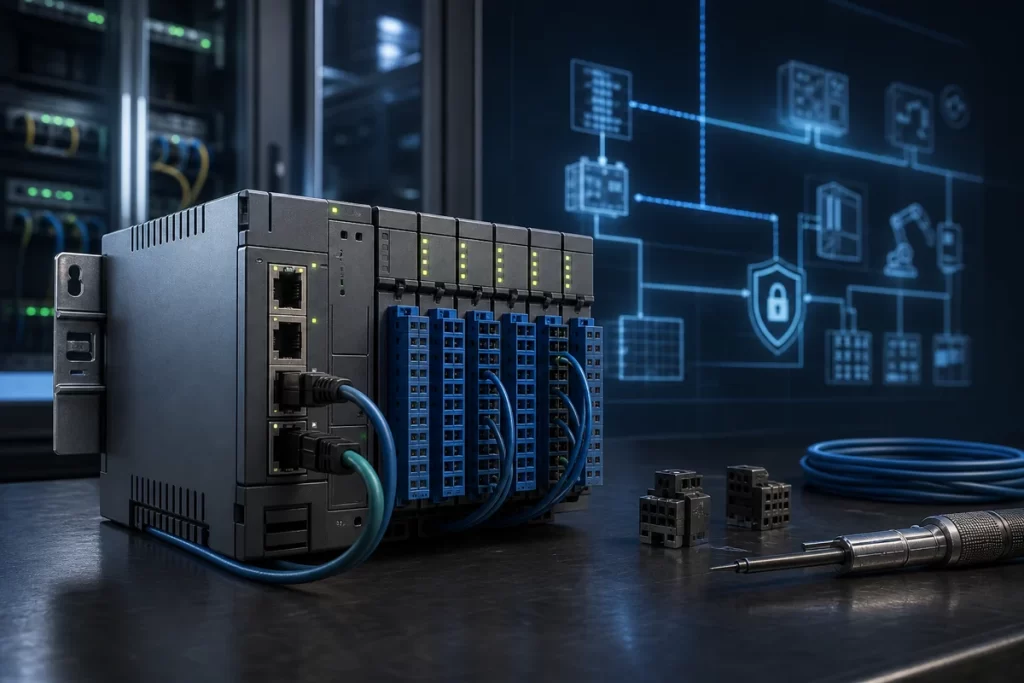
CISA’s June 30, 2026 advisory for the Delta Electronics DVP12SE PLC is the kind of notice that should make maintenance teams pause before they simply order another controller and put it on the shelf. The advisory describes two vulnerabilities affecting all versions of the DVP12SE PLC: missing authentication for critical functions and resource allocation without limits or throttling. In practical plant language, the concern is whether a reachable PLC can accept Modbus TCP interaction from the wrong source, whether its logic is protected, and whether a spare unit will be introduced with the same exposure.
The advisory assigns a CVSS v3 score of 9.8 and notes that successful exploitation could allow an attacker to remotely issue commands, modify operational values, interfere with control logic, and alter device behavior without authentication or privilege enforcement. CISA also states that no known public exploitation specifically targeting these vulnerabilities had been reported at the time of publication. That last point matters, but it should not be read as permission to wait. PLC risk becomes expensive when a plant discovers the exposure during a breakdown, a rushed replacement, or a remote support session.
Why this matters beyond the affected controller
The DVP12SE is a compact PLC, but the risk pattern is familiar across many small and mid-range controllers used in packaging machines, conveyors, utilities skids, dosing panels, and OEM-built equipment. These devices often run for years with stable logic and limited change control. If the controller is reachable over TCP/502 from a wider plant network, a maintenance engineer may inherit a cybersecurity problem created long before the current team owned the machine.
For sourcing teams, the advisory also changes the way a spare should be specified. A request for Delta automation parts should not stop at the model number. It should include the installed topology, current network exposure, whether IP Filter is enabled, whether a PLC password is configured, and whether the spare must match an existing program exactly. The model is essential, but the configuration evidence is what protects the replacement from repeating the same risk.
The spare shelf can carry the same weakness
A common mistake is to treat spare PLC hardware as electrically correct but operationally neutral. In reality, a spare can carry risk in three ways. It may be commissioned without network filtering, loaded from an old program backup, or connected temporarily to a laptop, remote access bridge, or plant switch that exposes it to networks the original machine never touched.
When evaluating industrial PLC controller sourcing, ask for more than availability and lead time. Record the exact model, hardware label photos, firmware or software environment if known, installed network addresses, connected HMI or SCADA hosts, and backup status. The strongest spare plan is not just a controller in a box; it is a controller with a documented path back into a segmented, known-good control environment.
What maintenance teams should check first
Delta’s workaround guidance in the advisory is practical: enable the PLC’s IP Filter feature, restrict access to trusted devices such as designated HMI panels or SCADA hosts, set up PLC password protection, and place the controller inside an independent OT control network protected by a firewall. CISA’s general guidance is equally familiar: minimize network exposure, keep control system devices away from the public internet, isolate control networks from business networks, and use secure, updated VPN methods if remote access is required.
For a plant maintenance team, those recommendations translate into a short field checklist. Identify every DVP12SE or similar compact PLC. Confirm whether TCP/502 is reachable beyond the machine cell. Verify which IP addresses genuinely need to communicate with the PLC. Check whether programming software can read or write logic without a password. Confirm whether the spare program backup includes network settings or only logic.
If the affected PLC communicates through gateways or machine I/O, include related communication modules and I/O hardware in the same evidence package. Many failures blamed on a PLC replacement are actually caused by missed gateway addresses, fieldbus mapping, or HMI tag assumptions. A clean RFQ should therefore capture the controller, the network path, and the operator interface.
Do not rush from vulnerability to replacement
A critical advisory does not automatically mean every unit must be replaced immediately. For many facilities, a controlled hardening plan will be better than an emergency hardware swap. The right decision depends on exposure, remote connectivity, process criticality, backup quality, and whether the plant can validate behavior after configuration changes.
This is where a structured replacement risk review for automation parts helps. The question is not simply “Can we buy another DVP12SE?” The better question is “Can we replace or harden this controller without losing logic, creating communication mismatches, or leaving the same network exposure in place?” That framing is more useful for engineers and buyers because it connects procurement, OT security, and downtime planning.
FAQ
Does this advisory mean every Delta DVP12SE PLC must be removed from service?
No. The advisory should trigger a risk review, not an automatic replacement order. Plants should first confirm network exposure, trusted communication partners, password protection, program backup quality, and whether the controller can be isolated or filtered without disrupting the process.
What information should I collect before requesting a spare PLC?
Collect the exact model, label photos, hardware revision if visible, installed program backup status, communication settings, connected HMI or SCADA hosts, panel photos, quantity, urgency, and destination. If the controller is part of a machine retrofit, include the machine function and any known downtime limit.
Should the spare be configured before it ships?
That depends on the site’s change control rules. Some plants prefer a blank verified spare, while others need preloaded logic or parameter notes. In either case, the spare should not be commissioned with default network exposure. Treat IP filtering, password handling, and backup verification as part of the spare plan.
How should procurement describe this request to avoid delays?
Use a concise request such as: “Delta DVP12SE PLC spare, existing Modbus TCP application, need model verification, network configuration notes, and replacement risk review.” Attach photos of the label, cabinet, wiring, and any connected HMI or gateway. That gives the supplier and engineering team enough context to respond usefully.
Practical next step
If your plant is reviewing Delta DVP12SE PLCs or similar compact controllers after this advisory, prepare the model evidence, network notes, current spare status, required quantity, destination, and downtime window before sourcing. SmartNexMSK can help route the request as exact spare sourcing, configuration evidence review, or lifecycle replacement planning. Send details to [email protected] or WhatsApp/Phone +86 18259474341.
Source checked: CISA ICS Advisory ICSA-26-181-07, Delta Electronics DVP12SE PLC, June 30, 2026.
Route this topic into a sourcing request
Connect the article topic to a model number, category, brand, quantity, and destination before opening the RFQ.
Related Insights
Continue with sourcing and model matching guides
 Sep 8, 2026
SANYO DENKI QS1E Spares: Save Parameters First
When a SANMOTION Q axis stops, the purchasing request often becomes a model number: “Please quote QS1E01AA0H4A3P1T.” That is a useful starting point, but…
Read guide Sep 6, 2026
Yaskawa SGDH-05DE-OY Spares: Check the Servo Chain
A servo drive fault often produces a deceptively simple purchasing request: “Replace the SGDH-05DE-OY.” In a running machine, however, the amplifier is only one…
Read guide Sep 5, 2026
GE IS220PCLAH1A Spares: Check Mark VIe Fit
When a Mark VIe cabinet develops an intermittent control fault, the urgent request often becomes a single line: “Please quote IS220PCLAH1A.” That is understandable…
Read guide