
Motor Contactor Spares: Match the Switching Duty
Match motor contactor spares to the actual switching duty, complete coil and accessory identity, and approved starter protection combination.
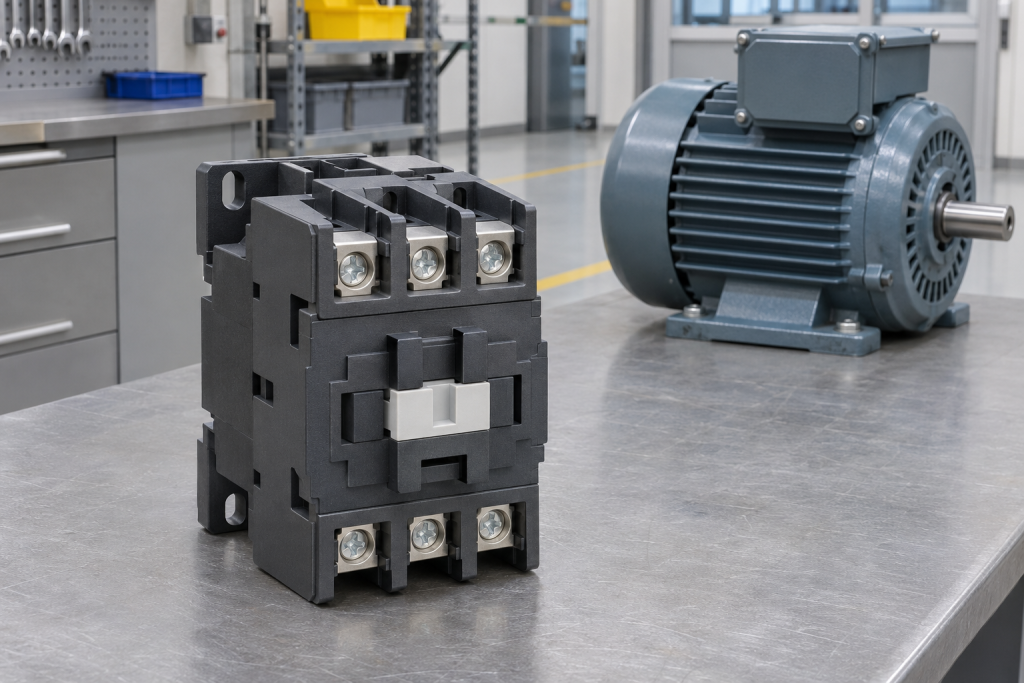
A replacement contactor can have the expected coil voltage and still be unsuitable for the motor circuit. The missing detail is often what happens when its main contacts open. Stopping a motor after it has reached normal running conditions is a different purchasing requirement from repeated short movements or electrically reversing a moving load.
For motor contactor spares, describe the switching duty before comparing current figures. This is an equipment-identification and sourcing review for ordinary motor-control circuits, not a procedure for live testing, changing a starter or substituting a safety-related component.
Record what the contactor actually switches
Identify the contactor’s function from the approved drawings and operating description. Record whether it starts and stops a motor directly, belongs to a reversing or other starter assembly, or performs a different documented role. Do not assume that every device beside a drive switches the same duty as a direct-on-line starter.
Separate the motor power circuit from the coil control circuit and auxiliary feedback. The existing relay coil and contact-duty guide addresses the control-circuit distinction. A motor contactor needs an additional review of the main switching application, not simply a larger version of a relay’s headline current.
Keep the utilization category with the rating
Schneider Electric’s AC-1 and AC-3 explanation distinguishes primarily resistive loads from squirrel-cage motor starting and opening during normal running. These category labels describe conditions associated with a rating. They are not interchangeable marketing descriptions of the same capacity.
Its utilization-category reference separately identifies AC-4 with squirrel-cage motor starting, plugging and inching. A procurement request that includes repeated short movements or interruption before normal running should preserve that requirement for the responsible engineer. Do not silently evaluate it using only an AC-3 row.
Keep the applicable category, operational voltage, current or motor-power rating and stated conditions together. A rating copied without its column heading can be misleading. Do not transfer a manufacturer’s example, or a rating for another voltage, to the offered device.
Attach the motor’s approved identity and supply information to the same review. A power value without voltage and application context is not a complete selection record. Where a motor or operating sequence has changed since the original starter was specified, identify that change explicitly. An exact copy of the old contactor is not evidence that the revised duty has been qualified.
Describe the operating pattern, not an invented derating
Ask the equipment owner to describe the approved sequence and expected switching pattern. Include starts, normal stops, any jogging or reversing requirements, and the relevant operating schedule. Mark unknown information as unresolved rather than estimating it from the contactor’s size or the operator’s preferred spare.
Schneider’s TeSys technical information presents electrical-durability selection separately for AC-3 and AC-4 duties. That supports checking the actual manufacturer’s selection conditions; it does not provide a universal percentage by which every contactor can be derated.
Mechanical endurance is not a substitute for electrical-duty evidence. Neither is a successful coil movement on a bench. Ask for the applicable rating and selection reference for the complete proposed code and intended application. Do not create a live jogging test merely to decide which spare to buy.
Preserve the starter’s protection boundary
Record the associated overload relay and short-circuit protective device, including the approved combination reference. A contactor’s motor-switching rating does not by itself establish the complete starter’s short-circuit performance. Any alternative must be reviewed as part of the installed assembly rather than in isolation.
Schneider’s coordination explanation distinguishes Type 1 and Type 2 outcomes after a short circuit and recognizes that contact welding can require manufacturer-defined measures. Do not translate a Type 2 description into a promise that no inspection is needed after any real fault.
If failure involved a protection trip or visible damage, keep the investigation and return-to-service decision with qualified site personnel. Buying a contactor does not authorize resetting protection, reusing damaged components or changing the protection arrangement. This review does not prescribe fuse sizes, overload settings or fault-current calculations.
Make the offered assembly identifiable
Retain the full contactor code and coil designation, main-pole arrangement, required auxiliary contacts, mating accessories, mounting and connection details. Include the approved interlock arrangement where relevant. A common frame size or the same family name does not establish that all suffixes or accessories match.
Use the AC contactor sourcing collection to organize the enquiry after the duty has been defined. It is not an interchange table, and no listed variant is endorsed as suitable for an unidentified installation. Require the supplier to identify the offered unit and disclose every difference before purchase approval.
Agree who will resolve any difference in the operating pattern or protection combination before an order is released. Keep the original document reference and the accepted revision together. A purchasing note that an alternative was discussed should not become an engineering approval merely because the delivery deadline is approaching.
Keep the comparison in one short record: installed identity, motor duty, category and voltage, operating pattern, coil requirement, protection combination, accessories, supporting documents and acceptance owner. Distinguish exact replacement from an alternative awaiting review. Record unresolved questions before shipment rather than letting stores count an unqualified unit as available coverage.
FAQ
Does matching the coil voltage qualify a motor contactor spare?
No. Main-circuit duty, applicable ratings, the complete variant and the starter assembly require separate evidence.
Can an AC-1 current rating be used as a motor rating?
No. Read the manufacturer’s rating for the actual utilization category, voltage and conditions; do not transfer an unrelated rating.
Does an AC-3 rating automatically cover inching or plugging?
No. Preserve the actual operating pattern and obtain the applicable engineering selection rather than assuming category equivalence.
Does Type 2 coordination remove post-fault checks?
No. Follow the applicable combination documentation, manufacturer instructions and qualified site assessment before return to service.
Prepare the contactor spare review
Send complete model and coil codes, nameplate photos, the motor duty, discontinued-part replacement needs and delivery requirements to [email protected] or WhatsApp/Phone +86 18259474341. Identify any proposed alternative and the application questions still awaiting engineering acceptance.
Route this topic into a sourcing request
Connect the article topic to a model number, category, brand, quantity, and destination before opening the RFQ.
Related Insights
Continue with sourcing and model matching guides
 Nov 28, 2026
Series 90-30 Spares: Check the RX3i Rack Boundary
Separate exact Series 90-30 spares from the verified RX3i rack, processor and retained I/O needed for a planned migration.
Read guide Nov 27, 2026
HMI Screen Spares: Identify the Failed Layer
Separate surface damage, touch input and the supported display assembly before specifying an HMI hardware spare.
Read guide Nov 26, 2026
Motor Brake Rectifier Spares: Match the Coil
Check the fitted brake coil and approved control function before treating a motor brake rectifier as an exact spare.
Read guide