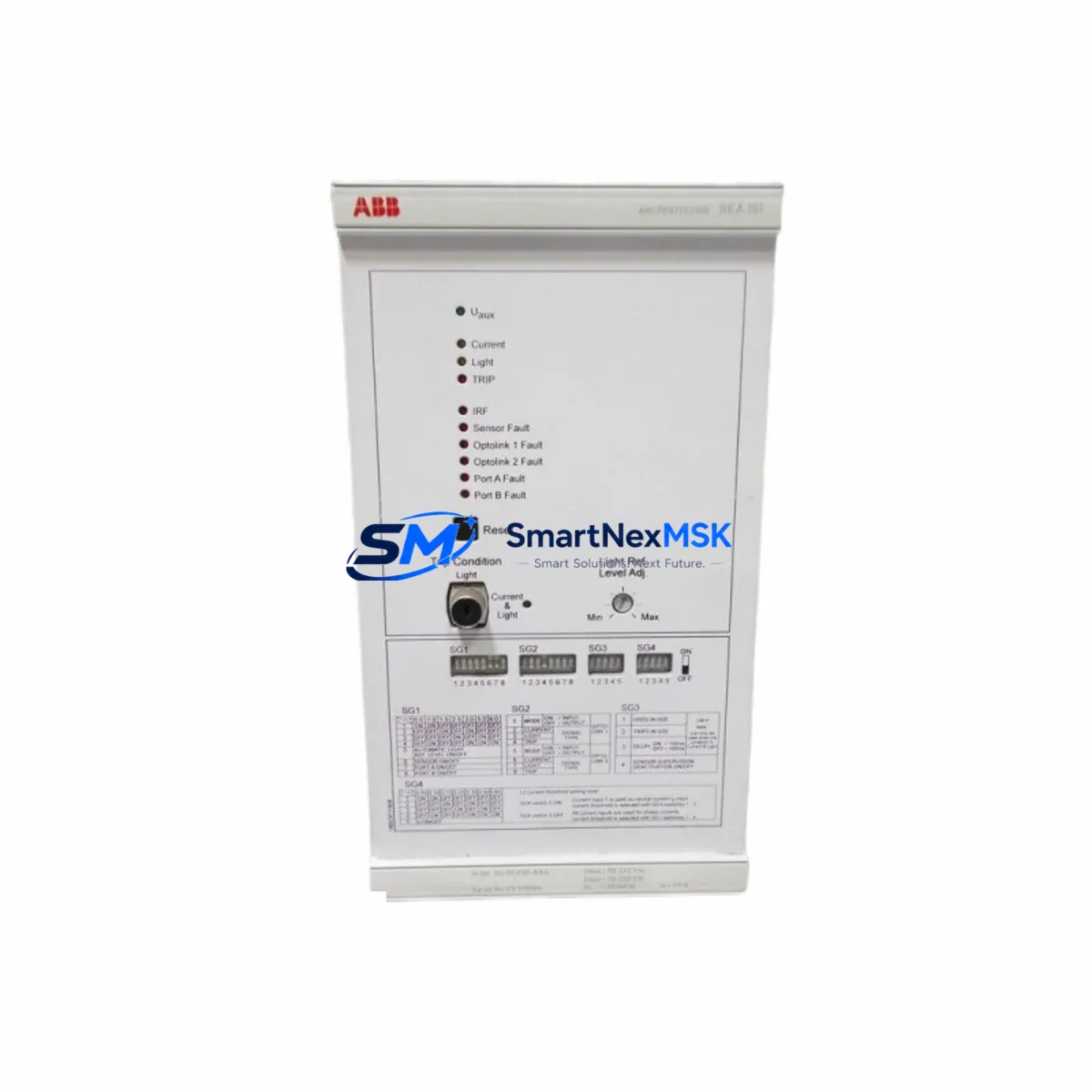
ABB REA101-AA Retrofit-Ready Arc Flash Relay for REA100 Control Systems
When aging medium-voltage switchgear protection systems reach end-of-life or when a plant-wide safety upgrade is mandated, the ABB REA101-AA arc flash detection relay stands out as the most reliable retrofit path for facilities that originally deployed the REA100 series. Designed to slot directly into existing protection architectures, the REA101-AA preserves the core logic of arc flash detection while delivering enhanced sensitivity, faster trip response, and improved compatibility with modern protection coordination schemes. For maintenance engineers managing MV switchgear in substations, industrial distribution panels, or process plant switchrooms, this module eliminates the need for full panel redesign and dramatically reduces the engineering hours required for a safe, verified cutover.
The REA101-AA operates on the same fundamental principle as its predecessor — optical arc flash detection combined with overcurrent supervision — but introduces a more robust sensor interface and a cleaner relay output architecture. Facilities that previously relied on the REA100 will find that terminal assignments, auxiliary power requirements, and trip output wiring are closely aligned, making the physical swap straightforward once the protection engineer has reviewed the updated wiring diagram and confirmed the auxiliary voltage supply. The module accepts both 24 VDC and 48 VDC auxiliary inputs, which covers the majority of existing battery-backed DC distribution panels found in legacy switchgear installations.
Upgrade Compatibility Table
| Parameter | Details |
|---|---|
| SKU / Part Number | REA101-AA |
| Brand / Series | ABB / REA100 Series |
| Product Type | Arc Flash Detection Relay (Protection Relay) |
| Replaces / Upgrades | ABB REA100 Series (REA100, REA101 legacy variants) |
| Detection Method | Optical arc flash sensor + overcurrent supervision |
| Auxiliary Voltage | 24 VDC / 48 VDC (compatible with legacy DC panels) |
| Trip Output | Relay contact output, compatible with existing trip coil wiring |
| Sensor Interface | Point and arc sensor inputs; backward-compatible sensor wiring |
| Communication | Compatible with REA100-era protection coordination schemes |
| Mounting / Form Factor | DIN rail / panel mount; same footprint as REA100 series |
| Operating Temperature | -10°C to +55°C |
| Origin | Germany (ABB) |
| Warranty | 12-Month Warranty — covered from date of shipment |
| Pre-Shipment Testing | Full functional test performed before dispatch |
Retrofit Planning for Existing Automation Systems
A successful REA101-AA retrofit begins well before the physical module arrives on site. The protection engineer must first audit the existing REA100 installation: document the current sensor layout (point sensors, arc sensors, or fibre-loop sensors), verify the auxiliary DC supply voltage and available current capacity, and capture the existing trip output wiring to the circuit breaker trip coils or contactor coils. In most REA100 installations, the trip circuit is wired through a dedicated terminal block on the protection panel, and the REA101-AA uses a compatible terminal assignment that allows direct reconnection without re-routing cables.
During the planning phase, it is equally important to review the upstream and downstream protection coordination. The REA101-AA is typically installed alongside an ABB REF615 feeder protection relay or an ABB REM615 motor protection relay, both of which provide the overcurrent supervision signal that the arc flash relay uses to confirm a genuine arc event before issuing a trip. If the existing installation uses an older ABB SPAJ 140 C overcurrent relay for this supervision function, the engineer should verify the output contact rating and signal timing to ensure compatibility with the REA101-AA’s input requirements.
For facilities that are simultaneously upgrading their protection panel infrastructure, the REA101-AA integrates cleanly with ABB’s COM600 series station automation units and can be monitored via IEC 61850 GOOSE messaging when paired with a compatible IED gateway. In installations where the existing communication backbone relies on older serial protocols, a protocol converter or an ABB RIO600 remote I/O unit may be used to bridge the legacy communication link to the new protection architecture. The REA101-AA’s relay output contacts are also compatible with ABB’s SACE Emax 2 and Tmax XT series circuit breakers, which are common choices in MV/LV transformer secondary switchboards undergoing simultaneous upgrade.
Sensor wiring is another critical checkpoint. The REA100 series typically used ABB’s standard point arc sensors (TVOC-2 type) or fibre-loop sensors. The REA101-AA supports the same sensor families, so existing sensor cabling can generally be reused. However, the engineer should inspect sensor cable insulation and connector integrity, particularly in installations that have been in service for more than ten years, as degraded sensor cables are a common source of nuisance trips after a relay replacement. Where sensors are replaced as part of the upgrade, ABB TVOC-2 point sensors are the recommended choice for new installations.
Downtime Control During System Migration
Minimising unplanned downtime during a protection relay replacement is a primary concern for any plant operating continuous processes. The REA101-AA retrofit is designed to support a structured, low-risk cutover procedure. The recommended approach is to prepare the new relay on the bench — configure the auxiliary voltage connections, verify the trip output wiring against the updated wiring diagram, and perform a bench-level functional test using a portable arc flash test kit — before the scheduled outage window begins.
During the outage, the sequence is: isolate the switchgear bay, remove the REA100 module, install the REA101-AA using the existing mounting hardware, reconnect the terminal wiring following the updated wiring schedule, restore auxiliary power, and perform an on-site trip test to confirm correct operation. In most installations, this sequence can be completed within a two-to-four hour maintenance window, provided the pre-outage preparation has been thorough. The REA101-AA’s factory-tested condition means that no additional calibration is required on site — the module arrives ready for installation.
For facilities where even a short outage is operationally sensitive, a parallel commissioning approach can be used: install the REA101-AA in a temporary position within the panel, connect the sensor inputs and verify detection function, then perform the final trip output cutover during a brief planned interruption. This approach is particularly effective in continuous manufacturing environments such as chemical plants, paper mills, or data centre power distribution systems where arc flash protection must remain active at all times. Throughout the migration, the original REA100 module should be retained as a spare until the REA101-AA has completed a full commissioning verification cycle.
Retrofit Support FAQ
Q1: Is the REA101-AA a direct drop-in replacement for the REA100?
The REA101-AA is designed as the primary upgrade path for REA100 series installations. Terminal assignments, auxiliary voltage requirements, and sensor interfaces are closely aligned. A wiring review against the REA101-AA installation manual is recommended before installation to confirm compatibility with your specific panel configuration.
Q2: What pre-shipment testing is performed on the REA101-AA?
Every REA101-AA unit undergoes a full functional test before dispatch, including auxiliary power-up verification, sensor input response check, and trip output contact continuity test. A test record is available upon request. All units are covered by a 12-month warranty from the date of shipment.
Q3: Can the REA101-AA be used with existing REA100-era arc sensors?
Yes. The REA101-AA supports the same point arc sensor and fibre-loop sensor families used with the REA100 series. Existing sensor cabling can typically be reused, subject to a site inspection of cable and connector condition. ABB TVOC-2 point sensors are recommended for any sensors replaced as part of the upgrade.
Q4: What is the lead time and supply continuity for the REA101-AA?
Units are held in stock and available for immediate dispatch. For projects requiring multiple units or phased delivery schedules, long-term supply agreements are available. Contact our team to confirm current stock levels and arrange a delivery schedule aligned with your project timeline.
© 2026 SMARTNEXMSK. All rights reserved.
Original Source: https://smartnexmsk.com
Contact: [email protected] | +86 18259474341