
ABB AC 800M Spare Planning: Lifecycle Risk Checks
Practical checks for ABB AC 800M spare planning, controller revisions, power supply evidence, lifecycle parts, and outage risk.

ABB AC 800M controllers are usually discussed as reliable control hardware, but plant maintenance teams see the lifecycle question differently. An ABB AC 800M controller CPU spare, communication interface, I/O module, power supply, or terminal assembly may run quietly for years, then become urgent when a shutdown, expansion, or unexpected fault exposes how little evidence exists for the installed base. The spare part decision is no longer only about finding a module. It is about confirming the exact installed context before a replacement is allowed near a running process.
ABB’s public LifeCycle Parts Services page describes authorized new parts, refurbished and exchange spare parts, repair, testing, emergency support, and parts lifecycle services for distributed control systems. That is useful because it frames spare parts as an uptime and lifecycle discipline, not a simple catalog transaction. For buyers and engineers, the practical lesson is clear: AC 800M spare planning should start before the failure, while the cabinet is accessible and the revision evidence can still be captured calmly.
Why AC 800M spares need lifecycle evidence
The AC 800M controller family can sit inside larger ABB System 800xA environments, packaged control panels, process skids, utility systems, or brownfield upgrade projects. Two plants may request the same controller name but have very different hardware roles, firmware expectations, communication paths, field wiring, and cabinet power arrangements. A spare that is correct for one site may be incomplete or risky for another.
This is why ABB automation parts sourcing should not begin with a short message such as “need AC 800M CPU.” The request should include the exact module number, front label, side label, revision or version marking, installed slot, associated I/O, cabinet power supply, communication interface, and whether the spare is needed for emergency recovery, planned outage preparation, or long-term warehouse replenishment.
Revision matching is part of the engineering work
Many lifecycle problems appear during replacement, not during purchasing. The buyer finds a module with the right broad description, the warehouse ships it, and the maintenance team only discovers the mismatch when the installed cabinet is open. The problem may be a different revision, missing terminal base, incompatible communication accessory, unverified repair history, wrong power assumption, or incomplete configuration evidence.
A disciplined replacement risk review for obsolete automation parts helps separate three questions that are often mixed together: is the module physically available, is it technically compatible, and is it ready for a safe commissioning attempt? For AC 800M hardware, the answer depends on the exact controller role and the condition of the supporting system around it.
Power, communication, and I/O dependencies matter
An AC 800M spare plan should not stop at the CPU. Controller recovery can also depend on power modules, communication interfaces, I/O hardware, terminal units, cabinet wiring, grounding, and configuration backup quality. A plant may own a controller spare but still lose time because the failed unit exposed a weak power supply, damaged connector, missing cable, or unverified interface module.
For that reason, combine controller planning with related industrial power supply sourcing and communication modules and I/O hardware checks. The goal is not to buy everything at once. The goal is to know which surrounding parts could block recovery if the controller has to be changed under time pressure.
When spare stock is not enough
Some plants have AC 800M spares on the shelf but cannot prove their readiness. The package may be old, the label may be incomplete, the storage history may be unclear, or the module may have been pulled from a panel years ago without test notes. During a planned outage that uncertainty is uncomfortable. During an unplanned shutdown it can become expensive.
ABB’s lifecycle parts language is useful here because it highlights testing, repair, exchange, emergency delivery, and lifecycle availability as separate service questions. A maintenance team should mirror that thinking internally. Mark whether each spare is unused, repaired, exchange, tested, unknown surplus, or installed pull. Store anti-static hardware correctly. Keep photos and revision records in the same location as the spare record. Treat a spare without evidence as a risk item, not as confirmed protection.
Procurement checklist for AC 800M requests
Before sending an RFQ, collect the full module number, revision, serial or batch markings if visible, front and side photos, installed cabinet photos, power supply model, communication module model, I/O context, fault symptoms, current spare stock, required quantity, destination country, target delivery date, and whether the plant can accept tested refurbished, exchange, surplus new, or only exact unused material.
For broader industrial PLC and controller sourcing, the same rule applies: the better the evidence, the lower the chance of purchasing the wrong spare. If the request is tied to a shutdown window, include the outage date and commissioning constraint. If it is for lifecycle inventory, include the number of installed controllers and which process areas would be affected by failure.
FAQ
Is an ABB AC 800M spare request only about the CPU module?
No. The CPU may be the visible item, but recovery can depend on power, communication, I/O, terminal hardware, cabinet condition, and configuration evidence. A useful RFQ should include the surrounding context.
Can a visually similar AC 800M module be treated as compatible?
Not without verification. Visual similarity is only an early filter. Revision, installed role, accessories, firmware expectations, and system configuration can all affect whether the spare is suitable.
Should repaired or refurbished controller modules be considered?
They can be considered when the plant accepts that sourcing path, but the buyer should ask for test evidence, repair scope, warranty terms, packing method, and compatibility notes. The risk profile is different from exact unused stock.
What evidence helps avoid the wrong spare?
Clear photos of the module label, side label, cabinet slot, related power supply, communication modules, I/O arrangement, and any fault or diagnostic information are more useful than a short part number alone.
How early should lifecycle spare planning begin?
Before a shutdown or failure. The best time to confirm installed revisions, spare readiness, and replacement options is while the system is stable and engineering staff can document the cabinet carefully.
Practical next step
If your plant is reviewing ABB AC 800M spare parts, prepare the module number, revision photos, cabinet position, power and communication context, current spare status, quantity, destination, and urgency before sourcing. SmartNexMSK can help route the request as exact controller spare sourcing, lifecycle inventory planning, or replacement risk review. Send details to [email protected] or WhatsApp/Phone +86 18259474341.
Source checked: ABB LifeCycle Parts Services for distributed control systems.
Route this topic into a sourcing request
Connect the article topic to a model number, category, brand, quantity, and destination before opening the RFQ.
Related Insights
Continue with sourcing and model matching guides
 Sep 8, 2026
SANYO DENKI QS1E Spares: Save Parameters First
When a SANMOTION Q axis stops, the purchasing request often becomes a model number: “Please quote QS1E01AA0H4A3P1T.” That is a useful starting point, but…
Read guide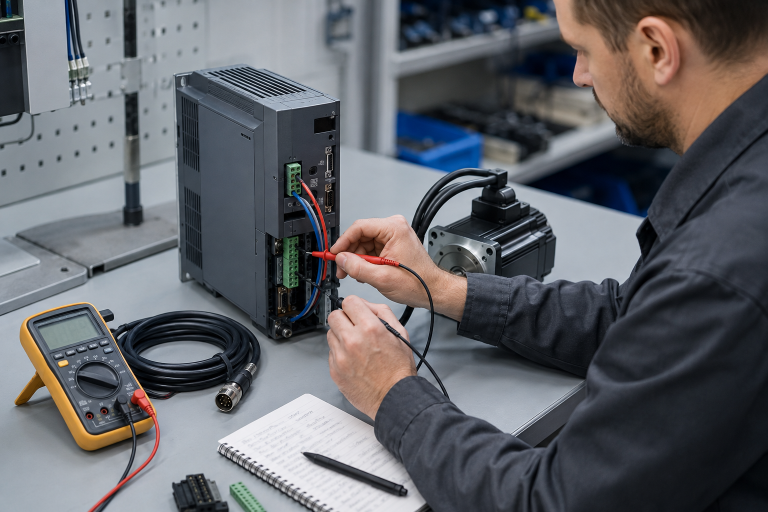 Sep 6, 2026
Yaskawa SGDH-05DE-OY Spares: Check the Servo Chain
A servo drive fault often produces a deceptively simple purchasing request: “Replace the SGDH-05DE-OY.” In a running machine, however, the amplifier is only one…
Read guide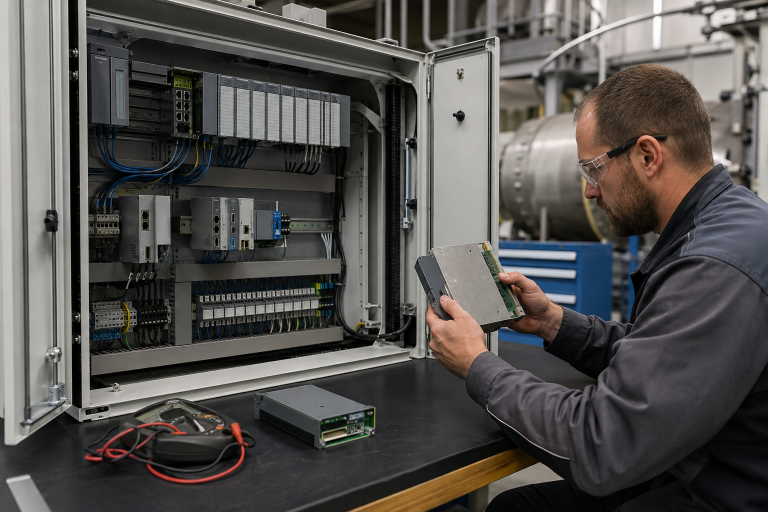 Sep 5, 2026
GE IS220PCLAH1A Spares: Check Mark VIe Fit
When a Mark VIe cabinet develops an intermittent control fault, the urgent request often becomes a single line: “Please quote IS220PCLAH1A.” That is understandable…
Read guide