
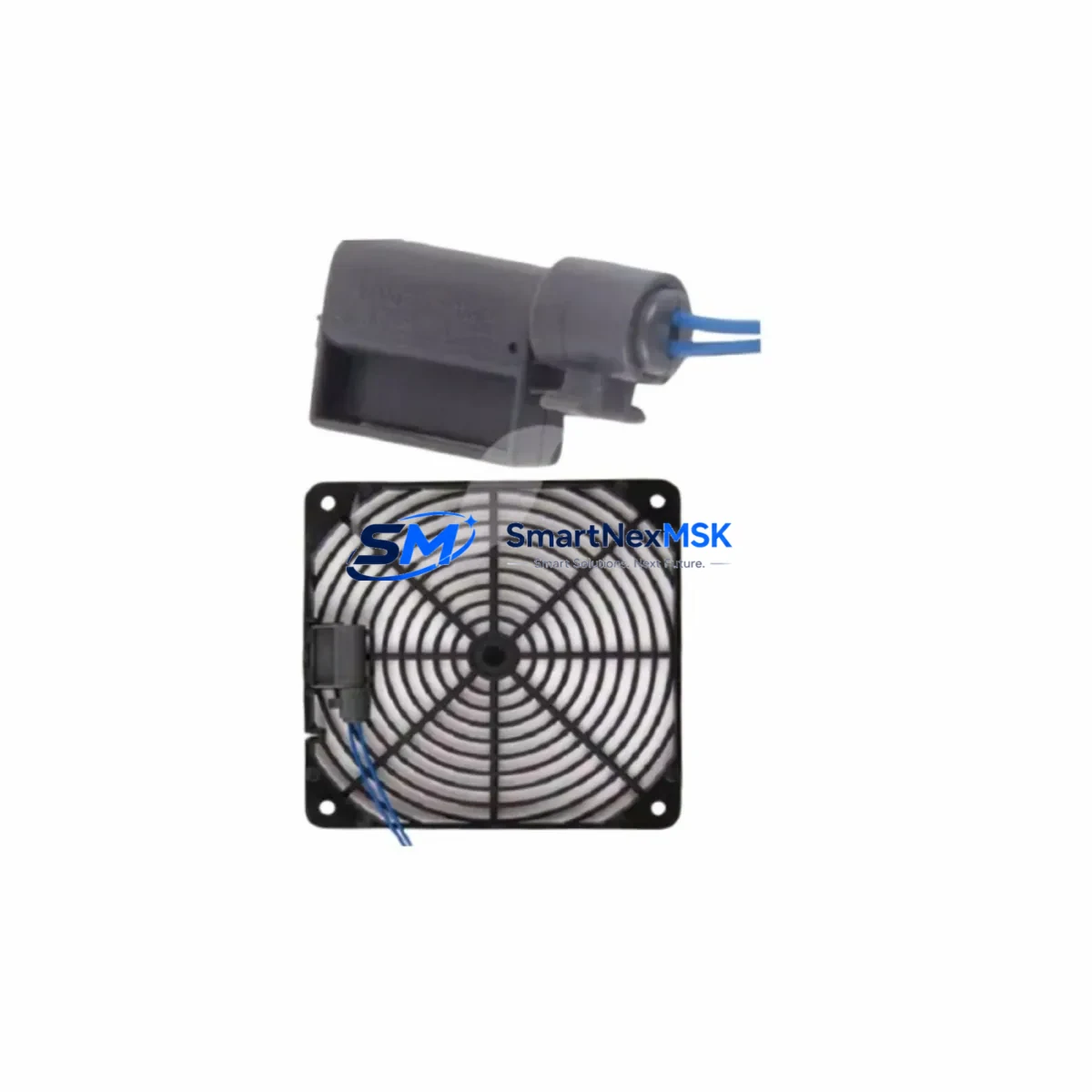
Airflow Monitor LCF 013 Retrofit-Ready Flow Sensor for LCF Series Control Systems
The Airflow Monitor LCF 013 is a retrofit-ready pneumatic flow sensor engineered for seamless integration into existing LCF Series automation and process control systems. As legacy pneumatic instrumentation reaches end-of-life or becomes increasingly difficult to source, the LCF 013 provides a verified drop-in replacement path that preserves original wiring layouts, signal ranges, and control logic — minimizing engineering rework and unplanned downtime during system modernization projects.
Industrial facilities operating aging distributed control systems (DCS) or programmable logic controller (PLC) platforms frequently encounter the challenge of maintaining airflow measurement accuracy when original OEM components are discontinued. The LCF 013 addresses this directly by maintaining full compatibility with standard 4–20 mA analog signal loops, allowing direct substitution without recalibrating upstream controllers or rewriting ladder logic programs. Whether your facility runs a legacy Siemens S5 series rack, a Honeywell TDC 3000 DCS node, or a Yokogawa CENTUM VP control station, the LCF 013 integrates without requiring signal conditioning modules or protocol converters.
During retrofit planning, engineers must verify several critical parameters before committing to a replacement module. Power supply capacity at the field junction box should be confirmed — the LCF 013 operates on a standard 24 VDC loop-powered configuration, consistent with most legacy pneumatic-to-electronic conversion installations. Terminal block wiring should be mapped against the original instrument loop drawing; the LCF 013 uses a standard two-wire connection that aligns with conventional field wiring practices for instruments in this class. If the existing installation uses a HART-compatible transmitter, the LCF 013 supports HART protocol overlay, enabling configuration and diagnostics through existing handheld communicators without additional infrastructure investment.
For facilities upgrading from older analog I/O modules — such as those found in Allen-Bradley SLC 500 analog input cards or legacy Mitsubishi Q series analog expansion modules — the LCF 013’s 4–20 mA output is directly compatible without requiring I/O card replacement. This is particularly valuable in control cabinet upgrade projects where the goal is to modernize field instruments while retaining the existing PLC backplane, power supply module, and CPU unit. In such scenarios, only the field device is swapped, and the existing I/O address mapping, HMI tag database, and SCADA historian configuration remain unchanged.
When the retrofit involves a broader system migration — for example, transitioning from a legacy Modbus RTU serial network to a PROFIBUS DP or EtherNet/IP backbone — the LCF 013 can serve as a stable analog anchor point while digital communication infrastructure is upgraded in parallel. This phased approach allows production lines to remain operational during the communication protocol migration, with the LCF 013 continuing to deliver reliable airflow data through the existing analog loop until the new digital fieldbus segment is commissioned and validated.
Upgrade Compatibility Table
| Parameter | LCF 013 Specification | Retrofit Notes |
|---|---|---|
| Signal Output | 4–20 mA (2-wire loop-powered) | Direct replacement for standard analog I/O inputs; no signal conditioner required |
| Supply Voltage | 24 VDC nominal | Verify field loop power supply capacity before installation |
| Terminal Wiring | Standard 2-wire terminal block | Map against original loop drawing; polarity must be confirmed |
| Communication Protocol | HART (optional overlay) | Compatible with existing HART handheld communicators; no gateway required |
| Mounting / Installation | Standard pneumatic inline fitting | Confirm pipe diameter and fitting thread standard before ordering |
| PLC / DCS Compatibility | Universal analog input (4–20 mA) | Compatible with Siemens, Honeywell, Yokogawa, Allen-Bradley, Mitsubishi analog I/O |
| HMI / SCADA Impact | No tag change required | Existing HMI screens and historian tags remain valid after replacement |
| Warranty | 12 Months | Covers manufacturing defects; includes pre-shipment functional test report |
Retrofit Planning for Existing Automation Systems
A successful LCF 013 retrofit begins with a thorough review of the existing control system architecture. In most legacy installations, the airflow sensor feeds directly into an analog input channel on the PLC or DCS I/O rack. Before removing the original instrument, technicians should document the current 4–20 mA loop current at operating conditions, verify the loop resistance budget, and confirm that the field power supply — typically a dedicated 24 VDC instrument power supply module mounted in the control cabinet — can sustain the loop without voltage drop issues.
In installations where the LCF Series sensor is mounted in a multi-instrument junction box alongside pressure transmitters, temperature elements, or valve positioners, care must be taken to isolate the correct loop before disconnecting terminals. Labeling conventions on older installations are not always consistent, and cross-referencing the instrument loop diagram against the physical terminal strip is essential before any wiring work begins.
For control systems using a Siemens ET 200 distributed I/O station or a Beckhoff EtherCAT I/O terminal block as the field I/O interface, the LCF 013 connects directly to the analog input terminal without any additional signal processing. Similarly, in installations using a Phoenix Contact QUINT power supply to feed the instrument loop, the LCF 013’s power consumption profile is well within the supply’s rated output, eliminating the need for power budget recalculation in most standard retrofit scenarios.
When the retrofit is part of a broader control cabinet upgrade — for example, replacing an aging Omron CJ2M CPU with a newer NX series controller while retaining existing field wiring — the LCF 013 allows the field instrument layer to remain stable while the control layer is modernized. The existing Modbus RTU or DeviceNet communication cables serving other devices in the cabinet can be retained, and only the CPU backplane, communication module, and programming cable connection need to be updated for the new platform.
In facilities where the original airflow sensor fed data to a Wonderware InTouch or Ignition SCADA system via an OPC DA server, the LCF 013 replacement does not require any OPC tag reconfiguration, as the analog signal path and I/O address remain unchanged. This is a significant advantage in environments where SCADA tag databases are large, complex, and tightly integrated with historian and reporting systems.
Downtime Control During System Migration
Minimizing production downtime is the primary operational constraint in any industrial retrofit project. For LCF 013 installations, the recommended approach is to pre-stage the replacement sensor in the control room, verify its calibration certificate and pre-shipment test report, and prepare all required tools and documentation before the scheduled maintenance window begins.
During the cutover, the existing PLC or DCS program should be placed in manual mode for the affected control loop, with the operator maintaining process conditions manually at the HMI workstation. The original sensor is then disconnected, the LCF 013 is wired in place using the documented terminal assignments, and the loop is energized for a bench-level current check before the control loop is returned to automatic mode. This procedure typically requires less than 30 minutes of instrument downtime per loop, making it compatible with standard shift-change maintenance windows in continuous process environments.
For facilities with redundant control architectures — such as those using a hot-standby CPU pair or a redundant I/O module configuration — the LCF 013 retrofit can often be performed without any process interruption by switching control authority to the redundant path during the instrument swap. After the replacement is complete and the loop has been verified at operating conditions, control authority is returned to the primary path and the redundant system is restored to standby status.
All LCF 013 units shipped by SMARTNEXMSK undergo a pre-shipment functional test that verifies output linearity across the full 4–20 mA range, confirms loop power consumption within specification, and validates HART communication response if applicable. A test report is included with each shipment, providing the commissioning engineer with baseline data for comparison during field verification.
Retrofit Support FAQ
Q: Is the LCF 013 a direct drop-in replacement for the original LCF Series airflow sensor?
A: Yes. The LCF 013 maintains the same signal output range (4–20 mA), supply voltage requirements, and terminal wiring configuration as the original LCF Series instruments it replaces. In most installations, no changes to the PLC program, HMI tag database, or field wiring are required. Confirm pipe fitting dimensions and thread standard before installation.
Q: What commissioning steps are required after installing the LCF 013?
A: After wiring, verify loop current at zero-flow and full-scale-flow conditions using a calibrated loop calibrator. Confirm that the PLC or DCS analog input channel reads the expected engineering unit values at both endpoints. If HART communication is used, connect a handheld communicator to verify device identification and configuration parameters. Document the as-found and as-left readings in the instrument calibration record.
Q: Can the LCF 013 be used in a system that is migrating from a legacy serial Modbus RTU network to EtherNet/IP?
A: Yes. Because the LCF 013 communicates via a standard 4–20 mA analog loop (with optional HART overlay), it is independent of the digital communication backbone used by the PLC or DCS. The analog signal is read by the I/O module regardless of whether the controller communicates via Modbus RTU, PROFIBUS DP, EtherNet/IP, or any other protocol. This makes the LCF 013 an ideal stable element during phased protocol migration projects.
Q: What does the 12-month warranty cover, and what is included at shipment?
A: The 12-month warranty covers manufacturing defects in materials and workmanship from the date of shipment. Each unit is shipped with a pre-shipment functional test report confirming output accuracy and loop integrity. In the event of a warranty claim, SMARTNEXMSK will arrange replacement or repair. Warranty does not cover damage resulting from incorrect installation, overvoltage, or mechanical impact.
© 2026 SMARTNEXMSK. All rights reserved.
Original Source: https://smartnexmsk.com
Contact: [email protected] | +86 18259474341