
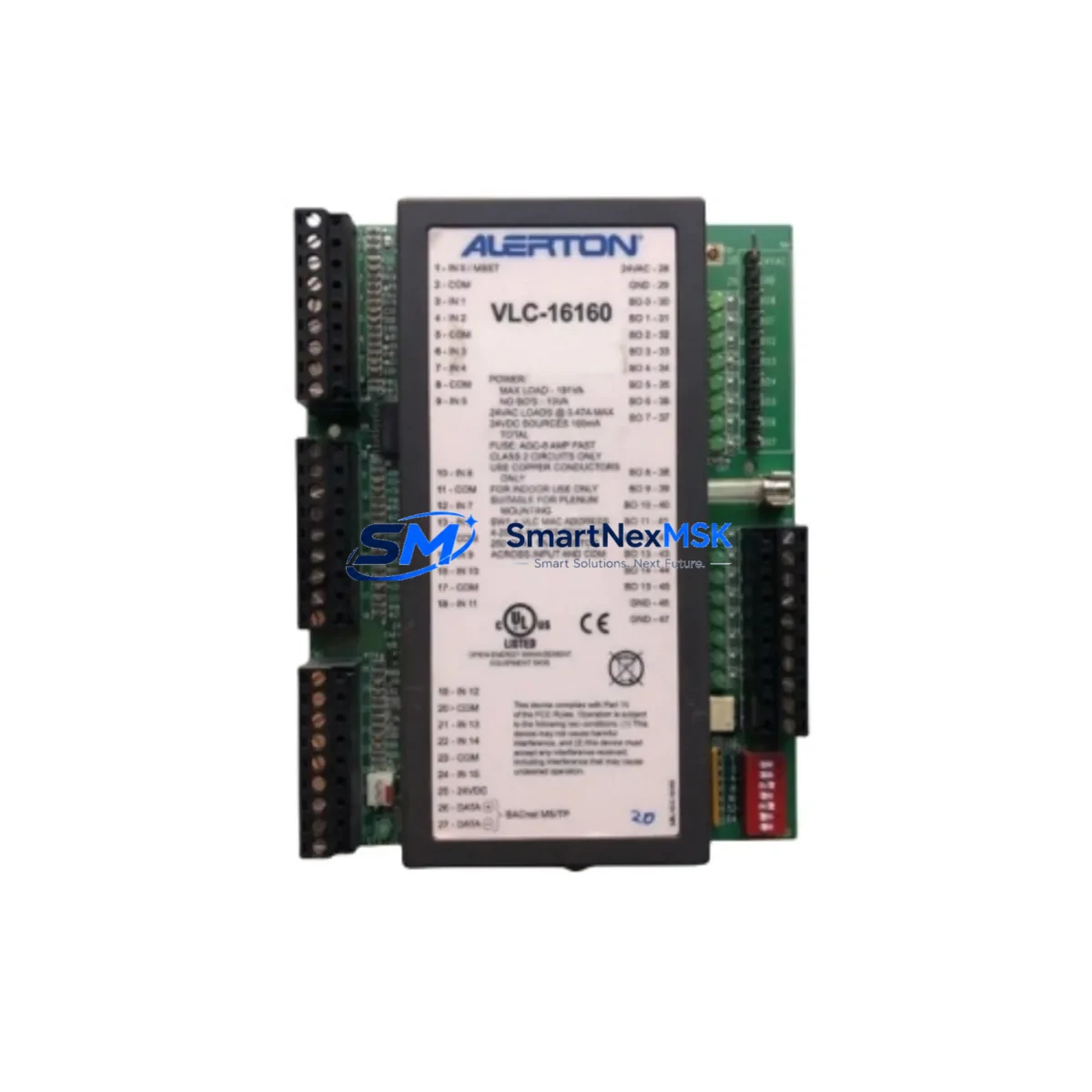
Alerton VLC-16160 Maintenance-Ready Spare for VLC Automation
The Alerton VLC-16160 is a Direct Digital Control (DDC) controller within Alerton’s proven VLC Series, widely deployed in commercial and industrial building automation systems (BAS). Designed for HVAC control, energy management, and multi-loop process regulation, the VLC-16160 supports BACnet MS/TP and BACnet IP communication protocols, making it a cornerstone component in modern and legacy building automation networks alike.
For maintenance engineers managing aging BAS infrastructure, the VLC-16160 represents a critical spare. Unplanned controller failure in a live HVAC or process control loop can trigger cascading alarms, comfort complaints, and energy waste within hours. Keeping a verified, tested replacement unit on the shelf is the most effective strategy to contain mean time to repair (MTTR) and protect operational continuity. This unit ships fully tested, with a 12-month warranty, and is sourced to match original factory specifications.
Procurement engineers sourcing for planned maintenance cycles or emergency stock will find the VLC-16160 available for fast dispatch. Each unit undergoes pre-shipment functional verification to confirm communication integrity, I/O channel response, and firmware compatibility before leaving the warehouse.
Spare Maintenance Table
| Parameter | Specification |
|---|---|
| SKU / Model | VLC-16160 |
| Brand / Series | ALERTON / VLC Series |
| Product Type | DDC Controller (Direct Digital Control) |
| Communication Protocol | BACnet MS/TP, BACnet IP |
| I/O Configuration | 16 Universal Inputs / 16 Outputs (inferred from model designation) |
| Power Supply | 24 VAC / VDC (typical VLC series) |
| Operating Temperature | 0°C to 50°C (32°F to 122°F) |
| Mounting | DIN rail or panel mount |
| Origin | United States |
| Compatibility | Alerton VLC Series BAS networks; Honeywell Alerton IBEX/Compass platforms |
| Application | HVAC control, VAV systems, AHU, chiller plant, energy management |
| Warranty | 12 Months from shipment date |
| Pre-Shipment Test | Communication, I/O channel, firmware verification |
Maintenance Planning for Continuous Operation
When a VLC-16160 controller fails or is flagged during a scheduled inspection, the replacement process should be treated as a system-level event, not an isolated component swap. Maintenance engineers should use the opportunity to audit the entire control cabinet and associated field wiring.
Begin with the 24 VAC power supply module feeding the controller — voltage sag or ripple is a common root cause of DDC controller instability and premature failure. Verify the Class 2 transformer output is within tolerance before energizing the replacement unit. Next, inspect the terminal block wiring at the I/O connectors: loose or corroded terminations on analog input channels (e.g., temperature sensors, pressure transducers) can cause erratic readings that are often misdiagnosed as controller faults.
Check the BACnet MS/TP network wiring — EOL (end-of-line) resistor placement, shield grounding, and daisy-chain topology should be confirmed before bringing the new VLC-16160 online. A misconfigured network segment can prevent the controller from joining the BAS network even when the hardware is fully functional. If the site uses a BACnet router or IP gateway to bridge MS/TP and Ethernet segments, verify that device is operating correctly and that the new controller’s MAC address and device instance are correctly configured in the Alerton Compass or IBEX operator workstation.
For sites running mixed Alerton hardware, also inspect adjacent VLC-853 or VLC-454 controllers on the same MS/TP trunk — a failing neighbor device can corrupt the bus and cause the replacement controller to appear non-responsive. Review the analog output modules driving actuators (VAV boxes, damper actuators, control valves) to confirm they are receiving correct command signals post-replacement. If the system includes Alerton BCM (Building Control Module) or a supervisory-level controller, re-bind the VLC-16160’s BACnet objects to the supervisory schedule and alarm routing after commissioning.
Finally, check any signal isolators or surge protection devices on field wiring inputs — these are frequently overlooked during emergency replacements and can be the source of recurring controller damage in electrically noisy environments such as mechanical rooms or rooftop AHU installations.
Site Replacement Workflow
Step 1 — Pre-Replacement Backup: Export the existing controller’s programming and configuration using Alerton Compass or the site’s BAS workstation. Document all BACnet object names, device instance numbers, and network addresses before powering down the failed unit.
Step 2 — Power Isolation: De-energize the 24 VAC supply to the controller cabinet. Confirm zero voltage at the controller terminals before disconnecting field wiring. Label all I/O terminations with their channel assignments to prevent wiring errors during reinstallation.
Step 3 — Physical Swap: Remove the failed VLC-16160 from its DIN rail or panel mount. Install the replacement unit in the same position. Reconnect all field wiring per the documented channel assignments. Reconnect the BACnet MS/TP network cable, observing correct polarity on the (+), (−), and shield conductors.
Step 4 — Power-Up and Commissioning: Restore 24 VAC power. Confirm the controller boots and appears on the BACnet network within the expected timeout period. Use Alerton Compass to download the backed-up program to the new controller. Verify all I/O points read correctly and all output commands respond as expected.
Step 5 — System Validation: Run a full-loop test on all controlled equipment (AHU, VAV, chiller, etc.) to confirm stable operation. Monitor the BAS alarm log for 24 hours post-replacement to catch any latent issues. Update the site’s maintenance log with the replacement date, unit serial number, and technician sign-off.
This workflow minimizes downtime to typically under 2 hours for a trained technician, preserving system compatibility and avoiding the need for full recommissioning of the BAS network.
Spare Parts Support FAQ
Q1: Is the VLC-16160 a direct drop-in replacement for an existing failed unit?
Yes. The VLC-16160 is designed as a form-fit-function replacement within the Alerton VLC Series. Physical dimensions, I/O connector layout, and BACnet communication parameters are consistent with the original factory specification. Configuration is restored via program download from the BAS workstation, requiring no hardware modification.
Q2: How is compatibility with my existing Alerton BAS network verified before shipment?
Each unit undergoes pre-shipment testing that includes power-up verification, BACnet communication response check, and I/O channel functional test. Units are confirmed to match the VLC-16160 model specification. Site-specific BACnet device instance and network address configuration is performed during on-site commissioning by the maintenance technician.
Q3: What does the 12-month warranty cover?
The 12-month warranty covers manufacturing defects and functional failures under normal operating conditions from the date of shipment. It does not cover damage resulting from incorrect installation, overvoltage, physical impact, or use outside the specified environmental range. Warranty claims are processed with return authorization and include replacement or repair at no additional cost.
Q4: Can you support long-term or recurring spare parts supply for multi-site BAS maintenance programs?
Yes. We support procurement engineers and facilities management teams with scheduled spare parts supply agreements. For multi-site programs requiring consistent availability of VLC-16160 units and associated Alerton VLC Series components, contact our team to discuss volume pricing, lead time commitments, and inventory reservation options.
© 2026 SMARTNEXMSK. All rights reserved.
Original Source: https://smartnexmsk.com
Contact: [email protected] | +86 18259474341