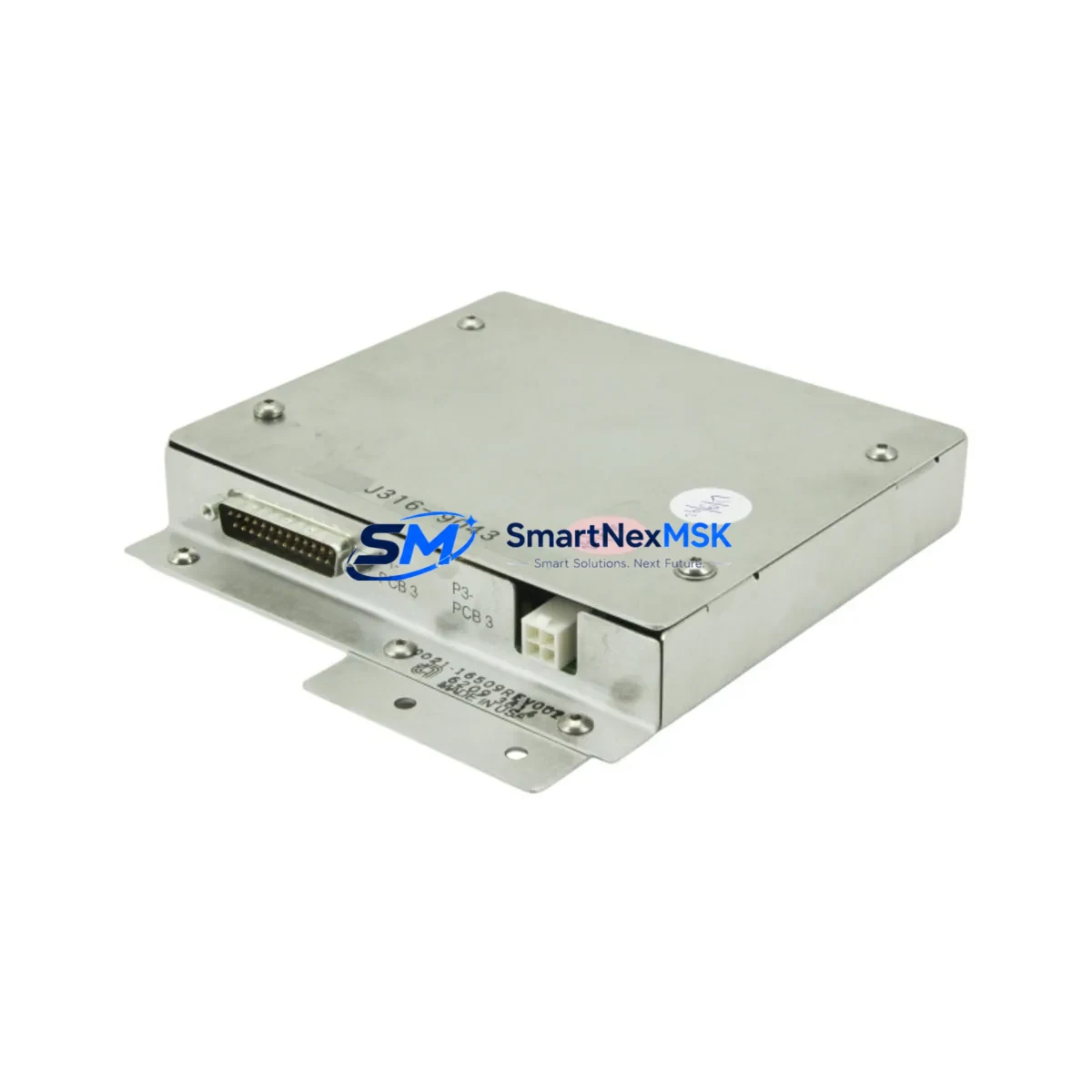
AMAT 0010-17633 ONH710 Retrofit-Ready Motor Torque Monitor for Legacy Control Systems
The Applied Materials 0010-17633 ONH710 RCP2W-RA4C-I-42P-5-50-P1-R05-SG is a precision motor torque monitor engineered for semiconductor process equipment control systems. As AMAT progressively phases out legacy platform support, sourcing a verified replacement for the 0010-17633 ONH710 has become a critical priority for fabs running older CVD, PVD, and etch tool generations. SMARTNEXMSK maintains ready stock of this module, fully tested and backed by a 12-month warranty, to support your retrofit and upgrade programs without extended lead times.
This unit is designed as a direct retrofit replacement within the RCP2W-RA4C robot control platform, monitoring motor torque feedback signals to protect wafer-handling mechanisms from overload faults. It integrates with the broader AMAT motion control architecture, including the ONH710 robot controller and associated ESA-Y3008T23-21 servo amplifier assemblies. When planning a replacement, engineers must verify the 42-pin connector pinout, confirm the 5V/50W power rail compatibility, and validate the P1 and R05 parameter configuration against the existing robot recipe files before commissioning.
Upgrade Compatibility Table
| Parameter | Details |
|---|---|
| Part Number | 0010-17633 ONH710 RCP2W-RA4C-I-42P-5-50-P1-R05-SG |
| Supplementary Reference | ESA-Y3008T23-21 |
| Function | Motor Torque Monitor — wafer-handling robot overload protection |
| Connector Interface | 42-pin proprietary AMAT backplane connector |
| Power Requirement | 5 VDC, 50 W rated supply rail |
| Compatible Platform | RCP2W-RA4C robot control chassis, ONH710 series |
| Communication Protocol | AMAT proprietary serial bus (RS-422 variant); verify with host controller firmware |
| Installation Type | Direct board-level swap; no mechanical modification required |
| Retrofit Recommendation | Confirm firmware revision on ONH710 controller before swap; update if below minimum supported build |
| Commissioning Focus | Torque threshold calibration, fault log reset, end-effector teach verification |
| Warranty | 12 months from date of shipment — covers functional defects under normal operating conditions |
Retrofit Planning for Existing Automation Systems
A successful retrofit of the 0010-17633 ONH710 motor torque monitor requires a structured approach that accounts for the interdependencies within the AMAT robot control ecosystem. Before removing the failed or end-of-life unit, engineers should document the current torque threshold parameters stored in the ONH710 robot controller memory, as these values are not always retained after a board swap. The RCP2W-RA4C chassis backplane must be inspected for pin corrosion or debris on the 42-pin interface, which is a common failure point in tools with high thermal cycling histories.
Power delivery is a frequent source of commissioning delays. The 5 VDC, 50 W supply rail feeding this module is shared with other logic boards in the control cabinet, including the AMAT 0010-09951 power distribution board and the associated DC-DC converter modules. Technicians should measure rail voltage under load before installing the replacement to rule out upstream power supply degradation — a marginal supply that was masking a torque monitor fault will cause repeat failures on the new unit.
For tools running the RCP2W robot platform, the motion control firmware on the host ONH710 controller must be at a compatible revision level. Older firmware builds may not correctly interpret the torque feedback signal format from the replacement module, resulting in nuisance faults or incorrect overload trips. Cross-reference the firmware revision against the AMAT field service bulletin index before proceeding. If the tool also uses an AMAT 0190-35964 I/O expansion board or a 0010-76502 analog input module for process sensor integration, verify that the torque monitor replacement does not alter the shared interrupt priority map.
In multi-chamber cluster tools, the 0010-17633 module may be installed in more than one robot arm assembly. A phased replacement strategy — replacing one arm at a time while keeping the remaining chambers in a safe-hold state — minimizes production impact. The AMAT Centura and Producer platform architectures both support this approach through their chamber isolation interlocks. Coordinate with the process engineer to confirm that the HMI alarm suppression mode is active during the swap to prevent false process abort signals from propagating to the MES system.
Communication link integrity between the torque monitor and the ONH710 controller should be verified using the AMAT diagnostic terminal before returning the tool to production. A loopback test on the RS-422 serial bus, combined with a manual jog of the robot arm through its full range of motion, will confirm that torque feedback is being correctly sampled and that the overload protection thresholds are functioning as designed. If the tool uses a Brooks Automation MagnaTran robot in a hybrid configuration, additional handshake timing verification between the AMAT controller and the Brooks motion card may be required.
Downtime Control During System Migration
Minimizing unplanned downtime during a motor torque monitor replacement on an AMAT semiconductor tool requires preparation that begins well before the maintenance window opens. The most effective approach is to pre-stage the replacement 0010-17633 ONH710 module in the cleanroom anteroom, pre-configured with the torque threshold parameters extracted from the outgoing unit. This eliminates the parameter re-entry step from the critical path and can reduce total swap time by 30–45 minutes on a typical RCP2W-RA4C platform.
Before the maintenance window, export the full robot recipe file from the ONH710 controller to a portable storage device and archive it in the tool’s maintenance log. This preserves the original program logic, end-effector teach positions, and speed profiles, ensuring that a full system restore is possible if the replacement module exhibits unexpected behavior during initial commissioning. The AMAT SPARC diagnostic software, if available on the tool’s host PC, can generate a pre-swap snapshot of all motion parameters in a single export operation.
During the swap, maintain power to the chassis backplane where possible to preserve volatile memory in adjacent control boards. If a full power-down is required — for example, when replacing the module in a live production cluster — coordinate with the fab operations team to place all connected chambers in a recipe-hold state rather than a full abort, which avoids the lengthy recipe reload and wafer recovery sequence that follows an uncontrolled shutdown. After the replacement is seated and the 42-pin connector is secured, perform a controlled power-up sequence and monitor the 5 VDC rail with a calibrated meter during the first 60 seconds of operation to confirm stable power delivery before enabling robot motion.
Post-swap verification should include a minimum of three full wafer-transfer cycles in simulation mode before returning the tool to automated production. Log the torque readings from each cycle and compare them against the baseline values recorded before the failure — a deviation of more than 10% may indicate a mechanical issue in the robot arm that the torque monitor was masking rather than a module defect. All verification results, including the pre- and post-swap torque logs, should be recorded in the tool’s maintenance management system to support future reliability analysis.
Retrofit Support FAQ
Q: Is the 0010-17633 ONH710 a direct drop-in replacement for the original AMAT part?
A: Yes. The replacement module supplied by SMARTNEXMSK matches the original AMAT 0010-17633 ONH710 specification, including the 42-pin connector interface, 5 VDC/50 W power requirement, and RCP2W-RA4C chassis compatibility. No mechanical modification to the control cabinet or backplane is required. Customers are advised to verify the firmware revision on the ONH710 controller before installation to ensure full compatibility.
Q: What pre-shipment testing is performed on each unit?
A: Every 0010-17633 ONH710 module undergoes functional verification prior to shipment, including power-on self-test, torque signal output validation, and connector integrity inspection. Units are shipped with a test report confirming pass status. The 12-month warranty covers functional defects identified under normal operating conditions from the date of shipment.
Q: How do I verify wiring compatibility with my existing RCP2W-RA4C installation?
A: Reference the AMAT field wiring diagram for the RCP2W-RA4C chassis and confirm that the 42-pin backplane connector pinout on the replacement module matches the original. Pay particular attention to the torque feedback signal lines (pins typically in the 30–42 range) and the power input pins. If the original wiring harness shows signs of wear or heat damage, replace the harness before installing the new module to avoid introducing a new fault source.
Q: What is the lead time and what happens if the unit develops a fault within the warranty period?
A: In-stock units ship within 1–3 business days. For warranty claims, contact SMARTNEXMSK with the original order number and a description of the fault. We will arrange return shipping and provide a replacement or repaired unit within the agreed service timeline. Warranty coverage does not apply to damage caused by incorrect installation, overvoltage conditions, or physical impact.
© 2026 SMARTNEXMSK. All rights reserved.
Original Source: https://smartnexmsk.com
Contact: [email protected] | +86 18259474341