
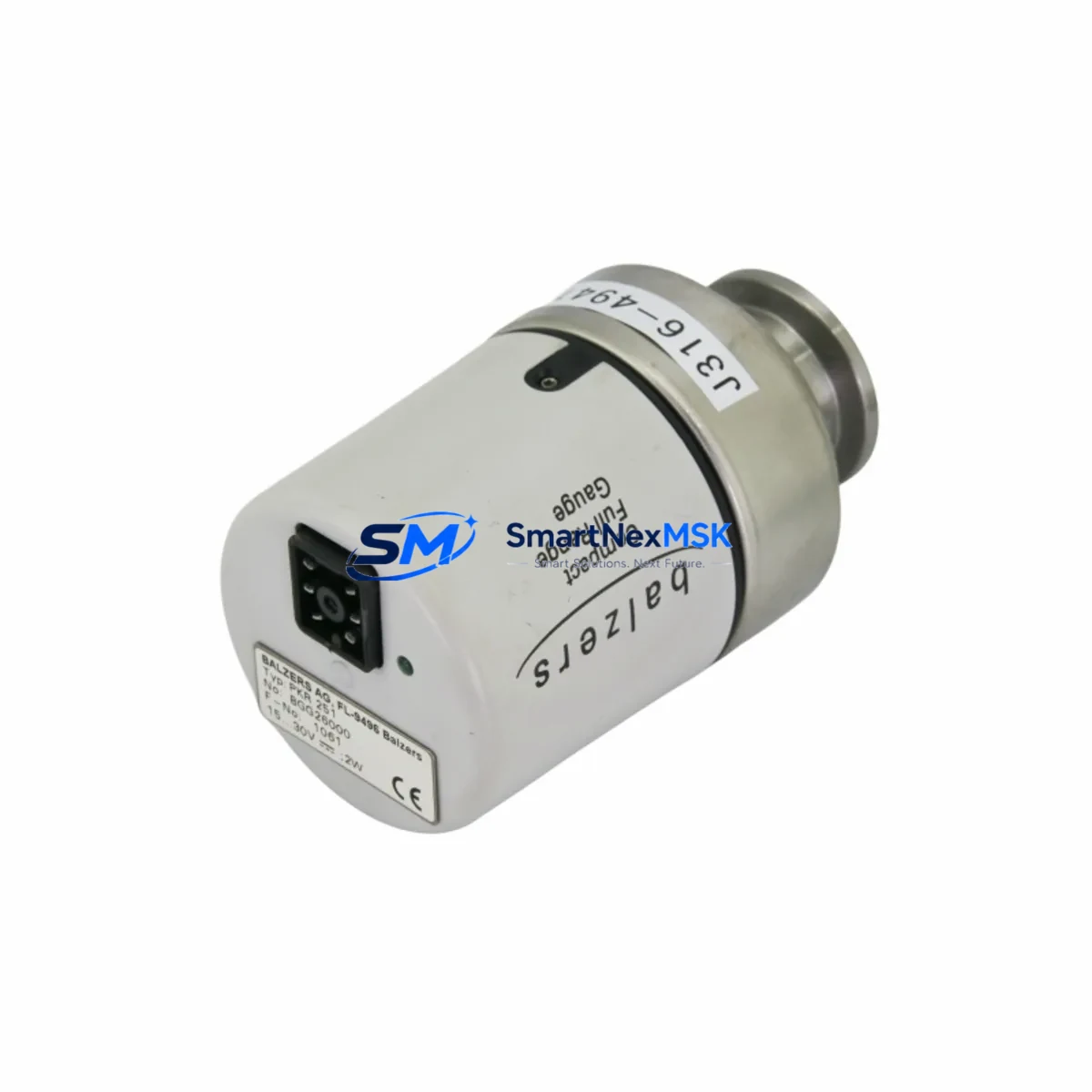
BALZERS BGG26000 FL-9496 Maintenance-Ready Spare PVD300: Spare Replacement & Industrial Downtime Risk Control
The BALZERS BGG26000 (part number FL-9496, cross-reference E-E15004080 / 16-144558-00) is a full-range vacuum gauge designed for high-vacuum and ultra-high-vacuum process environments, including PVD300 physical vapor deposition systems and related industrial coating and thin-film deposition platforms. As a maintenance-ready original spare, this unit supports rapid field replacement, minimizing unplanned downtime in vacuum-critical production lines. Each unit is tested prior to shipment and backed by a 12-month warranty, ensuring confidence for both planned maintenance cycles and emergency breakdown recovery.
For maintenance engineers managing aging PVD or CVD vacuum systems, the BGG26000 represents a critical measurement node. Gauge failure or drift directly impacts process repeatability, chamber pressure control, and product yield. Stocking this spare as part of a proactive maintenance inventory strategy is strongly recommended for any facility operating BALZERS or Pfeiffer Vacuum-branded vacuum systems.
Spare Maintenance Table
| Parameter | Specification / Detail |
|---|---|
| Part Number | BGG26000 |
| Reference SKU | FL-9496 / E-E15004080 / 16-144558-00 |
| Brand | BALZERS (Pfeiffer Vacuum Group) |
| Product Type | Full-Range Vacuum Gauge (Pirani + Cold Cathode Combination) |
| Compatible Systems | PVD300, BALZERS BAK series, Pfeiffer high-vacuum platforms, compatible OEM vacuum chambers |
| Measurement Range | 1×10⁻⁹ mbar to 1×10³ mbar (full-range, typical) |
| Connection Interface | Standard BALZERS gauge controller interface (verify controller compatibility before installation) |
| Origin | Germany (DE) |
| Application Environment | Industrial vacuum coating, PVD/CVD deposition, R&D vacuum systems, semiconductor process equipment |
| Maintenance Recommendation | Replace at first sign of pressure reading drift, filament failure, or controller alarm; inspect every 12–18 months during planned shutdown |
| Warranty | 12 Months |
| Shipping | Tested before dispatch; global shipping available; ESD-safe packaging |
Maintenance Planning for Continuous Operation
When replacing the BGG26000 FL-9496 vacuum gauge in a PVD300 or equivalent system, a thorough inspection of the surrounding vacuum and electrical subsystems is essential to prevent repeat failures and ensure stable process resumption. Maintenance engineers should treat this replacement as an opportunity for a broader control cabinet and vacuum system audit.
Begin by verifying the gauge controller unit — typically a BALZERS TPG or equivalent Pfeiffer vacuum gauge controller — for correct calibration offsets and communication integrity. A faulty controller can damage a new gauge within hours of installation. Next, inspect the high-voltage power supply module feeding the cold cathode section of the gauge; overvoltage conditions are a leading cause of premature gauge failure.
Check all vacuum feedthrough connectors and signal cables between the gauge and the controller. Damaged insulation or loose BNC/D-sub connectors introduce noise into pressure readings and can cause erratic controller behavior. If the system uses a Pirani gauge (such as the BALZERS TPR or equivalent) as a companion low-vacuum sensor, verify its calibration and filament condition simultaneously — these two sensors together define the full pressure range handoff in the system.
For systems with integrated turbo molecular pump controllers (e.g., BALZERS TCP or Pfeiffer DCU series), confirm that the interlock logic tied to the BGG26000 pressure signal is functioning correctly. A misconfigured interlock can prevent the turbo pump from reaching operating speed or cause premature shutdown. Inspect the roughing pump relay and contactor in the control cabinet, as these components experience high switching cycles and are common failure points during vacuum system restarts.
Additionally, review the terminal blocks and wiring harness within the control cabinet for signs of oxidation, loose terminations, or thermal damage — particularly on circuits supplying the gauge heater and ion current measurement paths. If the system includes a residual gas analyzer (RGA) or mass spectrometer module, cross-check its baseline readings against the BGG26000 output to validate gauge accuracy post-replacement. For facilities running multiple vacuum chambers, maintaining a spare gauge controller board or plug-in measurement card alongside the BGG26000 spare is a best practice that significantly reduces mean time to repair (MTTR).
Finally, if the system is equipped with a PLC-based vacuum sequence controller (common in automated PVD300 lines), verify that the analog or digital pressure signal from the new gauge is correctly scaled and mapped in the PLC I/O configuration before resuming production. Signal scaling errors post-replacement are a frequent but easily preventable source of process alarms.
Site Replacement Workflow
Step 1 — Isolation & Venting: Follow the system’s standard venting procedure. Confirm chamber pressure has risen to atmospheric before disconnecting the BGG26000. Never remove the gauge under vacuum.
Step 2 — Electrical Disconnection: Power down the gauge controller and disconnect the signal cable. Label the cable and connector orientation before removal to avoid polarity errors on reinstallation.
Step 3 — Mechanical Removal: Unscrew the gauge from the vacuum flange (typically KF16, KF25, or CF flange depending on system configuration). Inspect the flange O-ring or copper gasket and replace if compressed or damaged.
Step 4 — New Unit Installation: Install the BGG26000 FL-9496 replacement. Torque to manufacturer specification. Reconnect signal cable. Confirm no cross-threading on the flange fitting.
Step 5 — Leak Check & Pump-Down: Perform a helium leak check or monitor pump-down curve to confirm no virtual leaks at the new gauge fitting. Compare pump-down time against baseline records.
Step 6 — Controller Calibration: Zero the gauge at atmospheric pressure per the controller manual. Verify full-range reading consistency against the companion Pirani sensor during pump-down transition.
Step 7 — System Handover: Log the replacement in the maintenance record. Update the spare parts inventory. Schedule the next inspection interval (recommended: 12–18 months or per OEM guidance).
This workflow is compatible with legacy BALZERS systems and modern Pfeiffer Vacuum platforms, supporting old-system life extension without requiring full instrument upgrades.
Spare Parts Support FAQ
Q1: Is the BGG26000 FL-9496 a direct drop-in replacement for the original BALZERS unit?
Yes. The BGG26000 FL-9496 (E-E15004080 / 16-144558-00) is an original-specification spare. It is dimensionally and electrically compatible with the factory-installed unit in PVD300 and equivalent BALZERS vacuum systems. Always verify flange type and controller interface version before installation.
Q2: What is the recommended spare parts stocking strategy for vacuum gauges?
For facilities operating one to three vacuum chambers, maintaining a minimum of one BGG26000 spare on-site is recommended. High-throughput or multi-chamber facilities should stock two units. Gauge lifespan varies by process gas exposure and operating hours; plan replacement cycles at 12–18 month intervals or upon first indication of reading drift.
Q3: How is the unit tested before shipment?
Each BGG26000 FL-9496 unit undergoes functional verification prior to dispatch, including electrical continuity checks and, where applicable, vacuum performance validation. Units are shipped in ESD-safe, anti-vibration packaging to preserve gauge integrity during transit.
Q4: What does the 12-month warranty cover?
The 12-month warranty covers manufacturing defects and functional failures under normal operating conditions. It does not cover damage resulting from incorrect installation, overvoltage, contamination from process gases, or physical impact. Warranty claims are supported with documentation of the original purchase and installation date.
© 2026 SMARTNEXMSK. All rights reserved.
Original Source: https://smartnexmsk.com
Contact: [email protected] | +86 18259474341