
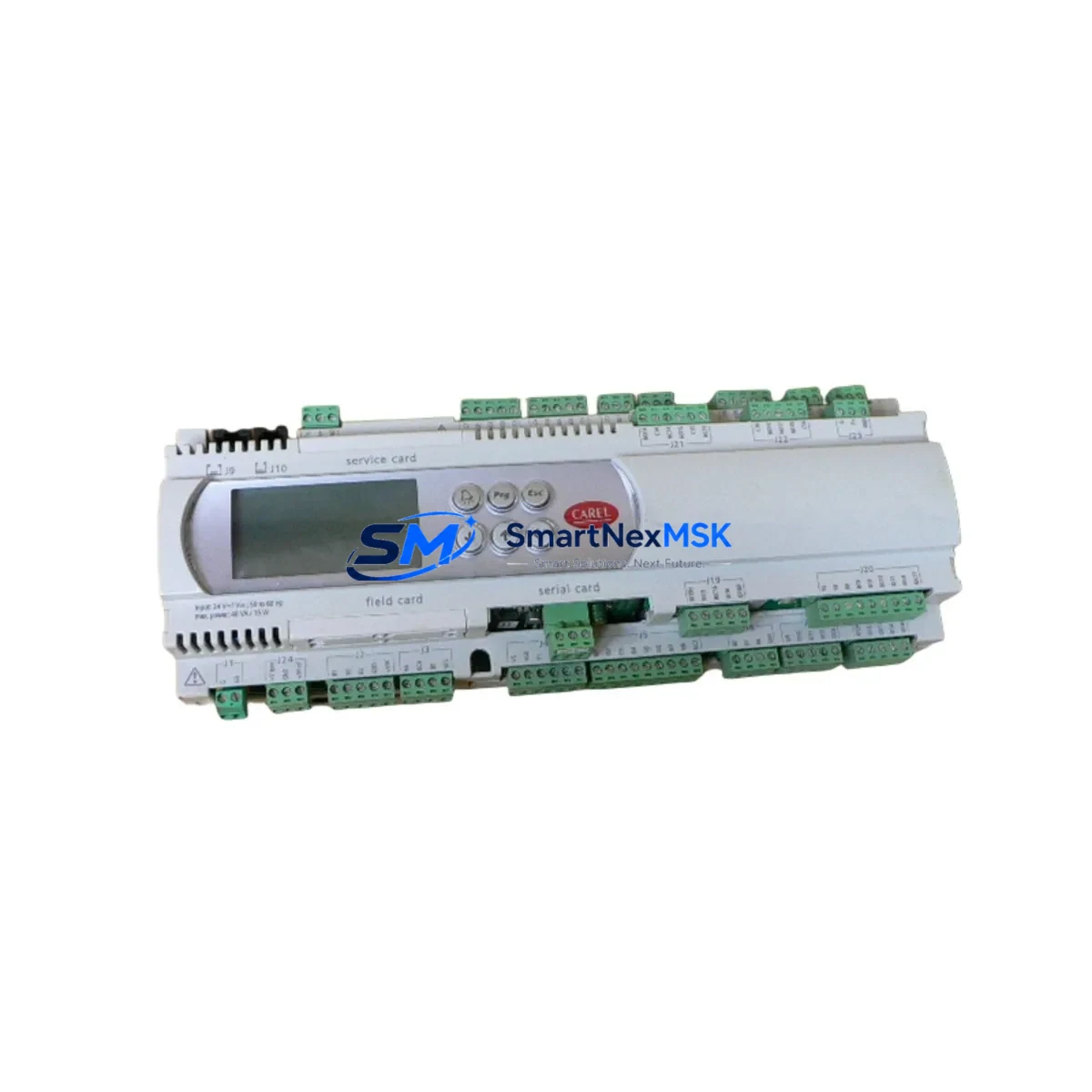
CAREL PCO3000EL0 Retrofit-Ready Controller for pCO3 Series Control Systems
The CAREL PCO3000EL0 is a high-performance programmable controller engineered for seamless integration into existing pCO3 Series control architectures. As legacy pCO3 units reach end-of-life or become increasingly difficult to source, the PCO3000EL0 provides a verified, drop-in compatible upgrade path that preserves original program logic, terminal wiring layouts, and communication protocol configurations — minimizing engineering rework and unplanned downtime during system migration.
Designed for HVAC, refrigeration, and industrial process control applications, the PCO3000EL0 supports the full range of CAREL’s proprietary I/O expansion ecosystem. Engineers replacing failed or obsolete pCO3 controllers will find that the PCO3000EL0 maintains backward compatibility with existing CAREL pCO3 I/O expansion modules, allowing existing terminal blocks and field wiring to remain undisturbed. The onboard memory architecture supports direct upload of programs previously developed in CAREL 1tool or CAREL PCO Manager, eliminating the need for full application rewrites in most retrofit scenarios.
When planning a retrofit from an older pCO3 variant, engineers should verify power supply capacity — the PCO3000EL0 operates on a 24 VAC/DC supply and draws comparable current to its predecessor, but any shared CAREL PSU power supply module feeding multiple controllers on the same panel should be audited for total load before commissioning. Backplane interface compatibility with existing CAREL pCO5 or pCOe expansion boards should also be confirmed against the installed firmware revision to ensure correct address mapping and I/O polling behavior.
Upgrade Compatibility Table
| Parameter | Legacy pCO3 | PCO3000EL0 (Retrofit) |
|---|---|---|
| Power Supply | 24 VAC/DC | 24 VAC/DC (compatible) |
| Terminal Wiring | Standard pCO3 layout | Direct pin-compatible |
| Communication Protocol | RS-485 / BACnet / Modbus | RS-485 / BACnet / Modbus (full support) |
| I/O Expansion | pCO3 I/O modules | Compatible with pCO3 / pCOe expansion |
| Programming Environment | CAREL 1tool / PCO Manager | CAREL 1tool / PCO Manager (direct upload) |
| HMI Interface | pGD1 / pGDE terminal | Compatible with pGD1 / pGDE |
| Module Address Config | DIP switch / software | Software-configurable (verify address map) |
| Installation Format | DIN rail / panel mount | DIN rail / panel mount (same footprint) |
| Retrofit Recommendation | — | Direct replacement; verify firmware rev. |
| Warranty | — | 12-Month Warranty included |
Retrofit Planning for Existing Automation Systems
A successful PCO3000EL0 retrofit begins with a thorough audit of the existing control cabinet. Before removing the legacy pCO3 unit, technicians should document all terminal assignments, record the current program version from the pGD1 operator terminal or pGDE graphical display, and back up the application using CAREL PCO Manager. This backup is critical — it preserves all setpoints, alarm thresholds, and custom logic that may have been modified in the field since original commissioning.
The PCO3000EL0 shares the same physical mounting footprint as the standard pCO3 chassis, which means the existing DIN rail position and panel cutout dimensions remain valid. Field wiring connected to analog inputs (NTC, 0–10V, 4–20mA), digital inputs, relay outputs, and analog outputs can typically be reconnected terminal-for-terminal without modification. However, engineers should cross-reference the wiring diagram against the PCO3000EL0 datasheet to confirm that any CAREL UGPCO3SR00 serial interface card or CAREL UGPCO3BN00 BACnet card previously installed in the legacy unit is also compatible with the replacement chassis slot configuration.
For systems using CAREL pCOe expansion controllers or CAREL EVD evolution electronic expansion valve drivers communicating over the pLAN network, the module address settings must be re-verified after installation. Address conflicts between the new PCO3000EL0 and any remaining pCO3 units on the same network segment can cause communication faults that are difficult to diagnose without a network topology map. Similarly, if the control system interfaces with a CAREL BOSS supervisory system or a third-party BMS via Modbus RTU or BACnet MS/TP, the device instance number and baud rate settings must be re-entered and tested before returning the system to automatic operation.
HMI screen compatibility is another key consideration. Existing pGD1 operator panels will display correctly with the PCO3000EL0 provided the application firmware version matches. If the original program was developed for an older pCO3 firmware baseline, a controlled firmware upgrade may be required — this should be tested in a staging environment or on a duplicate unit before applying to a live production line.
Downtime Control During System Migration
Minimizing production interruption during a pCO3 to PCO3000EL0 migration requires a structured changeover plan. The recommended approach is to pre-configure the PCO3000EL0 offline — loading the backed-up application, setting all parameters, and verifying I/O simulation — before the scheduled maintenance window begins. This reduces live panel time to a physical swap, wiring reconnection, and functional verification sequence that can typically be completed within a single shift.
Where the control system manages critical refrigeration or HVAC loads, a parallel run strategy may be appropriate: the PCO3000EL0 is installed and powered alongside the legacy unit in monitor-only mode, with outputs disabled, allowing engineers to verify sensor readings and logic execution before cutting over. Once confidence is established, the legacy pCO3 is isolated and the PCO3000EL0 assumes full control. This approach is particularly valuable in multi-compressor rack systems where a CAREL pRack rack controller coordinates multiple circuit controllers and any communication gap can trigger unnecessary alarms or compressor lockouts.
All units supplied by SMARTNEXMSK are pre-tested prior to dispatch and covered by a 12-month warranty. Stock is maintained for immediate shipment, supporting urgent breakdown replacements where extended lead times from OEM channels are not acceptable.
Retrofit Support FAQ
Q: Is the PCO3000EL0 a direct drop-in replacement for all pCO3 variants?
A: The PCO3000EL0 is compatible with the standard pCO3 form factor and I/O configuration. Variants with non-standard I/O counts or special communication cards should be verified against the CAREL compatibility matrix before ordering. Our technical team can assist with cross-reference confirmation.
Q: Can I reuse my existing pCO3 application program without rewriting?
A: In most cases, yes. Programs developed in CAREL 1tool or PCO Manager can be uploaded directly to the PCO3000EL0. Compatibility depends on the firmware version and any hardware-specific library calls in the original application. A pre-installation test upload is strongly recommended.
Q: What wiring changes are required during installation?
A: Terminal assignments on the PCO3000EL0 follow the standard pCO3 layout. In most retrofit scenarios, existing field wiring can be reconnected without modification. Engineers should verify analog input type settings (NTC/0–10V/4–20mA) in software after installation, as these are firmware-configured rather than hardware-jumpered on the PCO3000EL0.
Q: What does the 12-month warranty cover, and how is it handled?
A: All PCO3000EL0 units supplied by SMARTNEXMSK carry a 12-month warranty covering manufacturing defects and functional failures under normal operating conditions. Units are tested before dispatch. In the event of a warranty claim, contact our sales team for RMA processing and expedited replacement to minimize system downtime.
© 2026 SMARTNEXMSK. All rights reserved.
Original Source: https://smartnexmsk.com
Contact: [email protected] | +86 18259474341