
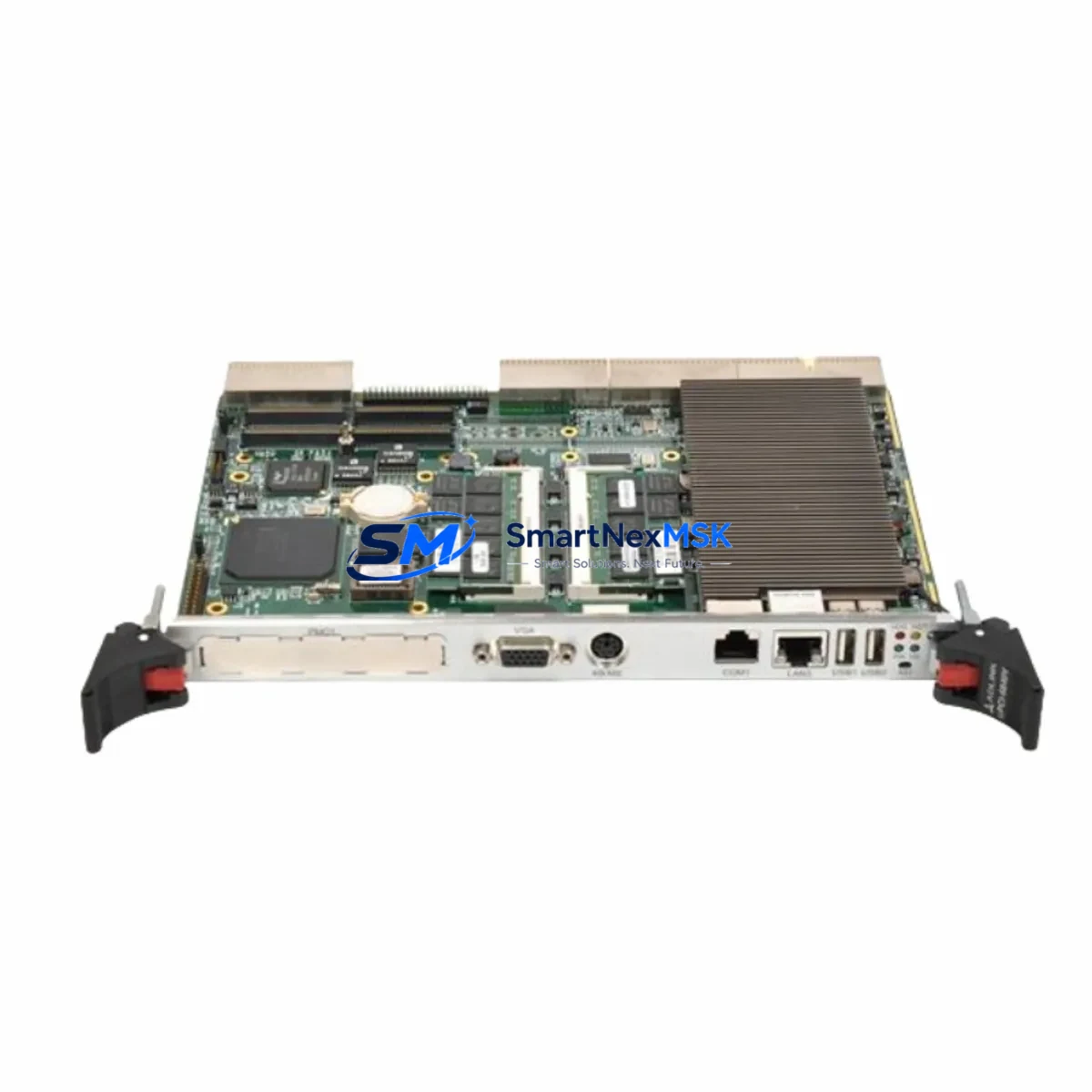
eiuie CPCI-6840V Retrofit-Ready Processor for CompactPCI Serial Control Systems
The eiuie CPCI-6840V is a high-performance CompactPCI Serial processor board engineered for seamless integration into existing automation infrastructures. As industrial facilities face the growing challenge of maintaining aging control architectures, the CPCI-6840V delivers a proven, retrofit-ready solution that bridges legacy system requirements with modern processing capability. Whether you are replacing an end-of-life controller in a production line, upgrading a control cabinet, or migrating from an older PICMG 2.0 parallel bus platform to a PICMG 2.30 CompactPCI Serial architecture, the CPCI-6840V is designed to minimize engineering risk and reduce total downtime.
For system integrators and maintenance engineers managing older automation platforms, the CPCI-6840V addresses the most critical pain points in retrofit projects: backplane compatibility, terminal wiring adaptation, module addressing, and program logic preservation. The board is compatible with standard 3U CompactPCI Serial chassis and can be installed alongside existing I/O modules, communication modules, and power supply units without requiring a full rack replacement. This makes it an ideal candidate for phased upgrade strategies where budget constraints or production schedules prevent a complete system overhaul.
When planning a retrofit using the CPCI-6840V, engineers should verify the available power budget within the existing chassis. CompactPCI Serial backplanes distribute power across multiple slots, and adding a new processor board may affect the load balance — particularly in older cabinets where the CPCI power supply module may already be operating near capacity. It is recommended to audit the total slot power draw before installation and, if necessary, replace the existing PSU with a higher-rated unit rated for the new configuration.
Terminal wiring and I/O mapping are equally important during migration. If the legacy system used a parallel CompactPCI I/O module with a specific connector pinout, the replacement process must account for any differences in the new I/O carrier board or transition module. In many cases, engineers use a CompactPCI Serial transition module or rear I/O panel to maintain existing field wiring without re-termination, significantly reducing installation time and the risk of wiring errors.
Backplane slot addressing must also be reconfigured when swapping processor boards. The CPCI-6840V uses standard geographic addressing over the CompactPCI Serial fabric, but if the previous system relied on a different slot assignment scheme — common in older CPCI-6U chassis configurations — the system integrator must update the slot address map in the firmware or BIOS settings before commissioning. Failure to do so can result in communication conflicts between the processor and peripheral modules such as CompactPCI Serial communication modules or CPCI Ethernet switch modules.
Program compatibility is a key concern in any processor board replacement. If the legacy controller ran a real-time operating system or a proprietary PLC runtime, the migration to the CPCI-6840V may require recompilation of the application software or re-flashing of the firmware image. Engineers should back up the original program logic, HMI screen configurations, and communication link parameters before beginning the swap. HMI panels connected via RS-232, RS-485, or Ethernet to the original processor must be reconfigured to point to the new board’s communication ports, and any Modbus RTU, PROFIBUS, or EtherCAT device mappings must be verified against the new hardware’s protocol stack.
Communication link migration is particularly important in systems that use fieldbus protocols. If the original system included a dedicated PROFIBUS DP master module or a CANopen communication card installed in an adjacent CompactPCI slot, these modules can typically be retained during the processor upgrade, provided the new processor board supports the same backplane communication interface. The CPCI-6840V’s CompactPCI Serial fabric ensures high-speed, low-latency communication with co-resident modules, making it compatible with a wide range of existing peripheral cards.
On-site commissioning after installation should follow a structured validation sequence. Begin with a power-on self-test to confirm the board is recognized by the chassis management controller. Next, verify that all peripheral modules — including CompactPCI Serial digital I/O modules, analog input cards, and motion control boards — are enumerated correctly on the backplane. Load the application software, confirm HMI connectivity, and perform a dry-run of the control logic before returning the system to live production. This sequence minimizes the risk of unexpected faults during the first production cycle after the upgrade.
Every CPCI-6840V unit supplied by SMARTNEXMSK undergoes pre-shipment functional testing to verify processor initialization, memory integrity, and backplane communication. Units are shipped with a 12-month warranty covering manufacturing defects and operational failures under normal industrial use conditions. Our inventory is maintained to support urgent replacement orders, with fast global shipping available to minimize production downtime for customers facing critical system failures.
Upgrade Compatibility Table
| Parameter | Details |
|---|---|
| SKU | CPCI-6840V |
| Brand | eiuie |
| Form Factor | 3U CompactPCI Serial (PICMG 2.30) |
| Backplane Interface | CompactPCI Serial Fabric |
| Legacy Compatibility | Replaces parallel CPCI processor boards in upgraded chassis |
| Communication Interfaces | Ethernet, RS-232, RS-485, USB (model-dependent) |
| Installation Requirement | 3U CompactPCI Serial chassis; verify slot power budget |
| Replacement Recommendation | Direct replacement for end-of-life eiuie CPCI-series processor boards |
| Commissioning Notes | Re-map slot addresses; verify HMI and fieldbus links; reload application |
| Warranty | 12 Months — covers manufacturing defects and operational failures |
Retrofit Planning for Existing Automation Systems
A successful retrofit begins well before the physical board swap. During the planning phase, engineers should compile a full inventory of the existing rack contents, including the CompactPCI Serial chassis backplane, the installed CPCI power supply module, any CompactPCI Serial I/O modules, CPCI communication modules, and the CompactPCI Serial system slot controller. Understanding the exact configuration of the existing system allows the retrofit team to identify which components can be reused and which must be replaced or reconfigured alongside the CPCI-6840V processor board.
In many legacy installations, the control cabinet also contains a CompactPCI Serial Ethernet switch module for inter-rack communication, a CPCI rear transition module for field wiring, and a CompactPCI Serial timing and synchronization module for time-critical control loops. These components are generally compatible with the CPCI-6840V and can remain in service during and after the processor upgrade, provided their firmware versions are compatible with the new processor’s operating environment.
For systems that include an HMI panel connected to the legacy processor via a serial or Ethernet link, the HMI configuration files must be updated to reflect the new processor’s IP address or COM port assignment. If the HMI was programmed using a proprietary development tool tied to the original processor platform, a migration of the HMI project to a compatible runtime environment may be required. Similarly, any programming cable or JTAG debug interface used for the original processor must be replaced with a tool compatible with the CPCI-6840V’s programming interface.
Downtime Control During System Migration
Minimizing production downtime is the primary operational concern during any processor board replacement. The recommended approach is to pre-configure the CPCI-6840V in a bench environment before the scheduled maintenance window. This includes loading the application software, configuring communication parameters, and verifying basic I/O functionality using a test chassis or a spare rack. By completing as much pre-commissioning work as possible offline, the on-site installation time can be reduced to the physical swap, cable reconnection, and a final validation sequence.
During the maintenance window, the original processor board’s program logic and configuration data should be archived to a secure backup medium before removal. This preserves the ability to restore the original system if an unexpected compatibility issue arises during commissioning of the CPCI-6840V. Once the new board is installed and powered on, the pre-loaded application can be activated immediately, and the system can be returned to production after a brief functional verification — typically covering I/O status, communication link health, and HMI display accuracy.
For systems where even brief interruptions are unacceptable, a parallel commissioning strategy can be employed: the CPCI-6840V is installed in a secondary slot or a shadow chassis, configured and validated while the original processor remains in service, and then switched into the active control role during a planned micro-outage. This approach is particularly effective in continuous process industries where control continuity is critical and scheduled downtime windows are measured in minutes rather than hours.
Retrofit Support FAQ
Q: Is the CPCI-6840V a direct drop-in replacement for my existing eiuie CompactPCI processor board?
A: The CPCI-6840V is designed as a retrofit-compatible replacement for eiuie CompactPCI Serial processor boards. Physical installation is straightforward in any compatible 3U CompactPCI Serial chassis. Software and firmware migration steps are required to transfer your application logic to the new board, and communication link parameters must be reconfigured to match the new hardware.
Q: What wiring or terminal changes are needed during installation?
A: If your existing system uses a rear transition module or a standard CompactPCI Serial I/O carrier, field wiring typically does not need to be changed. The CPCI-6840V uses standard CompactPCI Serial connector interfaces. For systems with custom wiring harnesses tied to the original processor’s front-panel connectors, an adapter or re-termination may be required.
Q: How do I verify compatibility before ordering?
A: Please provide your existing chassis model, current processor board SKU, backplane specification (PICMG 2.0 or PICMG 2.30), and communication protocol requirements. Our technical team will confirm compatibility and advise on any additional components needed for the retrofit.
Q: What does the 12-month warranty cover?
A: The 12-month warranty covers manufacturing defects and operational failures under normal industrial use conditions. Each unit is functionally tested prior to shipment. Warranty claims are supported by our technical team, and replacement units are dispatched promptly to minimize any impact on your production operations.
© 2026 SMARTNEXMSK. All rights reserved.
Original Source: https://smartnexmsk.com
Contact: [email protected] | +86 18259474341