
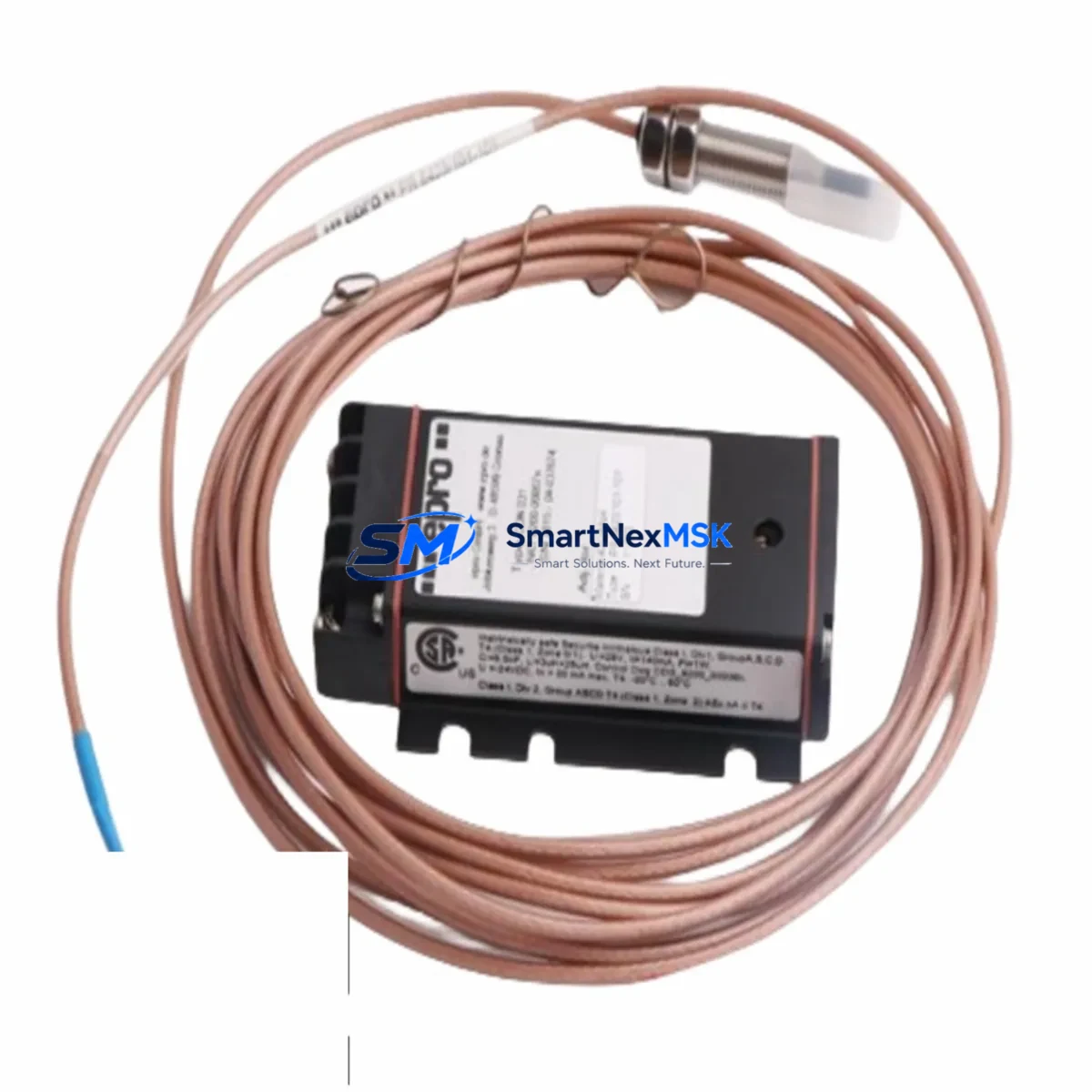
EPRO PR6424/013-110 CON021 Retrofit-Ready Eddy Current Proximity Sensor for PR6424 Series Control Systems
The EPRO PR6424/013-110 CON021 is a high-precision eddy current proximity sensor engineered for seamless retrofit integration into existing PR6424 Series vibration monitoring and machinery protection systems. Manufactured by EPRO (a Baker Hughes company), this sensor is the preferred drop-in replacement for aging or discontinued PR6424 variants deployed across turbine control panels, compressor protection racks, and rotating machinery monitoring cabinets. Whether you are upgrading a legacy Bently Nevada 3300 Series-compatible installation or migrating from an older EPRO CON011 or CON021 conditioner-based architecture, this sensor delivers verified electrical and mechanical compatibility with minimal re-engineering effort.
Designed for industrial environments demanding continuous uptime, the PR6424/013-110 CON021 operates reliably in high-temperature, high-vibration, and chemically aggressive surroundings. Its 8 mm probe diameter, 110 mm cable extension, and standard M10 thread mounting make it directly interchangeable with the majority of PR6424 Series installations without modification to existing probe holders, junction boxes, or conduit runs. The sensor is factory-calibrated and ships with full documentation, enabling rapid commissioning and reducing planned outage windows to the minimum.
Upgrade Compatibility Table
| Parameter | PR6424/013-110 CON021 | Retrofit Notes |
|---|---|---|
| Probe Diameter | 8 mm | Direct fit for standard PR6424 probe holders; no adapter required |
| Cable Length | 110 mm extension | Verify total system cable length with CON021 conditioner specification |
| Thread / Mounting | M10 × 1.0 | Compatible with existing probe brackets; check locknut torque spec |
| Supply Voltage | −24 VDC (nominal) | Confirm power supply rail capacity before hot-swap; typical draw <30 mA |
| Output Signal | −2 VDC to −18 VDC (linear range) | Compatible with CON021 conditioner input; verify gap voltage at installation |
| Communication / Interface | Analog (passive probe) | No protocol migration required; signal chain unchanged from legacy PR6424 |
| Conditioner Compatibility | EPRO CON021 / CON011 (with verification) | Confirm conditioner firmware revision if using CON011 legacy units |
| Replacement for | PR6424/013-110 CON021 (OEM equivalent) | Also compatible with select Bently Nevada 3300 XL 8 mm probe installations |
| Installation Environment | IP67, −40 °C to +120 °C | Suitable for outdoor turbine enclosures and high-humidity compressor rooms |
| Warranty | 12-Month Warranty — covers manufacturing defects; includes pre-shipment functional test report | |
Retrofit Planning for Existing Automation Systems
Successful integration of the PR6424/013-110 CON021 into a running plant begins well before the scheduled outage window. A structured retrofit plan should address the full signal chain from the probe tip through the extension cable, into the EPRO CON021 conditioner, and onward to the monitoring rack — typically a EPRO MMS 6350 or MMS 6110 vibration monitor module seated in a standard 19-inch DIN rack or a dedicated machinery protection cabinet.
Start by auditing the existing terminal wiring at the junction box. The PR6424 probe uses a coaxial signal path; confirm that the existing EPRO TK-C extension cable is undamaged and that its connector is free of corrosion or mechanical stress. If the extension cable shows impedance drift or physical damage, replace it simultaneously with the probe to avoid introducing a new fault source after reassembly. Document the original gap voltage reading — typically between −10 VDC and −12 VDC at the nominal air gap — so that the post-installation calibration target is clearly defined before the outage begins.
At the rack level, verify that the EPRO CON021 conditioner module is seated correctly in its backplane slot and that the backplane power bus is delivering a stable −24 VDC supply rail. If the conditioner is an older CON011 variant, cross-check the sensitivity specification (typically 7.87 V/mm) against the new probe’s datasheet to confirm compatibility before energizing. In systems where the monitoring rack interfaces with a Bently Nevada 3500 Series or a Siemens SIMATIC S7-400 safety PLC via a 4–20 mA or relay output, ensure that the I/O module address assignments and alarm setpoint configurations in the PLC program remain unchanged — the analog signal range of the new probe is identical to the original, so no program modification should be required.
For installations that feed vibration data into a GE Mark VIe or ABB Symphony Plus DCS via a serial or Modbus RTU link from the monitoring rack, confirm that the rack’s communication module — such as an EPRO MMS 6823 Modbus gateway — is correctly mapped to the channel being replaced. A channel substitution at the probe level should be transparent to the DCS historian, but a forced re-initialization of the monitoring rack after power cycling may temporarily interrupt the data stream; coordinate with the control room operator before proceeding.
Where the existing installation includes a local HMI panel — such as a Siemens TP700 or a Proface GP4000 series touchscreen — displaying real-time vibration trend screens, verify that the engineering unit scaling and alarm band graphics remain valid after the probe swap. No HMI screen modification is expected, but a visual confirmation of the live trend value against a portable reference instrument is recommended as part of the commissioning checklist.
Downtime Control During System Migration
Minimizing planned outage duration during a PR6424/013-110 CON021 replacement requires pre-staging all replacement components, tools, and documentation at the work site before the equipment is de-energized. The following practices consistently reduce field replacement time to under two hours for a single-channel swap:
Pre-outage preparation: Record the existing gap voltage, vibration baseline, and alarm setpoints from the monitoring rack display or DCS historian. Photograph the existing terminal wiring at the junction box and the conditioner module front panel before disconnection. Confirm that a spare EPRO CON021 conditioner is available on-site in case the existing conditioner is found to be faulty during the probe replacement — a simultaneous conditioner failure is the most common cause of extended outage duration in PR6424 retrofit projects.
During the outage: De-energize the probe circuit at the conditioner module, not at the main panel, to preserve the rack’s communication link to the DCS and avoid triggering a full system restart. Remove the probe using the correct spanner size for the M10 locknut — avoid pipe wrenches or improvised tools that can damage the probe holder threads. Install the new PR6424/013-110 CON021, set the air gap to the manufacturer’s nominal specification (typically 1.0 mm ± 0.1 mm for an 8 mm probe on a steel target), and re-energize the probe circuit. Measure the gap voltage at the conditioner test point and confirm it falls within the expected linear range before releasing the equipment to operations.
Post-commissioning verification: Allow the system to run for a minimum of 15 minutes under normal operating conditions before signing off. Confirm that the vibration trend on the DCS historian is stable and consistent with the pre-outage baseline. Issue a written commissioning record noting the new probe serial number, measured gap voltage, and the name of the technician who performed the installation — this record supports the 12-month warranty claim process if a defect is identified during the warranty period.
Retrofit Support FAQ
Q1: Is the PR6424/013-110 CON021 a direct drop-in replacement for the original EPRO PR6424/013-110 CON021?
Yes. This unit is an OEM-equivalent replacement with identical probe diameter, thread pitch, cable length, sensitivity, and output voltage range. No mechanical modification to the probe holder, junction box, or conditioner wiring is required. A gap voltage verification after installation is always recommended as standard commissioning practice.
Q2: What pre-shipment testing is performed on each unit?
Every PR6424/013-110 CON021 shipped by SMARTNEXMSK undergoes a functional output test confirming sensitivity (7.87 V/mm ± 10%), linearity across the full measurement range, and insulation resistance. A test report is included with each shipment. Units are individually packaged in anti-static foam to prevent transit damage.
Q3: Can this sensor be used with a Bently Nevada CON021-compatible conditioner?
The PR6424/013-110 CON021 is electrically compatible with conditioners that accept the standard EPRO 8 mm probe signal specification. Compatibility with specific Bently Nevada conditioner models should be verified against the conditioner’s input specification sheet, as connector pinout and sensitivity calibration may differ between manufacturers. Contact our technical team with your conditioner model number for a pre-sale compatibility confirmation.
Q4: What does the 12-month warranty cover, and how is a claim initiated?
The 12-month warranty covers manufacturing defects in materials and workmanship from the date of shipment. It does not cover damage resulting from incorrect installation, over-range mechanical impact, or chemical contamination. To initiate a warranty claim, contact [email protected] with the order number, unit serial number, a description of the fault, and the commissioning record. Replacement units are dispatched within 3 business days of claim approval.
© 2026 SMARTNEXMSK. All rights reserved.
Original Source: https://smartnexmsk.com
Contact: [email protected] | +86 18259474341