
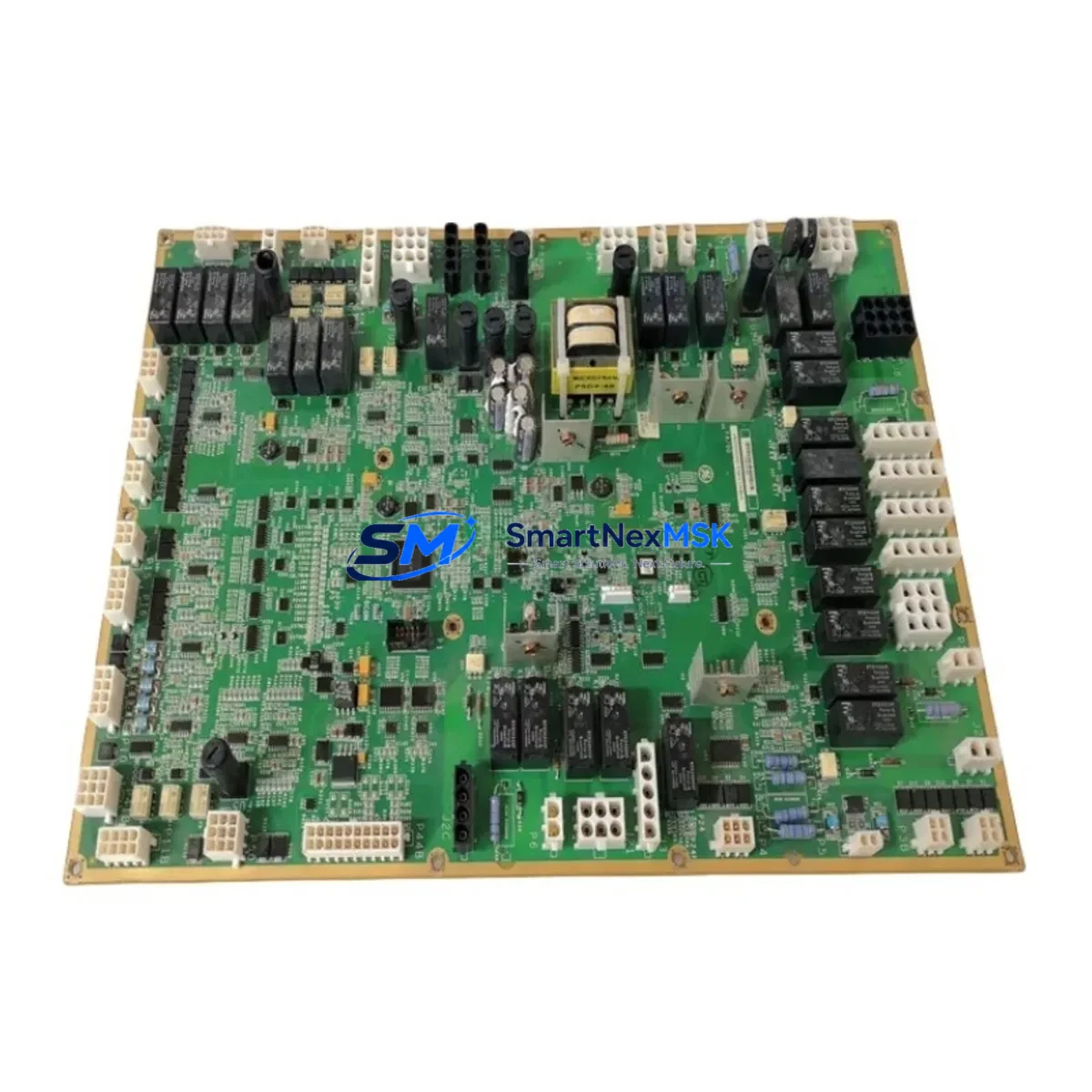
GE IS215WEMAH1A Retrofit-Ready Ethernet Module for Mark VIe Control Systems
The GE IS215WEMAH1A is a high-reliability Ethernet communication module engineered for the Mark VIe turbine control platform. As legacy Mark V and Mark VI installations reach end-of-service milestones, plant engineers and automation integrators increasingly rely on the IS215WEMAH1A as a proven retrofit solution that preserves existing control architecture while delivering modern network communication performance. Whether you are executing a full turbine control system upgrade or replacing a failed communication card to restore production continuity, the IS215WEMAH1A provides a direct, compatible path with minimal engineering risk.
This module supports 10/100 Mbps Ethernet connectivity and is designed to integrate seamlessly within the Mark VIe I/O and control network topology. It mounts directly onto the Mark VIe I/O pack backplane and communicates over the IONet high-speed deterministic network, ensuring real-time data exchange between the controller, I/O modules, and HMI workstations running Toolbox ST or Cimplicity. Before installation, engineers should verify backplane slot assignments, confirm IONet IP addressing, and review the existing Mark VIe application code for any module-address-dependent logic blocks that may require parameter updates.
In retrofit scenarios where the plant is migrating from a Mark V VCMI or Mark VI VCMI communication card, the IS215WEMAH1A requires careful attention to terminal wiring differences. The Mark VIe I/O pack connector pinout differs from earlier-generation terminal boards, and adapters or rewired junction boxes may be necessary. Power supply capacity should also be confirmed — the IS215WEMAH1A draws from the Mark VIe I/O pack power rail, and the associated IS200 power supply module or IS215 power conditioner must have sufficient headroom to support the added load without triggering undervoltage faults.
Upgrade Compatibility Table
| Parameter | Details |
|---|---|
| SKU / Part Number | IS215WEMAH1A |
| Compatible Platform | GE Mark VIe Turbine Control System |
| Communication Interface | 10/100 Mbps Ethernet (IONet) |
| Backplane Interface | Mark VIe I/O Pack Connector |
| Replaces / Upgrades From | Mark V VCMI, Mark VI VCMI, IS200WEMAH1A |
| Installation Requirement | Slot assignment, IP configuration, IONet topology verification |
| Communication Compatibility | IONet, Modbus TCP (via gateway), OPC DA/UA (via HMI server) |
| Retrofit Recommendation | Verify power rail capacity; update Toolbox ST module address if changed |
| Commissioning Focus | IONet link status, HMI tag mapping, alarm list validation |
| Warranty | 12 Months — covers manufacturing defects and functional failure |
Retrofit Planning for Existing Automation Systems
A successful IS215WEMAH1A retrofit begins well before the module arrives on site. The engineering team should pull the existing Mark VIe application export from Toolbox ST and document all IONet node addresses, I/O pack assignments, and inter-controller communication links. If the plant also operates IS215WCVAH1B voting controllers or IS200TREGH1B terminal boards, their configurations must be cross-referenced to ensure the new Ethernet module does not conflict with existing node IDs on the IONet segment.
For plants running mixed-generation control cabinets — for example, a Mark VIe main controller paired with legacy Mark VI I/O racks via an IS200BIICH1A bus interface — the IS215WEMAH1A must be confirmed compatible with the specific firmware revision of the Mark VIe controller board (IS215UCVEH2A or equivalent). Firmware mismatches between the controller and communication modules are a leading cause of IONet link failures during commissioning and should be resolved before the maintenance window begins.
Terminal wiring adaptation is another critical planning step. If the existing installation uses IS200TTURH1C or IS200TBCIH1C terminal boards, the field wiring may need to be re-landed on new Mark VIe-compatible terminal assemblies. Labeling all field cables before disconnection and photographing the existing wiring layout will significantly reduce re-commissioning time. For plants with Profibus DP or DeviceNet field devices, a protocol gateway such as the IS200PGVAH1A may be required to bridge legacy fieldbus segments to the Mark VIe IONet backbone.
HMI integration should not be overlooked. Cimplicity or iFIX screens that reference the replaced module’s tag names must be updated to reflect any new IONet node addresses. If the plant uses a separate DCS historian — such as an OSIsoft PI server — the PI interface node should be reconfigured to poll the updated Mark VIe OPC server tag list after the IS215WEMAH1A is commissioned. Programming cables such as the IS200PCVAH1A are recommended for on-site Toolbox ST connections during final verification.
Downtime Control During System Migration
Minimizing unplanned downtime is the primary operational concern during any Mark VIe communication module replacement. The recommended approach is to pre-configure the IS215WEMAH1A offline — assigning the correct IONet IP address, verifying firmware compatibility, and running a bench-level communication test against a spare Mark VIe controller — before the scheduled maintenance window opens. This pre-staging process typically reduces on-site installation time to under two hours for a single-module swap.
During the cutover, the existing application program should be exported and archived from Toolbox ST before any hardware is disturbed. If the plant operates in a redundant Mark VIe configuration with primary and secondary controllers, the switchover sequence should be planned to maintain control continuity on the secondary path while the primary communication module is replaced. After the IS215WEMAH1A is installed and IONet link is confirmed, a controlled transfer back to the primary controller should be executed with operations personnel monitoring the HMI for alarm anomalies.
Post-installation, a full I/O scan and alarm list review should be completed before returning the unit to automatic control. Any latched faults from the previous module failure should be cleared in Toolbox ST, and the historian should be verified to confirm data continuity. All commissioning steps, including IONet link status, module diagnostics, and HMI tag verification, should be documented and retained as part of the plant’s maintenance record.
Retrofit Support FAQ
Q1: Is the IS215WEMAH1A a direct drop-in replacement for the IS200WEMAH1A?
A: The IS215WEMAH1A and IS200WEMAH1A share the same functional role within the Mark VIe I/O pack architecture, but connector and firmware revisions may differ. Confirm the backplane connector type and Toolbox ST firmware compatibility before installation. In most Mark VIe applications, the IS215WEMAH1A is the current preferred replacement.
Q2: What wiring changes are required when replacing a Mark VI VCMI with the IS215WEMAH1A?
A: The Mark VIe I/O pack uses a different connector standard than the Mark VI VCMI terminal board. Field wiring will need to be re-landed on a compatible Mark VIe terminal assembly. Document all existing wiring before disconnection and verify signal assignments against the Mark VIe I/O pack wiring diagram.
Q3: How is the IONet address configured on the IS215WEMAH1A?
A: IONet node addressing is configured via Toolbox ST during the application download. The module does not have onboard DIP switches for address setting. Ensure the Toolbox ST application file is updated with the correct node address before downloading to the Mark VIe controller.
Q4: What does the 12-month warranty cover?
A: The 12-month warranty covers manufacturing defects and functional failures under normal operating conditions. Each unit undergoes pre-shipment functional testing. Warranty claims are supported by SMARTNEXMSK with replacement or repair at no additional cost within the warranty period. Contact [email protected] for warranty service.
© 2026 SMARTNEXMSK. All rights reserved.
Original Source: https://smartnexmsk.com
Contact: [email protected] | +86 18259474341