
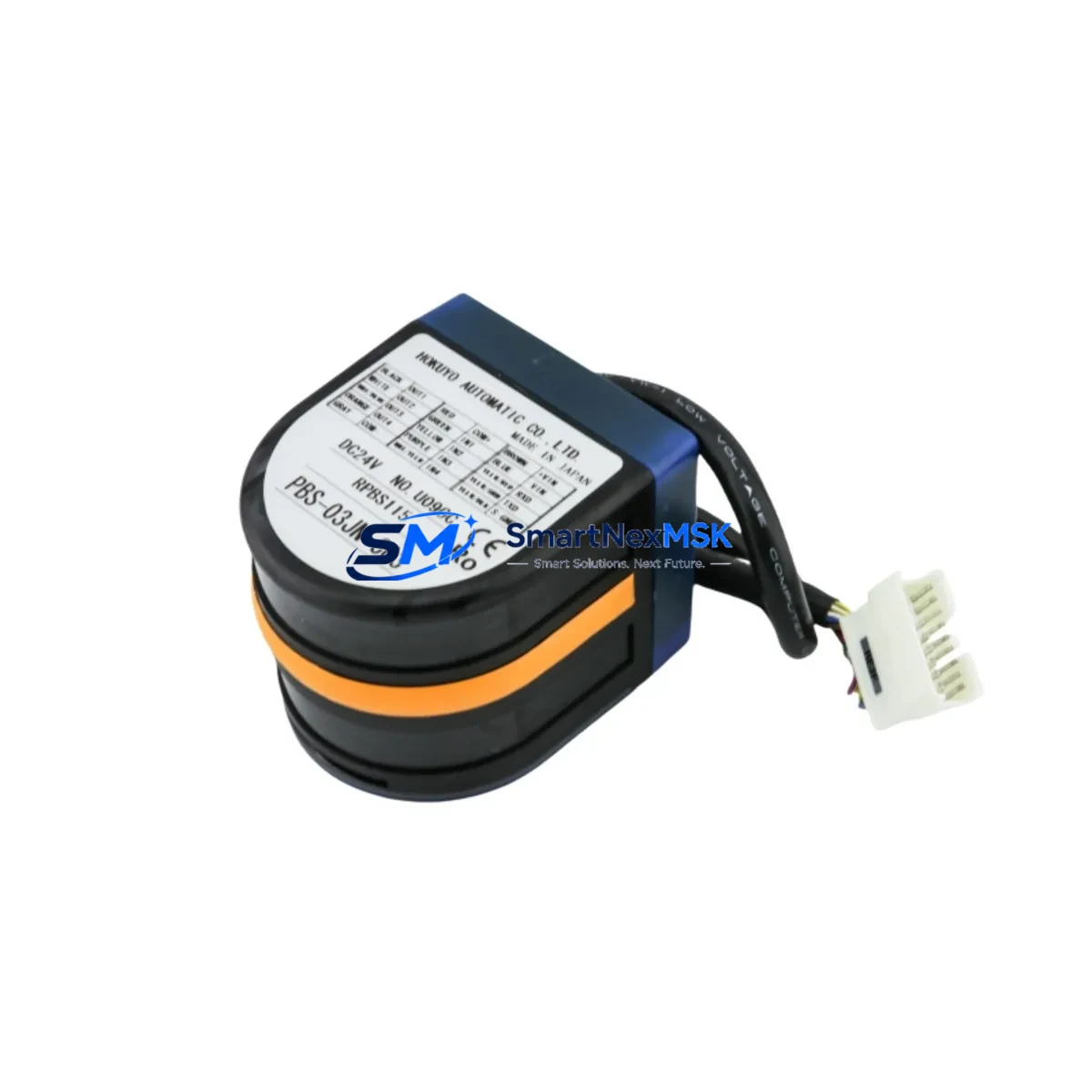
HOKUYO PBS-03JN Retrofit-Ready Obstacle Sensor for PBS Series Control Systems
The HOKUYO PBS-03JN is a precision photoelectric obstacle detection sensor engineered for seamless integration into existing PBS Series automation architectures. As legacy control systems age and original components reach end-of-life, the PBS-03JN serves as a verified drop-in retrofit solution — enabling production lines to resume operation without redesigning the control cabinet or rewriting PLC logic. Whether you are replacing a failed unit on a running line or proactively stocking critical spares for a PBS Series installation, the PBS-03JN delivers the detection accuracy, electrical compatibility, and mechanical form factor your system demands.
Industrial facilities operating HOKUYO PBS Series sensor arrays frequently encounter obsolescence challenges when sourcing replacement units through standard distribution channels. The PBS-03JN addresses this gap directly: it maintains the same mounting footprint, connector pinout, and output signal characteristics as the original specification, allowing maintenance engineers to complete a swap during a planned maintenance window without extended downtime. The sensor operates across a detection range of 2 to 12 mm, making it suitable for proximity detection tasks on assembly conveyors, robotic end-of-arm tooling, and material handling equipment where precise object presence confirmation is critical.
When integrating the PBS-03JN into a retrofit project, engineers should verify the supply voltage at the terminal block — the sensor accepts a standard 12–24 VDC input, consistent with the power rails commonly distributed by HOKUYO-compatible power supply modules and DIN-rail mounted switching power supplies already present in the control cabinet. Output wiring should be confirmed against the existing PLC input module’s sink/source configuration; the PBS-03JN’s NPN open-collector output is directly compatible with the discrete input channels found on most Mitsubishi MELSEC FX and Q Series input modules, as well as Omron CJ/CS Series I/O units commonly deployed alongside HOKUYO sensor arrays in the same control panel.
For installations where the PBS-03JN feeds signals into a safety or motion controller, confirm that the input response time of the receiving module — whether a Siemens S7-300 digital input card or a Keyence KV Series controller — is within the sensor’s switching frequency specification. In multi-axis systems, the sensor’s output is typically wired through a terminal block module before reaching the PLC backplane, so inspect the terminal strip labeling and update the I/O address map in your programming software (GX Works2, CX-Programmer, or TIA Portal) to reflect the new module address if the physical slot position changes during the retrofit.
Communication protocol migration is rarely required when replacing a PBS-03JN on a like-for-like basis, as the sensor operates as a discrete I/O device rather than a fieldbus node. However, in systems where sensor data is aggregated through a remote I/O coupler — such as a Beckhoff EK1100 EtherCAT coupler or a Phoenix Contact Inline bus terminal — verify that the coupler’s channel mapping remains intact after the physical replacement. If the retrofit involves upgrading from an older PBS variant to the PBS-03JN as part of a broader system modernization, update the HMI screen tag bindings in your SCADA or HMI project (Weintek, Proface, or Siemens TP series panels are common in PBS Series environments) to reflect any I/O address changes introduced during the upgrade.
Backplane and rack compatibility should also be confirmed when the PBS-03JN is installed adjacent to other HOKUYO sensor modules or alongside I/O expansion racks. In dense control cabinet layouts, DIN rail spacing and cable management must accommodate the sensor’s body dimensions and the routing of the M8 or M12 connector cable to the nearest terminal block. Where cable lengths differ from the original installation, use shielded sensor cables to maintain signal integrity, particularly in environments with variable-frequency drives or servo amplifiers generating electromagnetic interference.
Pre-shipment testing is conducted on every PBS-03JN unit: detection range calibration, output switching verification, and insulation resistance checks are performed before dispatch. Each unit ships with a 12-month warranty covering manufacturing defects and functional failures under normal operating conditions. Stock is maintained in Xiamen for rapid fulfillment, with export documentation prepared for international shipments to support customs clearance in target markets.
Upgrade Compatibility Table
| Parameter | Detail |
|---|---|
| SKU / Model | PBS-03JN |
| Brand / Manufacturer | HOKUYO |
| Product Series | PBS Series |
| Detection Range | 2 – 12 mm |
| Supply Voltage | 12 – 24 VDC |
| Output Type | NPN Open-Collector |
| Connector / Interface | M8 / M12 (confirm with original wiring diagram) |
| Mounting Compatibility | Direct drop-in for PBS Series mounting bracket |
| PLC Compatibility | Mitsubishi MELSEC FX/Q, Omron CJ/CS, Siemens S7-300/1200, Keyence KV |
| Communication | Discrete I/O (no fieldbus node configuration required) |
| Replacement Recommendation | Verified drop-in for discontinued PBS Series units |
| Commissioning Notes | Confirm I/O address, terminal polarity, and HMI tag binding before power-on |
| Warranty | 12 Months — manufacturing defects and functional failures |
| Origin | Japan |
| Stock Location | Xiamen, China — available for immediate dispatch |
Retrofit Planning for Existing Automation Systems
A successful PBS-03JN retrofit begins with a thorough audit of the existing control cabinet before any hardware is removed. Start by documenting the terminal block wiring diagram — note the wire colors, terminal numbers, and the PLC input module address assigned to the original sensor channel. In most PBS Series installations, the sensor signal passes through a Phoenix Contact or Weidmuller terminal strip before reaching the PLC input card; photograph the terminal layout and label each wire before disconnection.
Power supply capacity is the next checkpoint. Confirm that the existing 24 VDC switching power supply — often a MEAN WELL or HOKUYO-compatible rail-mount unit — has sufficient residual current capacity to support the PBS-03JN alongside other loads in the cabinet. In cabinets where multiple sensors, relay modules, and communication modules share a single power rail, a current audit prevents nuisance tripping after the replacement is installed.
If the retrofit is part of a broader upgrade — for example, migrating from a legacy HOKUYO PBS variant to a current-generation sensor while simultaneously upgrading the PLC from a Mitsubishi FX3U to an FX5U — plan the I/O address remapping carefully. The FX5U’s input module uses a different base address scheme than the FX3U, so GX Works3 project files must be updated to reflect the new X-device addresses before the program is downloaded. Similarly, if the control system includes a GOT2000 series HMI, update the device address references in GT Designer3 to maintain screen functionality after the PLC upgrade.
In systems where the PBS-03JN operates alongside Omron E3Z or Keyence PZ2 series photoelectric sensors on the same conveyor line, verify that the detection logic in the PLC ladder program correctly handles the sensor’s response time. Mixed-sensor installations sometimes require input filter time adjustments in the PLC configuration to prevent false triggers caused by differing switching speeds between sensor models.
For installations involving remote I/O — such as a Beckhoff EK1100 EtherCAT terminal or a Siemens ET 200SP distributed I/O station — the PBS-03JN’s discrete output connects to the nearest digital input terminal (e.g., a Beckhoff EL1008 or Siemens 6ES7 131 series input module). Confirm the terminal’s input voltage threshold and current consumption compatibility before finalizing the wiring. Update the TIA Portal or TwinCAT hardware configuration to reflect any slot changes introduced during the retrofit.
Downtime Control During System Migration
Minimizing production downtime during a PBS-03JN replacement requires preparation before the maintenance window opens. The most effective approach is to pre-configure and bench-test the replacement sensor before the line is stopped. Connect the PBS-03JN to a portable 24 VDC bench supply and a handheld I/O tester or a spare PLC input module to verify detection range and output switching before installation. This eliminates the risk of discovering a configuration issue after the line has been taken offline.
During the swap, keep the PLC in STOP mode and use the programming software’s forced I/O function (available in GX Works2, CX-Programmer, and TIA Portal) to hold the affected input channel at its last known state. This prevents downstream logic from triggering fault conditions or safety interlocks while the sensor is disconnected. Once the PBS-03JN is wired and mechanically secured, release the forced I/O, switch the PLC back to RUN mode, and monitor the input channel in the online monitor view to confirm the sensor is detecting correctly before resuming production.
For systems with redundant sensor channels — where two PBS Series sensors provide cross-checked detection on a critical conveyor position — the replacement can often be performed without stopping the line entirely. Disable the redundancy check in the PLC program temporarily, replace the failed sensor, verify its output, and re-enable the redundancy logic. This approach keeps the line running on single-sensor detection during the brief swap window, reducing downtime to the time required for physical replacement and wiring verification rather than a full line stop.
After the PBS-03JN is installed and the line is running, log the replacement in the maintenance management system with the date, the replaced unit’s serial number, and the new unit’s installation position. Schedule a follow-up inspection at 30 days to confirm stable operation and verify that detection range has not drifted due to target surface changes or mounting vibration.
Retrofit Support FAQ
Q1: Is the PBS-03JN a direct drop-in replacement for other PBS Series models?
The PBS-03JN is designed as a retrofit-compatible replacement for discontinued PBS Series obstacle detection sensors sharing the same mounting footprint and electrical interface. Before installation, confirm the supply voltage, output type (NPN/PNP), and connector type against your original wiring diagram. In most PBS Series installations, the PBS-03JN is a direct swap requiring no mechanical modification.
Q2: What commissioning steps are required after installation?
After wiring the PBS-03JN, power on the sensor and verify the indicator LED status. Use the PLC’s online monitor to confirm the input channel transitions correctly when an object enters the detection range. Adjust the sensing distance if required using the sensor’s built-in sensitivity control. Update the I/O comment in your PLC project file to reflect the new unit’s installation date for future maintenance reference.
Q3: How is wiring compatibility confirmed for mixed-brand PLC installations?
The PBS-03JN’s NPN open-collector output is compatible with the sink-type input channels found on most major PLC brands. For source-type (PNP) input modules — common in some Siemens and Beckhoff configurations — confirm the output polarity before wiring. If a polarity mismatch exists, an interposing relay or signal converter module can be inserted between the sensor output and the PLC input terminal without affecting detection performance.
Q4: What does the 12-month warranty cover, and how is a claim processed?
The 12-month warranty covers manufacturing defects and functional failures under normal operating conditions, including detection range degradation, output switching failure, and connector integrity issues. To initiate a warranty claim, contact [email protected] with the order number, installation date, and a description of the fault. Replacement units are dispatched from Xiamen stock upon claim verification, with return shipping instructions provided for the defective unit.
© 2026 SMARTNEXMSK. All rights reserved.
Original Source: https://smartnexmsk.com
Contact: [email protected] | +86 18259474341