
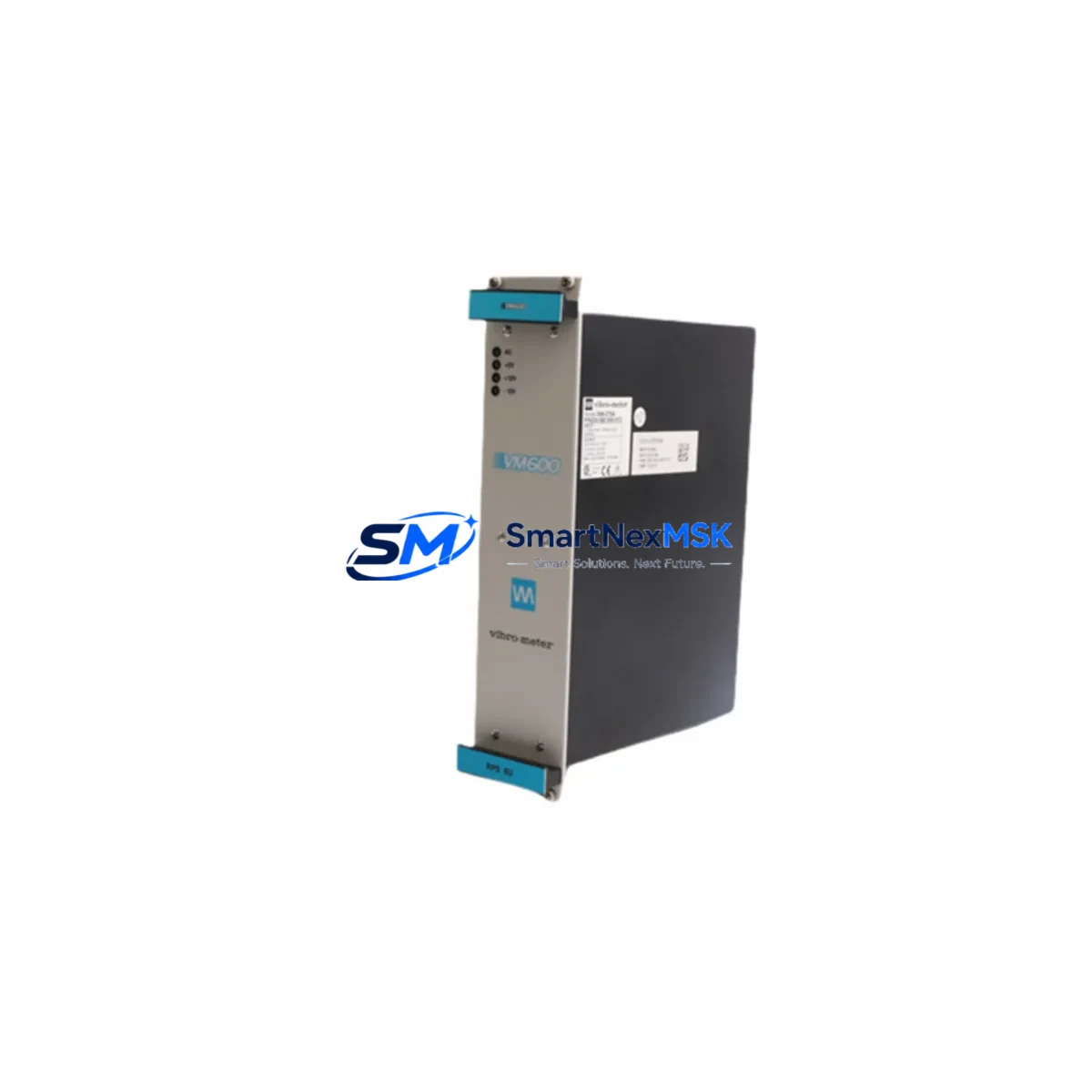
Meggitt VM600 RPS6U SIM-275D-24 Retrofit-Ready Rack Power Supply for VM600 Control Systems
The Meggitt VM600 RPS6U SIM-275D-24 (part number 200-582-200-013) is a rack-mounted power supply module engineered for the VIBRO-METER VM600 condition monitoring platform. Designed to deliver stable, regulated DC power to all modules seated within the VM600 rack chassis, this unit is a critical infrastructure component for turbine protection, rotating machinery monitoring, and industrial vibration analysis systems. As legacy VM600 installations age and OEM support windows narrow, the RPS6U SIM-275D-24 has become one of the most sought-after retrofit and replacement components for engineers tasked with extending the operational life of existing monitoring infrastructure without full system replacement.
Whether you are managing a planned upgrade cycle, responding to an unplanned power supply failure, or executing a phased modernization of your condition monitoring architecture, this module provides a verified drop-in replacement path that preserves your existing rack layout, wiring harness, and software configuration. Our inventory is sourced from controlled supply chains, subjected to functional power-on testing, and shipped with a 12-month warranty covering manufacturing defects and operational failures under normal service conditions.
Upgrade Compatibility Table
| Parameter | VM600 RPS6U SIM-275D-24 | Retrofit Notes |
|---|---|---|
| Part Number | 200-582-200-013 | Verify against rack label and system BOM |
| Platform Compatibility | Meggitt VIBRO-METER VM600 | Confirm rack chassis generation before ordering |
| Input Voltage | 24 VDC (SIM-275D-24 designation) | Match site power rail; verify UPS output tolerance |
| Rack Interface | VM600 backplane connector | Inspect backplane pins for corrosion before insertion |
| Module Slot | Dedicated PSU slot (RPS6U position) | Do not seat in signal module slots |
| Communication Compatibility | Passive power distribution — no protocol dependency | No firmware or address configuration required |
| Replacement Recommendation | Direct drop-in for failed or degraded RPS6U units | No rack reconfiguration needed for like-for-like swap |
| Commissioning Focus | Output voltage verification, load test under full rack population | Use calibrated multimeter at backplane test points |
| Warranty | 12 Months | Covers manufacturing defects and operational failure |
Retrofit Planning for Existing Automation Systems
Successful integration of the VM600 RPS6U SIM-275D-24 into an existing monitoring system begins well before the module arrives on site. Engineers should start by auditing the full rack population: document every installed module including the VM600 MPC4 machinery protection card, any VM600 IOC4T I/O concentrator modules, VM600 AMC8 advanced monitoring cards, and the VM600 RLC16 relay output modules that may be drawing load from the existing power supply. Understanding the aggregate current draw across all populated slots is essential to confirming that the replacement RPS6U unit will operate within its rated output envelope.
Terminal wiring on the DC input side should be inspected and re-torqued to manufacturer specification. In installations where the VM600 rack is fed from a SIM-275D series external power conditioner or a site UPS, verify that the upstream source can sustain inrush current during module hot-insertion or rack power-up sequencing. If the rack also houses a VM600 TIM-HV tachometer input module or VM600 XMx16 cross-channel multiplexer, confirm that these modules resume normal operation after the power supply swap without requiring manual re-initialization through the rack’s configuration software.
For sites running the Meggitt MMS6000 machinery management software or interfacing the VM600 rack to a DCS via Modbus RTU or PROFIBUS DP communication cards, the power supply replacement itself does not alter any protocol addressing or channel mapping. However, it is good practice to capture a full configuration export from the MMS6000 interface before beginning any hardware intervention, ensuring that alarm setpoints, transducer scaling factors, and relay trip thresholds are preserved and can be restored if a rack-level reset occurs during the swap procedure. Sites using VM600 RCOM remote communication modules should also verify that Ethernet link status is restored and that the host SCADA or historian re-establishes its data connection within the expected timeout window after power is restored.
Downtime Control During System Migration
Minimizing unplanned downtime during a power supply replacement on a live VM600 monitoring rack requires a structured pre-outage preparation protocol. Begin by notifying the control room and DCS operators that the affected rack will be temporarily offline, and confirm that any hardwired trip signals routed through the VM600 RLC16 relay modules are either bypassed at the field junction box or acknowledged at the safety system level to prevent spurious shutdowns of the monitored machinery.
Where the plant schedule permits, schedule the swap during a planned maintenance window aligned with a turbine or compressor outage. If the replacement must be performed with adjacent machinery running, isolate the affected rack’s power feed at the distribution panel, complete the module exchange, restore power, and allow the rack to complete its self-test and channel initialization sequence — typically completing within 60 to 90 seconds for a fully populated VM600 chassis — before re-enabling any trip relay outputs. This sequence protects the original program logic embedded in the MPC4 protection cards and ensures that vibration alarm thresholds, speed channel configurations, and relay output assignments are retained without requiring re-entry through the configuration interface. Throughout the procedure, maintain a technician at the local HMI or laptop running the VM600 configuration tool to monitor channel status in real time and confirm that all transducer inputs return to healthy readings before handing the system back to operations.
Retrofit Support FAQ
Q: Is the VM600 RPS6U SIM-275D-24 (200-582-200-013) a direct replacement for my existing failed power supply?
A: Yes, provided your rack is a Meggitt VIBRO-METER VM600 chassis and the failed unit occupies the RPS6U slot. Confirm the part number on the module faceplate or rack documentation before ordering. No rack reconfiguration or software changes are required for a like-for-like swap.
Q: What commissioning steps are required after installing the replacement module?
A: After seating the module and restoring DC input power, verify output voltage at the backplane test points using a calibrated multimeter. Confirm that all installed signal modules — including MPC4, IOC4T, and AMC8 cards — return to active status. Check that communication links (Modbus, PROFIBUS, or Ethernet) re-establish within the expected timeout and that all channel alarm states are consistent with pre-outage readings.
Q: How do I verify wiring compatibility before installation?
A: Inspect the DC input terminal block for correct polarity, conductor gauge compliance, and terminal torque. Confirm that the upstream power source (UPS or SIM-275D conditioner) output voltage is within the 24 VDC tolerance band specified for the SIM-275D-24 variant. Do not energize the module until all terminal connections have been verified against the original wiring diagram.
Q: What does the 12-month warranty cover, and how is it claimed?
A: The 12-month warranty covers manufacturing defects and operational failures occurring under normal service conditions within the rated electrical and environmental specifications. To initiate a warranty claim, contact our technical support team with the module serial number, a description of the failure mode, and your original order reference. Replacement or repair will be coordinated with priority handling to minimize your system downtime.
© 2026 SMARTNEXMSK. All rights reserved.
Original Source: https://smartnexmsk.com
Contact: [email protected] | +86 18259474341