
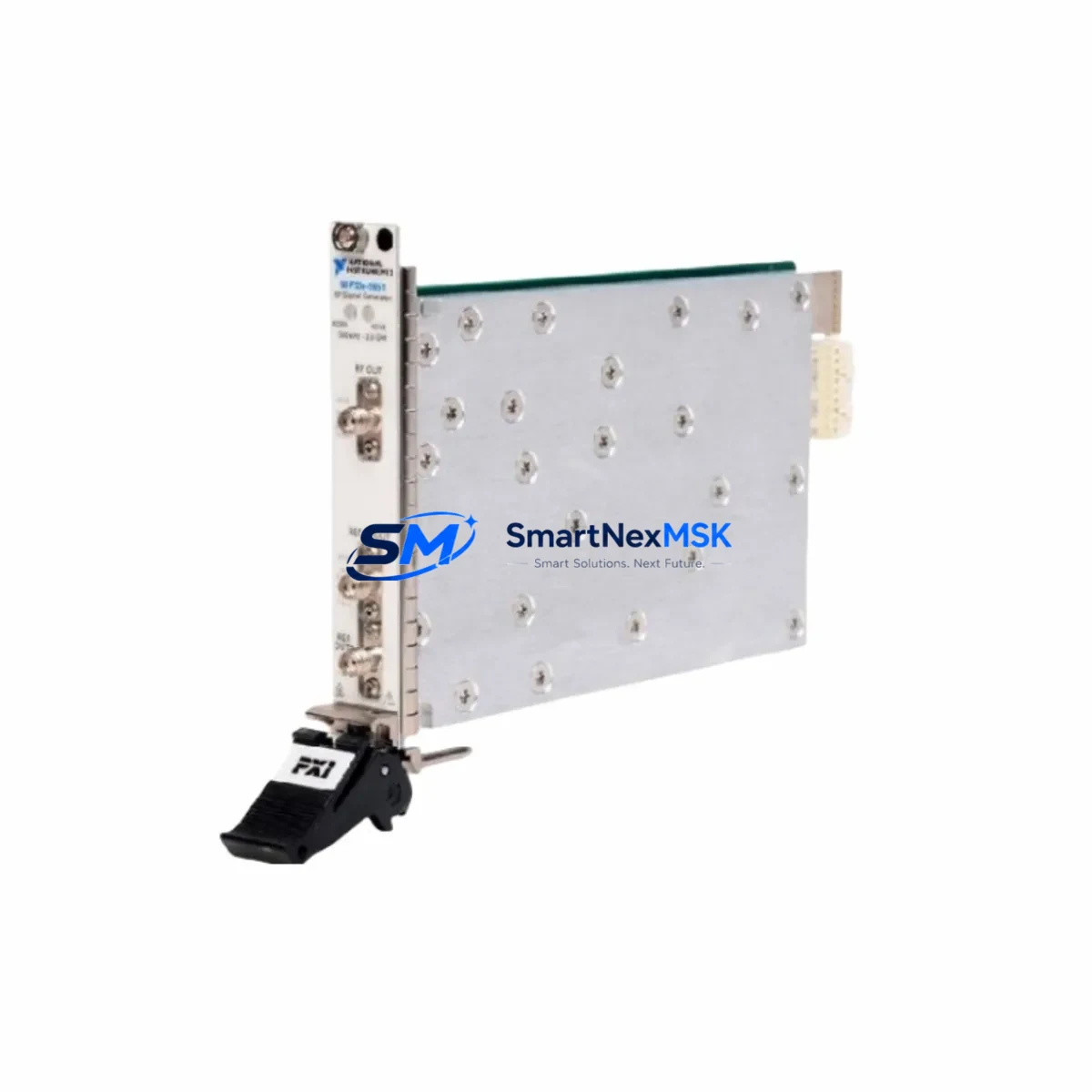
NI PXI-5651 Retrofit-Ready RF Signal Generator for PXI RF Series Control Systems
The NI PXI-5651 is a high-performance RF signal generator designed for PXI-based automated test and measurement systems. Operating across a frequency range of 100 kHz to 6.6 GHz, this module delivers stable, low-phase-noise output suitable for demanding RF characterization, radar simulation, and communications test applications. As legacy NI PXI RF Series chassis reach end-of-support cycles, the PXI-5651 has become a critical retrofit and replacement component for engineers modernizing existing test racks without full system redesign.
Whether you are replacing a failed unit in a production test cell, upgrading from an earlier NI PXI-5650 or PXI-5652 module, or migrating a multi-slot PXI chassis to a current-generation NI PXIe platform, the PXI-5651 provides a verified drop-in signal path with minimal reconfiguration. Our inventory is sourced, inspected, and shipped with a 12-month warranty, supporting your uptime requirements and procurement compliance.
Upgrade Compatibility Table
| Parameter | PXI-5651 (This Unit) | Retrofit Notes |
|---|---|---|
| Frequency Range | 100 kHz – 6.6 GHz | Verify DUT frequency plan before substituting PXI-5650 (3.3 GHz max) |
| Form Factor | 3U PXI, 1-slot | Compatible with all standard PXI-1000/1042/1045 chassis backplanes |
| Backplane Interface | PXI (32-bit, 33 MHz) | Hybrid PXIe chassis (e.g. PXIe-1082) supports PXI slots — confirm slot mapping |
| RF Output Connector | SMA (female) | Existing SMA cabling reusable; inspect for impedance mismatch at 6 GHz |
| Driver / Software | NI-RFSG IVI driver | Requires NI-RFSG 2.x or later; LabVIEW 2014+ recommended |
| Module Address | Slot-based PXI addressing | Update MAX resource name if slot position changes during retrofit |
| Replacement Path | PXI-5650 → PXI-5651 → PXIe-5654 | PXI-5651 is the recommended interim step before full PXIe migration |
| Warranty | 12 Months | Covers functional defects; includes pre-shipment functional verification |
Retrofit Planning for Existing Automation Systems
Integrating the PXI-5651 into an existing test rack begins with a thorough audit of the host chassis. Most legacy deployments use a NI PXI-1042 or NI PXI-1045 chassis with an embedded controller such as the NI PXI-8108 or NI PXI-8110. Before installing the PXI-5651, confirm that the chassis power supply can sustain the additional load — the module draws approximately 25 W from the +12 V rail. If the chassis is already near capacity due to co-installed digitizers, switching matrices, or NI PXI-2530 multiplexer modules, a power budget review is mandatory.
Slot assignment is the next critical step. In NI Measurement & Automation Explorer (MAX), each PXI module is identified by its chassis slot number. If the PXI-5651 replaces a module in a different physical slot than the original unit, all NI-RFSG session references in your LabVIEW or TestStand sequences must be updated to reflect the new resource name (e.g., PXI1Slot4). Failure to update these references is the most common cause of post-retrofit initialization errors.
For systems that also include NI PXI-5600 RF downconverters or NI PXI-5620 digitizers operating in a vector signal analyzer configuration, the PXI-5651 must be synchronized via the PXI trigger bus and 10 MHz reference clock. Verify that the NI PXI-6653 timing and synchronization module — or equivalent — is present and that its reference output is routed correctly to the PXI-5651 REF IN terminal.
Wiring and cabling deserve equal attention. The PXI-5651 uses a standard SMA RF output. In high-frequency applications above 3 GHz, cable quality becomes critical — replace any RG-316 runs longer than 0.5 m with low-loss alternatives such as UT-141 semi-rigid or phase-stable flexible assemblies. If the system includes a NI PXI-2596 dual 6×1 multiplexer for signal routing, confirm that the switch path insertion loss budget remains within the test system’s dynamic range requirements after the module swap.
For facilities running mixed PXI and PXIe infrastructure, the PXI-5651 can be installed in the PXI-compatible slots of a NI PXIe-1082 hybrid chassis alongside newer PXIe instruments. This approach allows a phased migration strategy: retain the PXI-5651 for RF generation while upgrading data acquisition to PXIe-based modules such as the NI PXIe-4300 series, deferring full RF infrastructure replacement to a later budget cycle.
Downtime Control During System Migration
Minimizing production downtime during a PXI-5651 retrofit requires a structured pre-installation checklist. Begin by exporting all NI-RFSG configuration data — frequency lists, power levels, modulation settings, and trigger configurations — from the existing system using the NI-RFSG soft front panel or a dedicated LabVIEW export VI. Store these configurations as XML or .ini files so they can be reloaded immediately after the new module is recognized by MAX.
Schedule the physical swap during a planned maintenance window. The PXI-5651 is a hot-swap-capable module in chassis that support it, but NI recommends powering down the chassis before module insertion to protect the backplane connectors. Once installed, power up and allow MAX to auto-detect the new module. If the module does not appear, reseat it and verify that the chassis firmware is current — outdated chassis firmware is a known cause of module enumeration failures in PXI-1042 and PXI-1045 systems.
After MAX recognition, run the NI-RFSG self-calibration routine before executing any test sequences. Self-calibration corrects for internal frequency and amplitude offsets and typically completes in under five minutes. Reload your saved configuration files and execute a subset of your standard test sequences in verification mode before returning the system to production. This staged validation approach — hardware swap, driver verification, self-calibration, configuration reload, sequence verification — consistently achieves system restoration within a two-hour maintenance window for experienced teams.
For critical production lines where even a two-hour window is unacceptable, consider maintaining a pre-configured spare PXI-5651 with a cloned MAX configuration. Our team can supply units with pre-shipment functional verification reports, reducing on-site commissioning time to under 30 minutes.
Retrofit Support FAQ
Q1: Is the PXI-5651 a direct drop-in replacement for the PXI-5650?
The PXI-5651 is mechanically and electrically compatible with the PXI-5650 slot position and uses the same NI-RFSG driver framework. The primary difference is the extended upper frequency limit (6.6 GHz vs. 3.3 GHz). No hardware modification is required, but your test sequences should be reviewed to ensure frequency settings do not exceed the PXI-5650’s original operating range if backward compatibility with other system components is required.
Q2: What wiring changes are needed when replacing a failed PXI-5651 in an existing rack?
In most cases, no wiring changes are required if the replacement unit occupies the same chassis slot. Reconnect the SMA RF output cable and any trigger or reference clock connections to the front panel. If the slot position changes, update the MAX resource name in your test software. Inspect all SMA connectors for wear or contamination before reconnection, particularly in high-cycle production environments.
Q3: How do I verify compatibility before committing to the retrofit?
Provide us with your chassis model, current slot configuration, NI-RFSG driver version, and LabVIEW or TestStand version. Our technical team will confirm compatibility and flag any known driver or firmware dependencies. We also offer pre-shipment functional verification at the requested frequency and power level, with a test report included in the shipment documentation.
Q4: What does the 12-month warranty cover?
The 12-month warranty covers all functional defects arising from normal use, including RF output failure, frequency lock errors, and communication faults. It does not cover physical damage caused by incorrect installation or ESD events. Warranty claims are processed with a target turnaround of 10 business days. Replacement units from verified stock can be dispatched within 48 hours for critical production situations pending warranty assessment.
© 2026 SMARTNEXMSK. All rights reserved.
Original Source: https://smartnexmsk.com
Contact: [email protected] | +86 18259474341