
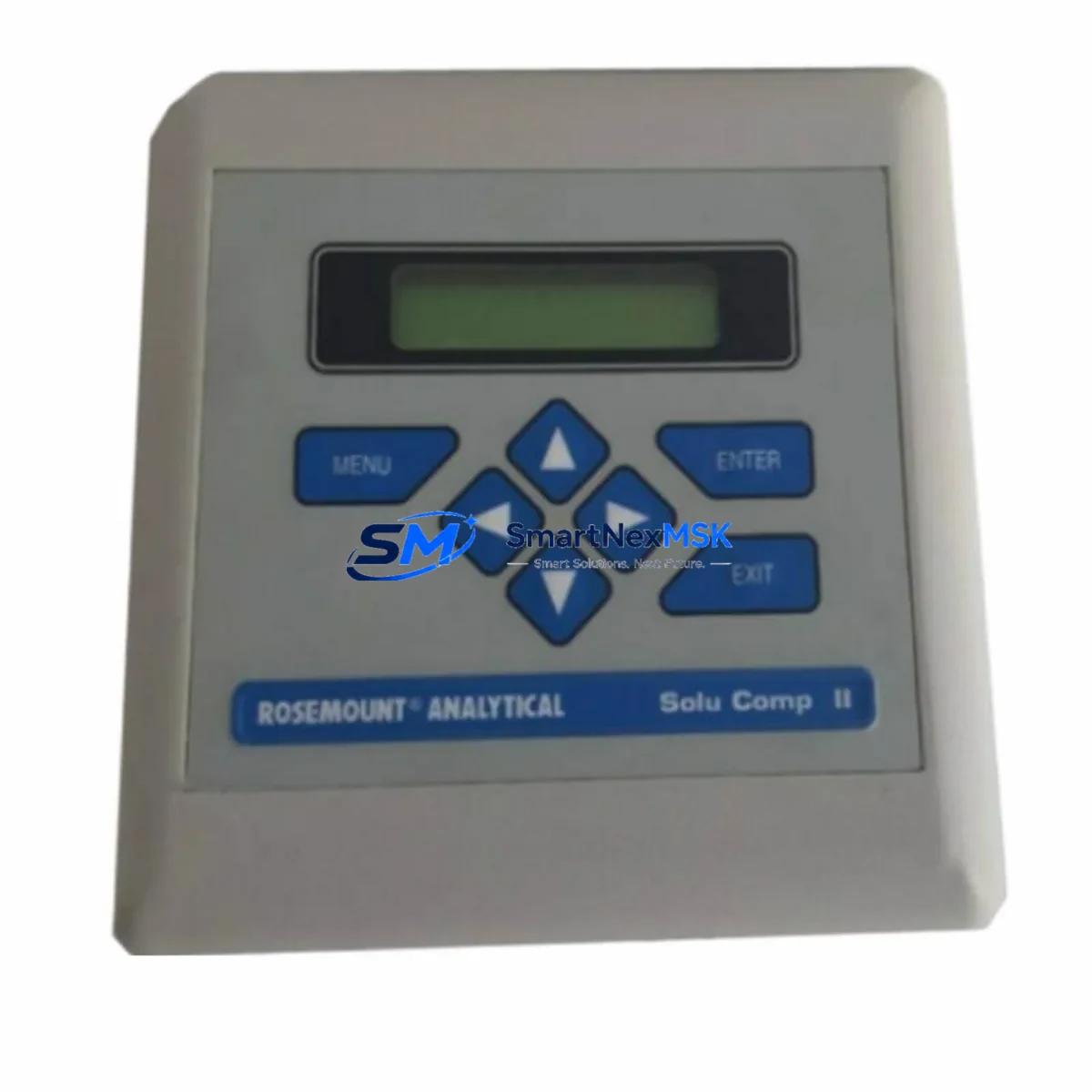
Rosemount 1055-01-10-20-30 Retrofit-Ready Dual-Channel Analyzer for 1055 Series Control Systems
The Rosemount 1055-01-10-20-30 is a dual-channel amperometric liquid analyzer engineered for seamless integration into existing 1055 Series process control architectures. Whether you are replacing an end-of-life transmitter, upgrading a legacy water treatment loop, or migrating a chemical dosing system to a modern DCS platform, the 1055-01-10-20-30 delivers a verified drop-in retrofit path with minimal engineering overhead and controlled downtime exposure.
Designed for continuous dissolved oxygen, chlorine, pH, and ORP measurement in demanding industrial environments, this analyzer supports dual-sensor inputs, 4–20 mA analog outputs, and HART communication — making it fully compatible with Emerson DeltaV, Ovation, and third-party SCADA systems that already communicate with legacy 1055 transmitters. Its DIN-rail and panel-mount form factor matches the original 1055 Series footprint, preserving existing conduit entries, terminal block wiring, and enclosure cutouts.
Upgrade Compatibility Table
| Parameter | Legacy 1055 Series | 1055-01-10-20-30 (This Unit) |
|---|---|---|
| Sensor Channels | Single / Dual (model-dependent) | Dual-channel standard |
| Analog Output | 4–20 mA (passive) | 4–20 mA (active/passive selectable) |
| Communication Protocol | HART 5 / Modbus RTU | HART 7 / Modbus RTU (backward compatible) |
| Power Supply | 100–240 VAC / 24 VDC | 100–240 VAC / 24 VDC (same) |
| Terminal Block Wiring | Screw-type, 2.5 mm² | Screw-type, 2.5 mm² (direct re-use) |
| Mounting | Panel / DIN rail | Panel / DIN rail (same footprint) |
| Enclosure Rating | IP65 / NEMA 4X | IP65 / NEMA 4X |
| Display | LCD (2-line) | Backlit LCD (4-line, improved readability) |
| Sensor Compatibility | Rosemount 499A series sensors | Rosemount 499A / 499ATR / 499ADO (compatible) |
| Calibration Method | Manual / Auto (air cal) | Manual / Auto / Automatic slope (enhanced) |
| Retrofit Complexity | — | Low — direct terminal re-use, no panel modification |
| Warranty | — | 12-Month Warranty |
Retrofit Planning for Existing Automation Systems
A successful retrofit of the Rosemount 1055-01-10-20-30 into an operating process line begins with a structured pre-installation audit. Engineers should first document the existing sensor cable routing from the Rosemount 499A Series amperometric sensors — including cable length, shielding continuity, and junction box condition — before disconnecting the legacy transmitter. In most installations, the original sensor cable can be re-terminated directly to the 1055-01-10-20-30 terminal block without re-pulling cable, which significantly reduces installation labor.
Power supply verification is the next critical checkpoint. Confirm that the existing 24 VDC loop supply or 120/240 VAC panel feed meets the analyzer’s input voltage tolerance and that the supply circuit breaker rating is appropriate for the new unit’s inrush current profile. If the control cabinet also houses a Rosemount 333 HART Tri-Loop or a Rosemount 848T temperature transmitter sharing the same 24 VDC bus, verify that total loop current draw remains within the power supply’s rated output.
For sites running Emerson DeltaV or Ovation DCS, the HART 7 output of the 1055-01-10-20-30 is backward compatible with HART 5 multiplexers and AMS Device Manager configurations already in use. No changes to the DeltaV I/O card assignments or channel addressing are required when replacing a HART-enabled legacy 1055 transmitter. However, engineers should export and archive the existing AMS device configuration before removal to preserve calibration history and alarm setpoints for the new unit’s baseline setup.
Sites using Modbus RTU over RS-485 should verify the existing Modbus gateway or serial communication module baud rate and parity settings match the 1055-01-10-20-30 default configuration (9600 baud, 8N1). If the legacy transmitter used a non-standard Modbus register map, the new unit’s register assignments should be confirmed against the SCADA polling table before go-live to avoid process variable mapping errors.
I/O expansion considerations are particularly relevant for multi-point monitoring upgrades. If the retrofit scope includes adding a second measurement channel — for example, adding a Rosemount 499ADO dissolved oxygen sensor alongside an existing chlorine sensor — the dual-channel architecture of the 1055-01-10-20-30 eliminates the need for a second transmitter enclosure, reducing panel space requirements and simplifying the 4–20 mA wiring back to the PLC analog input module. This is a common upgrade path for water treatment facilities transitioning from single-parameter to multi-parameter monitoring without expanding the control cabinet footprint.
HMI screen updates should be planned in parallel with the hardware swap. If the existing operator interface uses a Rosemount 375 Field Communicator or a panel-mounted HMI configured for the legacy 1055 tag structure, update the process variable display blocks and alarm faceplates to reflect the new unit’s tag name and engineering unit assignments before returning the loop to automatic control.
Downtime Control During System Migration
Minimizing process interruption during a liquid analyzer retrofit requires a phased approach that separates mechanical installation from software commissioning. The recommended sequence is to pre-configure the Rosemount 1055-01-10-20-30 on the bench — entering sensor type, measurement range, alarm setpoints, and output damping — before the scheduled maintenance window. This bench configuration step, performed using the front-panel keypad or a Rosemount 375 Field Communicator connected via HART, typically takes 20–40 minutes and eliminates the need for extended loop-open time during the live swap.
During the maintenance window, place the affected control loop in manual mode at the DCS or PLC level, record the current process variable and output signal values, and then proceed with the physical transmitter swap. Because the 1055-01-10-20-30 uses the same terminal block layout and sensor connector pinout as the legacy 1055 Series, the mechanical swap — including sensor cable re-termination and enclosure sealing — can typically be completed in under 30 minutes by a qualified instrument technician.
After power-up, verify the 4–20 mA output signal at the PLC analog input card or DCS I/O termination panel before returning the loop to automatic. Perform a single-point air calibration for dissolved oxygen sensors or a buffer calibration for pH/ORP sensors to establish the new unit’s calibration baseline. Once the process variable reading is confirmed stable and within expected range, return the loop to automatic control and document the as-found and as-left calibration data in the site’s instrument maintenance management system.
For critical continuous processes where even brief interruptions are unacceptable, consider a parallel installation approach: mount the new 1055-01-10-20-30 alongside the existing transmitter using a second sensor insertion point, verify its readings against the legacy unit over a 24–48 hour period, and then perform a hot cutover by switching the DCS input assignment from the old transmitter tag to the new one — eliminating any process blind time entirely.
Retrofit Support FAQ
Q1: Is the Rosemount 1055-01-10-20-30 a direct replacement for all 1055 Series models?
The 1055-01-10-20-30 is a direct functional replacement for the majority of 1055 Series single- and dual-channel configurations. The suffix codes (-01, -10, -20, -30) specify the measurement type (amperometric), output options, and communication options. Customers replacing a different 1055 suffix variant should confirm sensor type compatibility and output wiring before installation. Our technical team can provide a pre-shipment compatibility verification at no charge.
Q2: Will my existing Rosemount 499A Series sensor cables work with this unit?
Yes. The 1055-01-10-20-30 accepts the standard Rosemount 499A Series sensor connector and cable assembly without modification. Existing cable runs, junction boxes, and conduit seals can be retained. If the existing cable shows signs of insulation degradation or moisture ingress at the junction box, replacement with a new Rosemount 499A sensor cable assembly is recommended before commissioning the new transmitter.
Q3: What commissioning and wiring documentation is provided with the unit?
Each unit ships with the Rosemount 1055 Quick Start Guide, full terminal wiring diagram, and HART register map. A pre-shipment functional test report confirming analog output accuracy and communication response is included. All units are tested against factory calibration standards before dispatch. The 12-month warranty covers manufacturing defects and covers return-to-base repair or replacement at no cost to the customer.
Q4: Can this analyzer communicate with third-party SCADA systems via Modbus?
Yes. The 1055-01-10-20-30 supports Modbus RTU over RS-485 as a standard communication option (suffix -30). It is compatible with third-party SCADA platforms including Wonderware, iFIX, Ignition, and Citect, as well as Emerson DeltaV and Ovation systems. The Modbus register map is fully documented and available upon request to facilitate SCADA integration without requiring proprietary driver software.
© 2026 SMARTNEXMSK. All rights reserved.
Original Source: https://smartnexmsk.com
Contact: [email protected] | +86 18259474341