
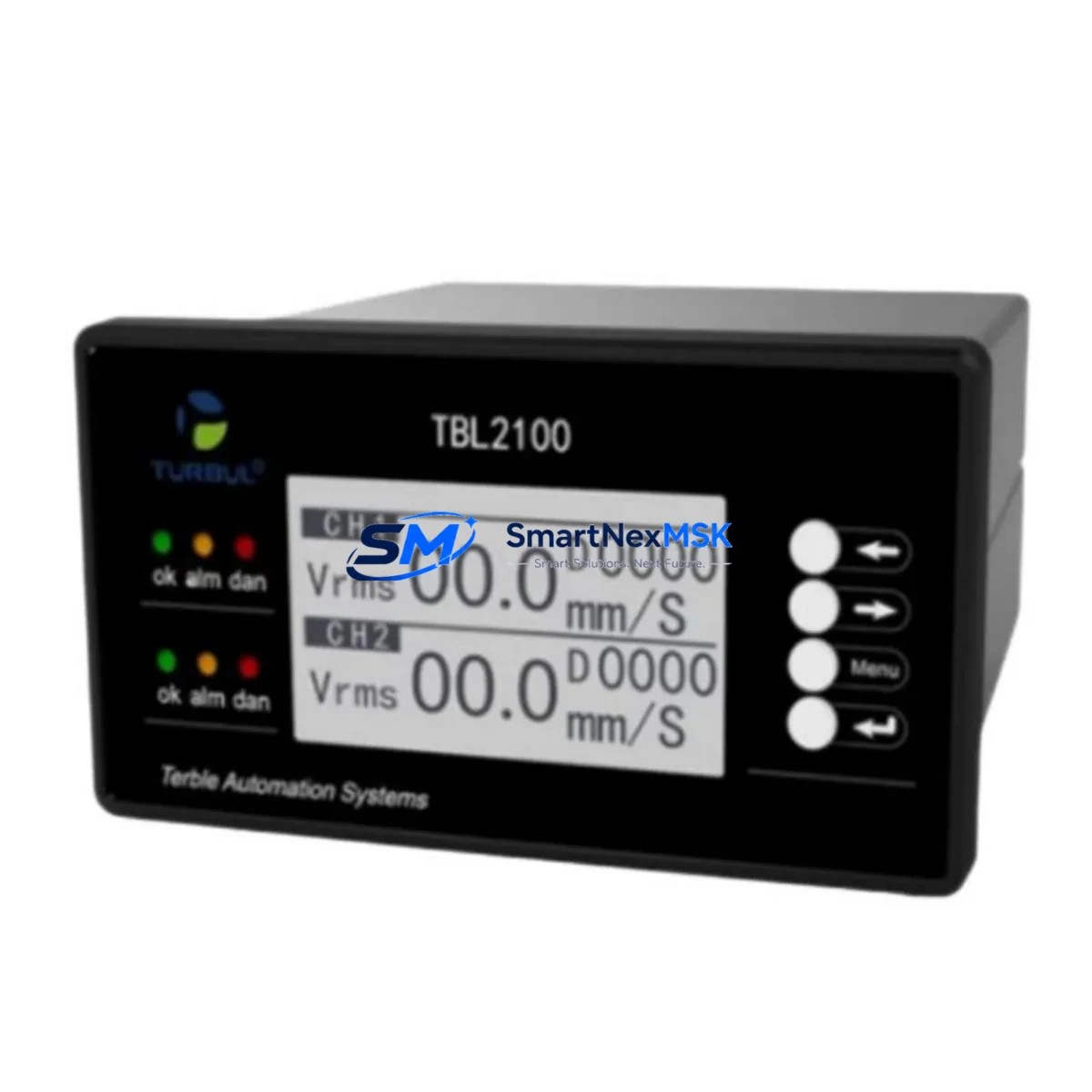
TURBUL TBL2100 Maintenance-Ready Spare for TBL Series Automation
The TURBUL TBL2100 is a precision vibration monitoring module engineered for continuous-duty industrial automation environments. As a maintenance-ready original spare, the TBL2100 is designed to support rapid field replacement in rotating machinery protection systems, DCS-integrated monitoring loops, and legacy TBL-series control architectures. For maintenance engineers managing planned shutdowns, emergency replacements, or long-term spare parts inventory, the TBL2100 delivers verified compatibility, factory-tested performance, and a 12-month warranty — minimizing unplanned downtime risk and protecting critical production assets.
In industrial facilities where vibration monitoring is a first-line defense against bearing failure, shaft misalignment, and rotor imbalance, the TBL2100 occupies a critical position in the condition monitoring chain. Its replacement must be executed with precision: incorrect module substitution or delayed procurement can cascade into extended outages, safety incidents, or regulatory non-compliance. Stocking a verified TBL2100 spare ensures your maintenance team can respond within hours rather than days.
Spare Maintenance Table
| Parameter | Specification |
|---|---|
| Part Number / SKU | TBL2100 |
| Brand | TURBUL |
| Series | TBL Series |
| Product Type | Vibration Monitoring Module |
| Origin | China (CN) |
| Measurement Type | Vibration / Acceleration Signal Monitoring |
| Signal Input | Compatible with standard ICP/IEPE accelerometer inputs (TBL series) |
| Output Interface | Analog signal output; DCS/PLC compatible |
| Power Supply | 24 VDC (nominal, TBL series standard) |
| Mounting | DIN rail / panel mount, TBL series backplane compatible |
| Operating Temperature | -10°C to +55°C (industrial standard) |
| Protection Rating | IP20 (control cabinet installation) |
| Application Environment | Rotating machinery, compressors, turbines, pumps, fans |
| Compatibility | TBL series monitoring systems; drop-in replacement for legacy TBL2100 installations |
| Condition | Original, factory-tested, new |
| Warranty | 12 Months |
| Shipping | Tested before dispatch; global shipping available |
Maintenance Planning for Continuous Operation
When replacing the TBL2100 vibration monitoring module during a planned or emergency maintenance event, a thorough inspection of the surrounding system is essential to ensure full restoration of monitoring integrity and prevent repeat failures. Maintenance engineers should treat the TBL2100 replacement as an opportunity to audit the entire vibration monitoring loop and adjacent control cabinet components.
Begin by verifying the 24 VDC power supply module feeding the TBL series rack — power quality issues such as ripple, voltage sag, or intermittent dropout are a leading cause of premature module failure. Inspect the TBL series backplane or mounting rail for corrosion, loose connector pins, or mechanical damage that may have contributed to the original fault. Check all signal cables and shielded sensor leads connecting the accelerometer to the TBL2100 input terminals; damaged cable insulation or broken shield continuity will introduce noise and compromise measurement accuracy after module replacement.
Review the terminal blocks and wiring connectors on the TBL2100 input and output sides — terminal oxidation or loose crimps are common in high-vibration environments and should be re-torqued or replaced. If the TBL2100 feeds an analog signal into a DCS analog input card or PLC I/O module, verify that the receiving channel is functional and that the signal scaling parameters match the replacement module’s output range. In systems using signal isolators or signal conditioners between the TBL2100 and the control system, confirm isolator integrity and loop continuity before returning the system to service.
For facilities running integrated condition monitoring platforms, also inspect the communication gateway or data acquisition module that aggregates TBL series data for historian or SCADA systems — a module swap is an ideal time to verify communication health. Where relay output modules or alarm relay cards are wired to TBL2100 trip outputs, test relay actuation and reset thresholds post-replacement. Finally, review the HMI display or operator panel configuration to confirm that vibration trend displays, alarm setpoints, and engineering unit scaling are correctly mapped to the new TBL2100 channel.
A complete spare parts kit for a TBL2100-based monitoring loop should also include: a spare ICP/IEPE accelerometer matched to the TBL2100 input specification, a set of shielded sensor cables in the appropriate lengths, and a spare fuse or circuit protection element for the 24 VDC supply branch. Proactive stocking of these components alongside the TBL2100 module eliminates secondary procurement delays during emergency shutdowns.
Site Replacement Workflow
The TBL2100 is designed for straightforward field replacement with minimal tooling, enabling maintenance teams to restore vibration monitoring coverage quickly and safely. Follow this workflow to ensure a clean, verified swap:
1. Isolate and de-energize: Shut down the 24 VDC supply to the TBL series rack segment containing the TBL2100. Confirm zero voltage at the module terminals using a calibrated multimeter before proceeding. Lock out / tag out (LOTO) per site safety procedures.
2. Document existing wiring: Photograph or sketch the terminal connections on the TBL2100 before disconnecting. Note cable labels, shield termination points, and any jumper or DIP switch settings on the original module — these must be replicated on the replacement unit.
3. Remove the faulty module: Disconnect signal cables and power terminals. Release the DIN rail locking tab or unscrew the panel mount fasteners. Slide the TBL2100 free from the backplane connector, taking care not to bend backplane pins.
4. Install the replacement TBL2100: Confirm the replacement module’s jumper/DIP switch settings match the original configuration. Seat the module firmly onto the backplane connector and secure the DIN rail latch or panel mount screws. Reconnect all signal cables and power terminals per the documented wiring layout.
5. Power-up and verify: Restore 24 VDC supply. Observe the module’s status indicators for normal operation. At the DCS or PLC, confirm the vibration channel is reading a valid signal within expected range. Compare readings against adjacent channels or historical baseline values to validate correct installation.
6. Reset alarms and update maintenance records: Clear any latched alarms triggered during the outage. Update the equipment maintenance log with the replacement date, new module serial number, and post-replacement vibration readings. Schedule the next inspection interval per your predictive maintenance program.
This workflow supports a typical replacement time of under two hours for a trained technician, minimizing production impact and ensuring the monitoring system is returned to full protective function before restart.
Spare Parts Support FAQ
Q1: What is the warranty coverage for the TBL2100 spare module?
All TBL2100 units supplied by SMARTNEXMSK carry a 12-month warranty covering manufacturing defects and functional failures under normal operating conditions. Each module is tested before dispatch to verify signal integrity, power consumption, and output accuracy. Warranty claims are supported with replacement or repair at no additional cost within the coverage period.
Q2: How do I confirm compatibility before ordering the TBL2100?
The TBL2100 is a direct replacement for existing TBL series vibration monitoring installations. To confirm compatibility, provide your existing module’s part number, rack or backplane model, and signal type (ICP/IEPE or voltage input). Our technical team can cross-reference your system configuration and confirm fit before shipment. For legacy systems where original documentation is unavailable, we can assist with compatibility assessment based on site photographs and wiring diagrams.
Q3: What is your recommended spare parts stocking strategy for the TBL2100?
For facilities with multiple TBL2100 installations, we recommend maintaining a minimum of one spare module per monitoring system, with additional units for high-criticality assets such as main compressors, turbines, or primary cooling pumps. Given typical lead times for specialty vibration monitoring modules, holding 2–3 units in local inventory provides adequate buffer for both planned maintenance cycles and emergency replacements without excessive capital tie-up.
Q4: Can the TBL2100 be used to replace older or discontinued TBL series variants?
In many cases, yes. The TBL2100 is designed within the TBL series architecture and shares common backplane, power, and signal interface standards with earlier TBL variants. However, specific firmware versions, input sensitivity ranges, or output scaling may differ between generations. We recommend providing the original module’s full part number and any visible revision markings so our team can confirm backward compatibility and advise on any configuration adjustments required for a seamless drop-in replacement.
© 2026 SMARTNEXMSK. All rights reserved.
Original Source: https://smartnexmsk.com
Contact: [email protected] | +86 18259474341