
PLC-5 1785-ME64 Spares: Backup Before Migration
Plan 1785-ME64 PLC-5 spares by confirming memory capacity, processor compatibility, backup practice, and the migration decision before failure.
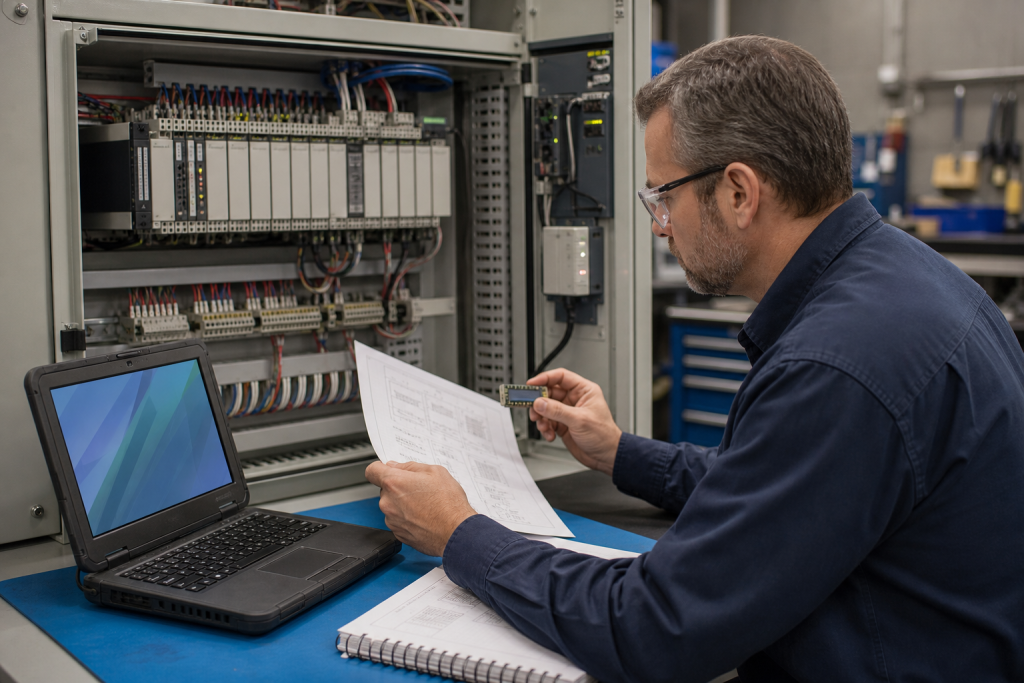
A PLC-5 memory-module request often arrives after the real protection work should have been done. The controller is still running, but the project backup is incomplete, the memory module reference is uncertain, or the maintenance team is treating a small removable module as if it were a complete PLC replacement. When the processor or battery-backed memory is finally challenged, the spare decision becomes a recovery decision.
Rockwell Automation identifies the PLC-5 platform as discontinued and provides a migration path toward ControlLogix. At the same time, its technical literature still gives useful information for identifying 1785-series memory modules. That combination supports a practical strategy: protect the running program now, verify the exact module and processor relationship, and decide whether the spare is a bridge to migration or part of a longer approved service plan.
What the PLC-5 lifecycle means
Rockwell’s PLC-5 migration material describes the platform as being at the end of its lifecycle and states that the PLC-5 control platform was discontinued in 2017. Rockwell also describes repair and modernization options for discontinued installations. These statements should lead to a documented asset decision, not an assumption that every remaining component is immediately unusable or that a repair path guarantees future availability.
Record the exact processor, chassis, I/O network, software environment and memory module reference. Set a review date for the asset and define the point at which a last-time-buy, repair strategy or ControlLogix migration must be approved. The Allen-Bradley brand catalog can help locate published parts, but lifecycle status and compatibility must be checked against the installed system.
1785-ME64 is a memory module, not a PLC
Rockwell’s installation data for Enhanced PLC-5 and Ethernet PLC-5 memory modules lists the 1785-ME64 at 64K words. The same document shows that the 1785-ME family contains different capacities and different characteristics, so a part number that looks close is not enough. Confirm the processor family, series and revision, module capacity, installation procedure and the project’s memory requirements before ordering.
A 1785-ME64 PLC-5 memory spare can be relevant when the installed reference is confirmed. It does not replace the PLC-5 processor, chassis, I/O modules, communication interface, power supply or application software. Treat it as one element of the control-system recovery package.
Protect the program before touching the hardware
The first question is not “where can we buy the module?” It is “can we restore the correct program if the controller loses usable memory?” Keep a current program archive with the processor identity, project revision, documentation, I/O map, communication settings, passwords or access procedure where permitted.
Also record the battery condition and the site’s approved battery-replacement procedure. Do not remove a module or battery from a live controller simply to create a photograph. Follow the electrical, process-safety and change-control requirements for the installation. A memory-module spare without a verified project archive is a weak recovery measure.
Check the complete compatibility chain
Before approving a 1785-ME64 request, confirm:
- Processor: exact catalog number, series, revision and memory architecture.
- Module: 1785-ME64 reference, capacity, physical condition and installation history.
- Program: RSLogix 5 project revision, documentation, comments and last verified checksum or equivalent control record.
- System: chassis, remote I/O, DH+ or Ethernet path, supervisory interfaces and external interlocks.
- Recovery: approved transfer method, qualified personnel, test plan and rollback decision.
Do not use a memory module capacity comparison as proof that two PLC-5 processors are interchangeable. A module may hold a program while the target processor, I/O map or network path remains wrong for the application. The spare review must cover the system that the processor controls.
Spare now or migrate?
A 1785-ME64 spare can make sense as a short-term continuity measure when the installed PLC-5 remains approved for operation, the program archive is verified, and the plant has a defined test procedure. It can protect a planned outage from becoming a data-recovery exercise.
Migration becomes the stronger lifecycle option when the plant has repeated hardware failures, incomplete software access, scarce engineering knowledge, missing network documentation, or an outage consequence that the legacy platform can no longer justify. Rockwell’s modernization material points customers toward ControlLogix, but a migration is an engineering project. It requires I/O mapping, communications conversion, sequence validation, HMI or SCADA checks, alarm review and operator acceptance.
Do not present a memory spare as a migration substitute. Conversely, do not start a migration during an emergency without first protecting the running program and documenting the existing system. The two actions can be staged: a verified bridge spare for immediate resilience, followed by a controlled modernization plan.
Test the recovery path during a planned window
Use a controlled maintenance window to verify that the archive can be opened, the correct project can be identified, the memory-module procedure is understood and the processor can be returned to a known-good state. Test communications to remote I/O and supervisory systems, alarm handling, permissives, sequence steps and the plant rollback plan.
A successful power-up is not enough. The acceptance record should state which processor and module were tested, which program revision was used, which network and I/O points were checked, and who approved the return to service. Store that evidence with the spare record.
What to include in a PLC-5 memory spare RFQ
Send the exact processor catalog number, series and revision, the 1785-ME64 label, clear photos of the module and chassis, the program software context, quantity, destination, fault symptoms and urgency. State whether the requirement is for a memory-module spare, a complete controller, a repair assessment or a migration study.
If the label is damaged, provide cabinet photos, adjacent module references, network details and the last known-good program record. This lets the sourcing review identify whether the immediate risk is memory, processor hardware, software access, communications or a broader lifecycle problem.
Frequently asked questions
Is 1785-ME64 a PLC-5 processor?
No. It is a PLC-5 memory module reference. It does not replace the processor, chassis, power supply, I/O or communication equipment required to run the application.
Can any 1785-ME64 be used in any PLC-5 system?
Do not assume that. Confirm the exact processor family, series, revision, memory requirements and installation instructions. The part number and capacity must be checked against the actual controller.
Does a memory-module spare eliminate the need for a program backup?
No. A spare is only one recovery element. Maintain an approved project archive with the processor identity, revision, documentation, communication settings and a known-good test record.
Should a PLC-5 site migrate immediately?
Not every site has the same risk or outage window. Because the platform is discontinued, every site should have a lifecycle decision. A verified bridge spare may support continuity while a controlled ControlLogix migration is assessed and validated.
What should I photograph before requesting a quote?
Photograph the 1785-ME64 label, PLC-5 processor, chassis, power supply, I/O and communication modules, network connections and cabinet labels. Include the project software context and last known-good backup if available.
Reference documents
- Rockwell Automation PLC-5 Migration and lifecycle information
- Rockwell Automation 1785 PLC-5 memory-module installation data
- Rockwell Automation RSLogix 5 End of Life announcement, updated 2022-11-03
For a model check, send the full processor and memory-module references, nameplate or cabinet photos, quantity, destination, any end-of-life replacement need and delivery requirement to [email protected] or WhatsApp/Phone +86 18259474341.
Route this topic into a sourcing request
Connect the article topic to a model number, category, brand, quantity, and destination before opening the RFQ.
Related Insights
Continue with sourcing and model matching guides
 Sep 8, 2026
SANYO DENKI QS1E Spares: Save Parameters First
When a SANMOTION Q axis stops, the purchasing request often becomes a model number: “Please quote QS1E01AA0H4A3P1T.” That is a useful starting point, but…
Read guide Sep 6, 2026
Yaskawa SGDH-05DE-OY Spares: Check the Servo Chain
A servo drive fault often produces a deceptively simple purchasing request: “Replace the SGDH-05DE-OY.” In a running machine, however, the amplifier is only one…
Read guide Sep 5, 2026
GE IS220PCLAH1A Spares: Check Mark VIe Fit
When a Mark VIe cabinet develops an intermittent control fault, the urgent request often becomes a single line: “Please quote IS220PCLAH1A.” That is understandable…
Read guide