
Power Meter Spares: Keep the Transformer Record
Keep meter identity, installed current and voltage transformer records, and approved measurement configuration together before accepting a spare.
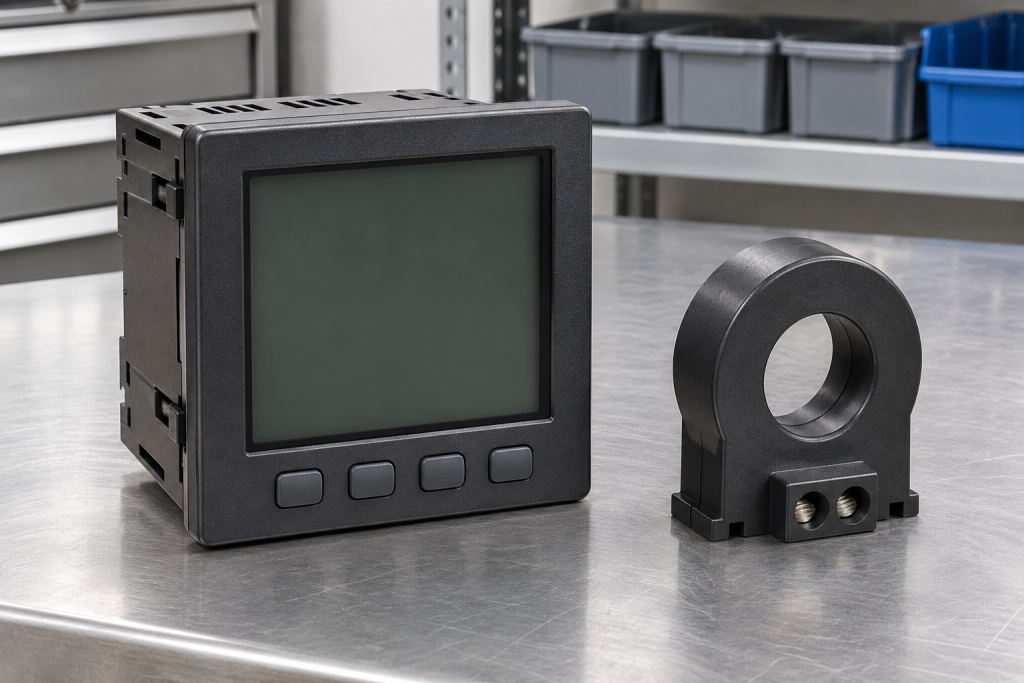
A replacement power meter can fit the panel cutout and display a plausible number while the measurement chain remains undocumented. The purchasing description identifies the instrument, but not the external transformers or scaling that give its readings meaning. A matching display is not evidence that the plant will receive the same information.
For power meter spares, preserve the complete instrument identity alongside the approved current and voltage measurement record. This is a documentary procurement review, not a wiring, transformer-selection, calibration or commissioning procedure. Work on metering circuits, electrical isolation and release to service remain with qualified personnel under the equipment owner’s approved arrangements.
Identify what the meter actually measures
Start with the circuit reference and the purpose of the measurement. A local indication, an energy-management input and an instrument associated with protection are different responsibilities. Record who uses the values and what acceptance evidence that owner requires. Do not treat a monitoring instrument as a substitute for a protective device.
Ask whether the enquiry covers a complete meter, a display component or an accessory. Preserve the full manufacturer reference, suffixes, supply identity and relevant drawing revision. A family name, bezel size or photograph alone cannot establish that the offered item includes the required measuring inputs and interfaces.
Separate the instrument from the installed transformers
The manufacturer’s meter specification and the plant’s installed transformer record answer different questions. One describes the instrument being offered; the other describes the signals presented to it. Keep both rather than allowing a single current figure in a quotation to stand for the entire circuit.
Siemens’ SENTRON PAC3200 manual provides a useful documented example. Its basic-parameter information distinguishes connection type, voltage measurement arrangements and current-transformer primary and secondary data. This is evidence for retaining those separate records, not a universal specification for every power meter.
Request the applicable transformer references and the controlled measurement drawing from the engineering owner. Record missing information as an unresolved acceptance item. Procurement should not infer the installed transformer ratio from the spare meter’s input designation or invent a ratio from an unclear label.
Preserve the voltage-measurement arrangement
Keep the approved distinction between direct voltage measurement and measurement through voltage transformers. The PAC3200 reference treats these as different parameter arrangements. Do not assume that the settings or evidence for one arrangement automatically describe the other.
The auxiliary supply belongs in a separate identity field. A supply description is not a substitute for the voltage-measurement record. Ask engineering to identify the applicable instrument documentation and installation constraints before accepting an alternative; this guide gives no connection diagram or permissible voltage limits.
Maintain the units and document revision with each item. A number copied without its meaning may describe a transformer primary, a secondary, an instrument input or an unrelated supply. Resolve that ambiguity in the enquiry instead of transferring it to the receiving team.
Keep approved scaling separate from factory defaults
A replacement’s stored settings are not automatically the plant’s accepted configuration. Preserve the approved parameter record and the owner’s method for controlling any necessary restoration. An apparently familiar display after power-up does not demonstrate that the measurement arrangement has been reproduced.
Record the authoritative file or controlled document, its revision and the person responsible for application acceptance. If a parameter export is available, state what it covers and which software or documentation is needed to interpret it. Do not promise that an unidentified replacement can accept that file unchanged.
This review does not provide menu steps, numerical settings, polarity changes or a method for working on transformer secondary circuits. A procurement checklist cannot authorise electrical work or resolve a hazardous installation question.
Follow the value beyond the front display
If the meter supplies another system, preserve that data relationship in the enquiry. Identify the required interface and the plant-owned mapping record. A local reading and a value consumed by a supervisory application are separate acceptance observations; matching one does not by itself prove the other.
Keep the units, destination and intended meaning of important values with the record. Ask the responsible owner to define the required verification scope. Avoid claiming universal protocol or register-map compatibility from a familiar connector or a shared product-family name.
Describe the receiving and acceptance boundaries
A receiving inspection can compare the supplied identity, condition and included accessories against the accepted order. It cannot, by itself, establish the installed transformer arrangement or prove the accuracy of the complete measurement chain.
The automation spare test-report guide explains why a report needs a stated scope. For a meter, request clear identification of the item assessed and the conditions covered. Do not turn a component report into a promise about an unidentified plant circuit.
The published power quality meter category is a sourcing route, not an interchange or application-approval table. No individual listing is endorsed here for an unidentified measurement chain. Keep unresolved differences on hold with an owner and next action before counting the spare as qualified coverage.
FAQ
Does matching the panel cutout qualify a power meter spare?
No. Preserve the complete instrument identity, measuring inputs, transformer records, supply, interfaces and application acceptance requirements.
Is the meter input designation the installed CT ratio?
No. Instrument input data and the installed current-transformer primary and secondary record are separate evidence.
Can factory defaults replace the approved scaling record?
No. The application owner must identify the controlled configuration and the verification needed for the actual installation.
Does a plausible local display prove the complete measurement chain?
No. The measurement arrangement and any downstream data relationship require their own documented acceptance scope.
Prepare the power meter enquiry
Send the full model, nameplate photos, available transformer and drawing references, discontinued-part replacement need and delivery requirement to [email protected] or WhatsApp/Phone +86 18259474341. Identify configuration and application questions still awaiting engineering acceptance.
Route this topic into a sourcing request
Connect the article topic to a model number, category, brand, quantity, and destination before opening the RFQ.
Related Insights
Continue with sourcing and model matching guides
 Nov 28, 2026
Series 90-30 Spares: Check the RX3i Rack Boundary
Separate exact Series 90-30 spares from the verified RX3i rack, processor and retained I/O needed for a planned migration.
Read guide Nov 27, 2026
HMI Screen Spares: Identify the Failed Layer
Separate surface damage, touch input and the supported display assembly before specifying an HMI hardware spare.
Read guide Nov 26, 2026
Motor Brake Rectifier Spares: Match the Coil
Check the fitted brake coil and approved control function before treating a motor brake rectifier as an exact spare.
Read guide