
Proportional Valve Amplifier Spares: Match the Pair
Keep the amplifier, valve and command interface together when comparing an exact spare or a proposed alternative.
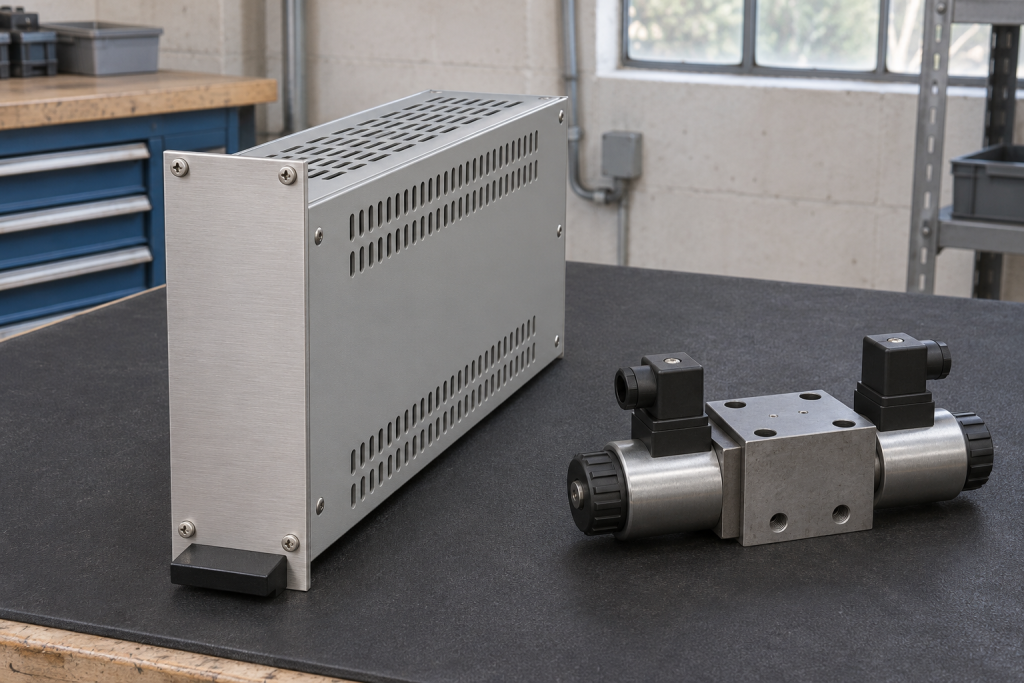
A stores record says “valve amplifier, 24 V.” The offered card fits the rack slot and the front plate looks familiar. Neither fact identifies which valve the card was designed to drive, how the controller requests motion, or whether the installed arrangement measures spool position. That information often lives in three different records. It needs to be brought together before a buyer can call the quotation an exact match.
For proportional valve amplifier spares, start with the amplifier, valve and machine control interface as one documented assembly. A compatible offer must account for all three, not just the board. This is a guide to identifying and accepting a spare on paper. It does not prescribe wiring, drive settings, pressure adjustments or release of hydraulic machinery to service.
Find out where the valve electronics live
Use the approved electrical drawings and the complete valve nameplate to distinguish an external amplifier card from electronics integrated with the valve. The names can be misleading if a request abbreviates the valve code. In the Bosch Rexroth 4WRA family selector, for example, the electronics option separates a valve without onboard electronics from a version with them. The distinction changes what should be included in the request for a spare.
The Bosch Rexroth RE 30110 amplifier data sheet gives an example of a separate card with a defined set of valve families and versions. It also distinguishes order-code options that share the same basic card family. Neither reference supports treating every member of a valve family or every card that fits the rack as equivalent.
Record whether spool position feedback is part of the documented arrangement. Keep that separate from a pressure transducer or position sensor that the machine controller uses elsewhere. A process reading on the HMI does not establish that the valve itself has an electrical position feedback device. Where that information is absent, put it on the list of unresolved questions instead of inferring it from a similar connector.
Compare the command and the valve drive separately
Identify the command source and the specified input option using the existing drawing and manufacturer’s data. A recorded voltage command and a recorded current command are different purchasing requirements. Preserve the complete option code, whether the input is signed or unidirectional, and the version of the document used to identify it. Do not ask a seller to match it by supply voltage alone: the card’s supply and its command interface describe different things.
Next identify the valve side. Request the full valve model, component series and solenoid arrangement, plus the manufacturer document that covers the pairing. Keep the amplifier hardware revision, card holder and connector identity in the record. If one of those details has changed over the service life of the machine, compare the installed information with the original bill of materials rather than silently substituting one for the other.
A useful RFQ states what exists, what is being offered and which points need an engineering decision. The proportional valve amplifier card category is a sourcing starting point, not an approved pairing table. The vendor’s exact model evidence still needs to match the machine record.
Define what an exact match would prove
Ask for a legible photo of the actual card label, its complete suffix and the included hardware. Separate a card-only offer from one that includes a holder, connector or valve assembly. Ask whether the offered item carries an unidentified setting or configuration from prior service, and what records accompany it. A bare card and an assembly with its accessories are not the same delivery even when the card code matches.
For an alternate, keep a written difference list. Distinguish identity and physical fit from documented valve compatibility, configuration transfer and any tests required by the equipment owner. The guide to reading automation spare test reports explains why a bench report is useful only within its tested scope. A result for a supplier’s fixture does not carry over to an unidentified valve and machine.
Before counting the offer as outage coverage, identify who will resolve each open item and where the accepted evidence will be stored. Keep energization and release decisions with the qualified team that owns the hydraulic equipment. A procurement record can prevent confusion; it cannot authorize an installation or change the machine’s protection design.
Frequently asked questions
Can a spare amplifier be matched by supply voltage and connector?
No. Those details help identify the offer but do not prove the input option, valve drive requirements or feedback arrangement. Compare the full codes and the document covering the intended pairing.
Does a position reading at the HMI mean the valve has spool feedback?
Not necessarily. The reading may come from an actuator sensor or another process instrument. Use the valve identity and system documentation to determine which feedback measurement belongs to the valve.
Can an integrated-electronics valve be treated as a card replacement?
No. It changes the equipment boundary in the request. Have the owner confirm the intended architecture and what the supplier is offering before buying it as an alternate.
What if only the family name is readable?
Collect the original purchasing record, valve plate, cabinet drawing and any approved changes. Mark the missing suffix as an open question. Do not count a photograph of a similar card as evidence of interchangeability.
Send the card and valve details together
For a spare or discontinued replacement enquiry, send the amplifier and valve model numbers, nameplate photos, the documented command option if known, and the required delivery date. Contact [email protected] or WhatsApp/Phone +86 18259474341. Note any unresolved identification points so they can be checked before an order is released.
Route this topic into a sourcing request
Connect the article topic to a model number, category, brand, quantity, and destination before opening the RFQ.
Related Insights
Continue with sourcing and model matching guides
 Nov 28, 2026
Series 90-30 Spares: Check the RX3i Rack Boundary
Separate exact Series 90-30 spares from the verified RX3i rack, processor and retained I/O needed for a planned migration.
Read guide Nov 27, 2026
HMI Screen Spares: Identify the Failed Layer
Separate surface damage, touch input and the supported display assembly before specifying an HMI hardware spare.
Read guide Nov 26, 2026
Motor Brake Rectifier Spares: Match the Coil
Check the fitted brake coil and approved control function before treating a motor brake rectifier as an exact spare.
Read guide